
[fusion_builder_container admin_label=”Episode” hundred_percent=”no” hundred_percent_height=”no” hundred_percent_height_scroll=”no” hundred_percent_height_center_content=”yes” equal_height_columns=”no” menu_anchor=”” hide_on_mobile=”small-visibility,medium-visibility,large-visibility” status=”published” publish_date=”” class=”” id=”” link_color=”” link_hover_color=”” border_color=”” border_style=”solid” margin_top=”” margin_bottom=”” padding_top=”” padding_right=”” padding_bottom=”” padding_left=”” gradient_start_color=”” gradient_end_color=”” gradient_start_position=”0″ gradient_end_position=”100″ gradient_type=”linear” radial_direction=”center center” linear_angle=”180″ background_color=”” background_image=”” background_position=”center center” background_repeat=”no-repeat” fade=”no” background_parallax=”none” enable_mobile=”no” parallax_speed=”0.3″ background_blend_mode=”none” video_mp4=”” video_webm=”” video_ogv=”” video_url=”” video_aspect_ratio=”16:9″ video_loop=”yes” video_mute=”yes” video_preview_image=”” filter_hue=”0″ filter_saturation=”100″ filter_brightness=”100″ filter_contrast=”100″ filter_invert=”0″ filter_sepia=”0″ filter_opacity=”100″ filter_blur=”0″ filter_hue_hover=”0″ filter_saturation_hover=”100″ filter_brightness_hover=”100″ filter_contrast_hover=”100″ filter_invert_hover=”0″ filter_sepia_hover=”0″ filter_opacity_hover=”100″ filter_blur_hover=”0″ admin_toggled=”no” type=”flex”][fusion_builder_row][fusion_builder_column type=”1_1″ layout=”1_1″ spacing=”” center_content=”no” link=”” target=”_self” min_height=”” hide_on_mobile=”small-visibility,medium-visibility,large-visibility” class=”” id=”” hover_type=”none” border_color=”” border_style=”solid” border_position=”all” border_radius=”” box_shadow=”no” dimension_box_shadow=”” box_shadow_blur=”0″ box_shadow_spread=”0″ box_shadow_color=”” box_shadow_style=”” padding_top=”” padding_right=”” padding_bottom=”” padding_left=”” margin_top=”” margin_bottom=”” background_type=”single” gradient_start_color=”” gradient_end_color=”” gradient_start_position=”0″ gradient_end_position=”100″ gradient_type=”linear” radial_direction=”center center” linear_angle=”180″ background_color=”” background_image=”” background_image_id=”” background_position=”left top” background_repeat=”no-repeat” background_blend_mode=”none” animation_type=”” animation_direction=”left” animation_speed=”0.3″ animation_offset=”” filter_type=”regular” filter_hue=”0″ filter_saturation=”100″ filter_brightness=”100″ filter_contrast=”100″ filter_invert=”0″ filter_sepia=”0″ filter_opacity=”100″ filter_blur=”0″ filter_hue_hover=”0″ filter_saturation_hover=”100″ filter_brightness_hover=”100″ filter_contrast_hover=”100″ filter_invert_hover=”0″ filter_sepia_hover=”0″ filter_opacity_hover=”100″ filter_blur_hover=”0″ last=”true” border_sizes_top=”0″ border_sizes_bottom=”0″ border_sizes_left=”0″ border_sizes_right=”0″ first=”true”][fusion_text columns=”” column_min_width=”” column_spacing=”” rule_style=”default” rule_size=”” rule_color=”” hide_on_mobile=”small-visibility,medium-visibility,large-visibility” class=”” id=”” animation_type=”” animation_direction=”left” animation_speed=”0.3″ animation_offset=””]
Episode Three – 16 June 2020
[/fusion_text][fusion_accordion type=”toggles” boxed_mode=”yes” divider_line=”” inactive_icon=”” active_icon=”” icon_boxed_mode=”” hide_on_mobile=”small-visibility,medium-visibility,large-visibility” class=”” id=”” border_size=”1″ border_color=”” hue=”” saturation=”” lightness=”” alpha=”” background_color=”” hover_color=”” divider_color=”” divider_hover_color=”” fusion_font_family_title_font=”” fusion_font_variant_title_font=”” title_font_size=”” title_color=”” icon_size=”” icon_color=”” icon_box_color=”” icon_alignment=”” fusion_font_family_content_font=”” fusion_font_variant_content_font=”” content_font_size=”” content_color=”” toggle_hover_accent_color=”” toggle_active_accent_color=””][fusion_toggle title=”Intro” open=”no” class=”” id=”” fusion_font_family_title_font=”” fusion_font_variant_title_font=”” title_font_size=”” title_color=”” hue=”” saturation=”” lightness=”” alpha=”” fusion_font_family_content_font=”” fusion_font_variant_content_font=”” content_font_size=”” content_color=””]
Welcome to the third episode of Think Agri REAL Insights in 2020 series.
I asked some trusted colleagues what they thought the world needs most from me right now. In the face of uncertainty and an influx of noise and opinion, the response was a rational level head being the voice of reason in a world full of uncertainty and volatility. That sounds like a big task and what does that mean at the farm level.
After giving it more consideration, my take is that I can help farm businesses like yours understand more about yourselves and your business so you can capture profit when it’s there to be taken while managing the downside risk. Decision making lies at the heart of this balance.
This episode is deliberately deep to get you thinking about your decision making.
In this episode:
- We look at the impact of information quality on decision making?
- We consider the many biases that can disrupt effective decision making?
- We introduce the Think Feel Do Modes of Action which result in effective implementation.
Each topic has some content and a practical activity. It’s up to you, how involved you want to get.
Happy reading, listening, thinking, and doing! Good luck Kate
[/fusion_toggle][fusion_toggle title=”Topic 1″ open=”no” class=”” id=”” fusion_font_family_title_font=”” fusion_font_variant_title_font=”” title_font_size=”” title_color=”” hue=”” saturation=”” lightness=”” alpha=”” fusion_font_family_content_font=”” fusion_font_variant_content_font=”” content_font_size=”” content_color=””]
Think Agri Real Insights 2020 Episode 3- Article 1
Decision making quick fix 1. Review your information diet
So, it’s mid-June and the majority of dryland cropping in the South East of Australia is complete with crops at various ages and stages. This season is pegged as one of promise but there’s a long way to go and the seasonal forecast is delivering a few mixed messages.
Whether you are fortunate to be coming off a good year or off a run of shockers, the weight of making the most of opportunities can weigh heavily on your shoulders. As does the weight of getting it wrong. It’s hard to be decisive, analytical, and clear when there are so many frustrations tinkering with our minds. A lack of spraying days, frosts, a run of clear weather that reminds you of drought, sporadic rain forecasts and sporadic rain events.
Everyone’s got an opinion, your neighbour’s agronomist is saying different things to yours. Your twitter mates are vocal and have the BOM in the gun. It’s hard to get consensus within your own farm team. Everyone has different appetites for risk, someone needs to decide a course of action so we can get on with it.
The fear of failure, of getting it wrong, only to be judged and criticized is growing by the minute. Even as the chief decision maker, it’s easy to feel powerless when the mind is in this state.
But wait a moment, what if you took some of that weight off by narrowing the odds of getting it wrong and reclaimed your power to make solid best you can decisions with imperfect information.
The monetary value is astounding. I think of 2011 in the Wimmera and North Central Victoria and seeing wheat and barley paddocks side by side vary by 3 to 4t/ha in a year of a full moisture profile but infrequent rain events during the season. GSRs of less than 250mm common. So 4t/ha at $250/t ex farm $1000/ha – $100,000 missed for every 100 Ha. Big bucks.
The emotional value of tightening up such decisions is valuable too. It’s easier to sleep and there’s nothing more satisfying than delivering APW wheat when the fellow truck drivers are all heading to the ASW bunker. This was the experience relayed to me by the two of a minority in 2011 that were delivering to the APW silo.
So, what did these two farm businesses have that their neighbours didn’t?
A healthy information diet
One of the things, they had was a good information diet of fact and a repeated process for yield estimation as the season progressed. They were also good implementers once the decision was made. More on implementation is a future article.
An information diet is a bit like the essential food groups pyramid you see in health brochures at the doctor or learn at school. The essential food groups pyramid advocates eating lots of fruit and vegies, some dairy, some meat. Sugar or fat loaded treats are recommended in moderation only.

The information diet of the APW deliverers in 2011 was factual (lots of fruit and vegies). They had deep soil N data and frequent paddock checks. They prioritised yield scenario analysis that incorporated seasonal forecasting. They used their agronomic adviser, not to decide for them, but to provide a one step removed perspective to balance their perspective. The adviser was a bit like a personal trainer.
There was much commentary in the neighbourhood as they called in the planes for another application in Spring. They tuned out from the noise of those who didn’t have the facts and consumed uninformed opinions in moderation.
Twitter and neighbourly opinions can be a bit like chocolate for two reasons.
- Quality can vary depending on the source.
- If the quality is unknown, its best consumed in moderation.
The odds of converting information into profitable decision improves if the external decision support source is high quality and evidence based.
The information diet audit
Look at your information diet and the information diet of your trusted advisers.
- Is there more fact, analysis and logic in your information diet than opinion?
- Do you measure soil N at depth?
- Do you incorporate scenario analysis and climate forecasts into your decisions?
- Can you observe the spreaders (or lack of) in the neighbour’s paddocks without questioning your final decision (assuming your process was rigorous?)
- Do you provide your agronomist with the information they need and the time they need to make a recommendation for you?
- If this is a $500,000 decision, do you give it the food it deserves or are you trying to run marathons on a diet of coke and fried chicken?
AUDIO
Practical resources to improve your information diet
http://www.yieldprophet.com.au/yplite/
http://www.bom.gov.au/watl/rainfall/ranges.shtml
https://climateapp.net.au/
https://climatetool.forecasts4profit.com.au/
http://www.bom.gov.au/climate/enso/
https://extensionaus.com.au/soilmoisturemonitoring/
Do this
- Take the Information diet audit above?
- If you answered yes to all the questions, your information diet is excellent so back your decisions.
- If you answered yes to at least 4 of the 6 questions, your information diet is rather good.
- If you had 3 or less yes answers, it might be time to review your information diet. What do you have too much of and what is there not enough of?
- What’s stopping you from doing rigorous fact collection and yield scenario analysis?
[/fusion_toggle][fusion_toggle title=”Topic 2″ open=”no” class=”” id=”” fusion_font_family_title_font=”” fusion_font_variant_title_font=”” title_font_size=”” title_color=”” hue=”” saturation=”” lightness=”” alpha=”” fusion_font_family_content_font=”” fusion_font_variant_content_font=”” content_font_size=”” content_color=””]
Think Agri Real Insights 2020 Episode 3- Article 2
Decision Making Quick Fix 2. Check for bias
We are in go mode on farm at this time of year. There are jobs to be done and we need to get on with it.
Our reasoning is prone to bias when we are busy and doing a lot of quick thinking or intuition-based decision making. Bias is like a room in a house we go looking for answers before deciding on a course of action. Sometimes we’d be better off not going in those rooms and getting distracted. By being aware of bias we can shut a few doors.
Having awareness of bias can be extraordinarily profitable as it allows you to put things in place to manage that bias. That way your decision making is sound and leads to a desirable outcome.
One former client was always in a hurry and prone to prioritising ease of logistics over herbicide plant bank observation. He could convince himself with several reasons why he didn’t need to wait the designated number of days before he sowed chickpeas after spraying a knockdown that contained phenoxy herbicide.
He was well aware that he was prone to logistics bias when making decisions and put things in place to manage that risk. His solution to counter that bias was to ring me and run through his rationale. Sometimes his bias was hijacking decision making and other times there was merit in his rationale. If you take the chickpea example,100 Ha impacted by herbicide residue and yielding 0.5 t/ha less as a result is a $30,000 to $50,000 decision.

Another client was a very smart highly educated chap. He was good on a spreadsheet which left him prone to confirmation bias. He had convinced himself that sowing after the break was not costing them any revenue. I analysed his data a different way and came to a different conclusion that he couldn’t ignore.
After some probing it became apparent that he was fearful that introducing dry sowing would lead to conflict with the older generation. He was inadvertently avoiding that conflict by his data analysis. He broached the subject and they sowed 2 to 4 weeks earlier, when the opportunity arose. The feared conflict did not eventuate. The bottom line improved substantially for the paddocks in the second half of their sowing program.
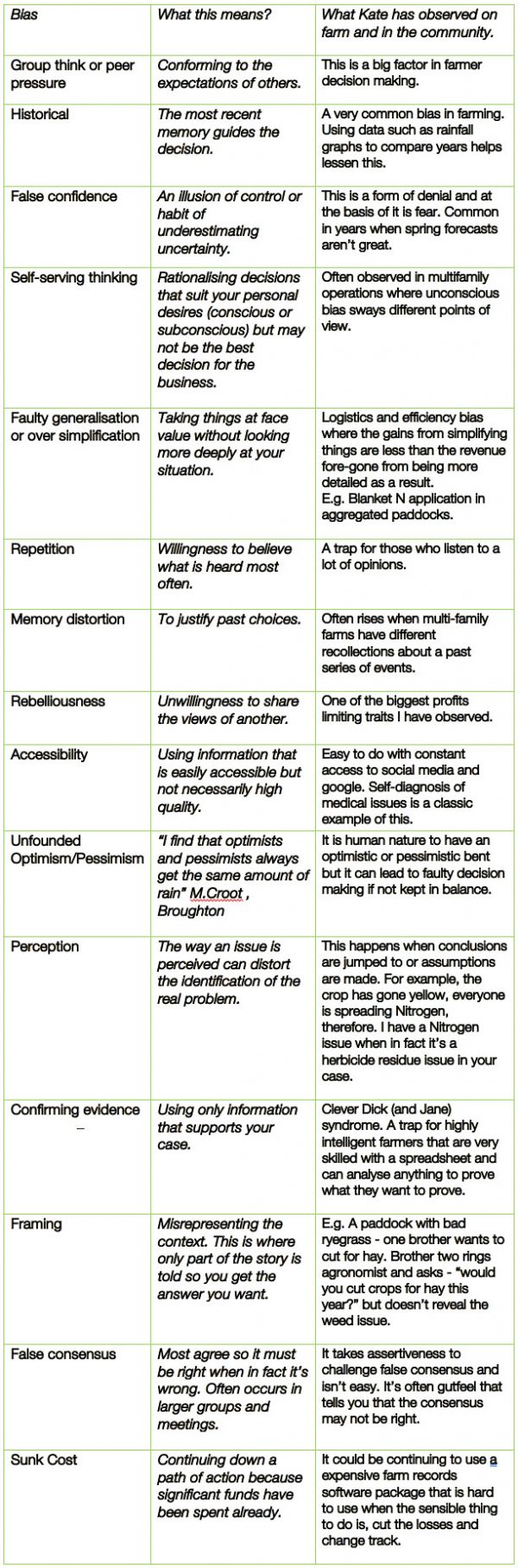
The first step to managing bias is to observe your own decision-making habits and check for bias. The table below is a bias guide for your reference.
Do this
- Do any of biases listed sound familiar? Can you think of a decision that didn’t end well? Were any of these biases at play when you made that decision.
AUDIO
[/fusion_toggle][fusion_toggle title=”Topic 3″ open=”no” class=”” id=”” fusion_font_family_title_font=”” fusion_font_variant_title_font=”” title_font_size=”” title_color=”” hue=”” saturation=”” lightness=”” alpha=”” fusion_font_family_content_font=”” fusion_font_variant_content_font=”” content_font_size=”” content_color=””]
Think Agri Real Insights 2020 Episode 3- Article 1
Decision Making Quick Fix 3. Implement!
In a recent series of workshops, I was curious to know what motivated young farmers and I asked them to design their own Excellent Farming adventure. This is what emerged:
- Most participants nominated profit and personal wellbeing as their highest priorities.
- Honouring the legacy of a multigenerational farm was also high on the list.
- Production and robustness were viewed as tools to achieve profit and generate funds to enhance lifestyle and build the legacy.
- The desire to thrive as a person rather than just survive was high on the agenda.
Sound decision making is only part of the recipe to achieve these goals.
Implementation is a key driver of long-term farm profit and personal wellbeing.
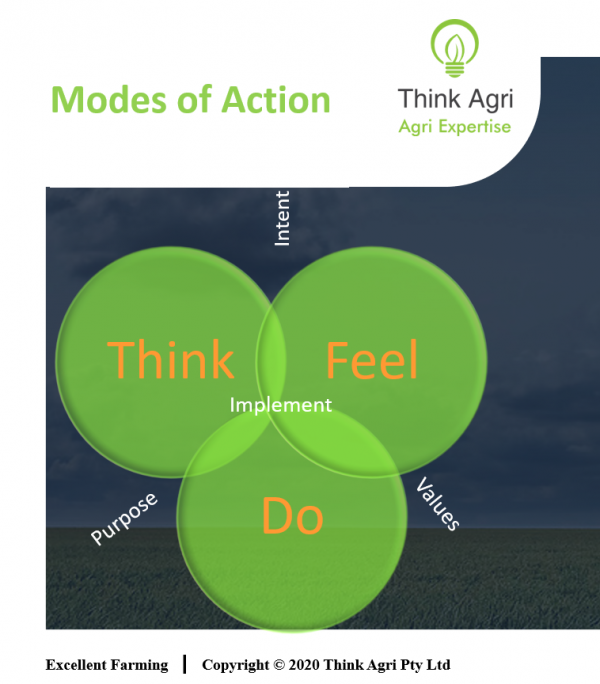
Implementation can be described as a combination of three modes of action:
Think Feel Do
Do
Right now, timing is of the essence and operations need to be squeezed in when the weather allows to drive production which in turn drives revenue.
Doing is vital in these situations but is most effective when preceded by a dose of thinking and feeling. Getting the mix right improves the odds of deciding the right course of action and considers the risks associated with that action to prevent nasty surprises.
Doing comes more naturally than the other modes of action for many farmers and advisers. Overdoing in a bull at a gate manner can see lots of stuff getting done but are those actions effective and contributing to profit? Conversely, Thinking and Feeling to come up with the perfect plan is useless as the plan is not implemented.
Feel
Feelings provide us with empathy and guide our values system. They lessen the risk of hurtful actions and keep us creative and innovative. They help us recognise opportunity and act on intuition.
There are clear benefits of tuning into the emotions of self and others, but like chocolate we can overdo feelings and emotion. A rather crude but effective quote comes from Mark Manson, author of “The subtle art of not giving a F###”.
Decision making based on emotional intuition alone, without the aid of reason to keep it in line, pretty much always sucks. You know who bases their entire lives on emotions? Three-year olds. And Dogs. You know what else Three years old’s and dogs do? S##t on the carpet “
That said emotion and intuition help ensure plans are practical and achievable and enables flexibility to respond to the changing season or work demands.
Think
The Think mode is a key tool for managing decision making bias, anticipating possibilities and being organised. Spending time thinking through the percenters, understanding the real cause of problems and then developing solutions to the real problem is where thinking pays dividends.
An example is being able to move past the perception that a parcel of land is too expensive or that it is a must buy because it’s next door. Some astute thinking and analysis can guide pivotal moments and unlock hidden value.
Another example was the early adopters to hay cutting as a salvage income option during the millennial drought. Supported by some solid thinking and analysis, these adopters were able to ignore group think and convert a certain loss into a small loss or in some cases reasonable profit.
Again, too much thinking is not always healthy. Overthinkers tend to get stuck in the small detail in search of the perfect solution which doesn’t exist.
Overthinking prolongs decision making and compromises timeliness. It also messes with our health. Basic selfcare of rest, sleep, healthy diet and exercise, scheduled fun and relaxation help manage stress and keep our thinking productive.
Rigid application of logic that dismisses the Feel and Do is a trap that inexperienced owners or operators can fall into.
Consider a “mega farm of 30,000 Ha made of three 10,000 Ha aggregations within 500km of each other. A hub and spoke model is set up with minimal staff based on each farm and a Regional Manager in a central location. This reduces fixed costs per hectare and looks good on a spreadsheet. Production suffers though from poor timeliness in monitoring and operations. Returns never reach expectations and the investment fails.
The best way to avoid such a thinking trap is to investigate what you might not know before implementing the spreadsheet perfect plan.
Summary
Implementation for high performance is a balance between thinking, feeling, and doing.
Do this
Reflect on these questions:
- Do you have the mix right?
- What could you alter if the mix isn’t right?
- What could you outsource to get the mix right?
AUDIO
[/fusion_toggle][/fusion_accordion][fusion_text columns=”” column_min_width=”” column_spacing=”” rule_style=”default” rule_size=”” rule_color=”” hue=”” saturation=”” lightness=”” alpha=”” content_alignment_medium=”” content_alignment_small=”” content_alignment=”” hide_on_mobile=”small-visibility,medium-visibility,large-visibility” sticky_display=”normal,sticky” class=”” id=”” margin_top=”” margin_right=”” margin_bottom=”” margin_left=”” fusion_font_family_text_font=”” fusion_font_variant_text_font=”” font_size=”” line_height=”” letter_spacing=”” text_transform=”none” text_color=”” animation_type=”” animation_direction=”left” animation_speed=”0.3″ animation_offset=””]
You can access all audio for all topics below or via your Podcast feed.
[/fusion_text][fusion_audio src=”https://www.thinkagri.com.au/wp-content/uploads/2022/01/TARI_E3_Final.mp3″ loop=”off” autoplay=”off” preload=”none” hide_on_mobile=”small-visibility,medium-visibility,large-visibility” class=”” id=”” background_color=”” hue=”” saturation=”” lightness=”” alpha=”” controls_color_scheme=”” progress_color=”” max_width=”” border_size=”” border_color=”” border_radius_top_left=”” border_radius_top_right=”” border_radius_bottom_right=”” border_radius_bottom_left=”” box_shadow=”no” box_shadow_vertical=”” box_shadow_horizontal=”” box_shadow_blur=”0″ box_shadow_spread=”0″ box_shadow_color=”” animation_type=”” animation_direction=”left” animation_speed=”0.3″ animation_offset=”” /][/fusion_builder_column][/fusion_builder_row][/fusion_builder_container][fusion_global id=”361″]