
[fusion_builder_container admin_label=”Episode” hundred_percent=”no” hundred_percent_height=”no” hundred_percent_height_scroll=”no” hundred_percent_height_center_content=”yes” equal_height_columns=”no” menu_anchor=”” hide_on_mobile=”small-visibility,medium-visibility,large-visibility” status=”published” publish_date=”” class=”” id=”” link_color=”” link_hover_color=”” border_color=”” border_style=”solid” margin_top=”” margin_bottom=”” padding_top=”” padding_right=”” padding_bottom=”” padding_left=”” gradient_start_color=”” gradient_end_color=”” gradient_start_position=”0″ gradient_end_position=”100″ gradient_type=”linear” radial_direction=”center center” linear_angle=”180″ background_color=”” background_image=”” background_position=”center center” background_repeat=”no-repeat” fade=”no” background_parallax=”none” enable_mobile=”no” parallax_speed=”0.3″ background_blend_mode=”none” video_mp4=”” video_webm=”” video_ogv=”” video_url=”” video_aspect_ratio=”16:9″ video_loop=”yes” video_mute=”yes” video_preview_image=”” filter_hue=”0″ filter_saturation=”100″ filter_brightness=”100″ filter_contrast=”100″ filter_invert=”0″ filter_sepia=”0″ filter_opacity=”100″ filter_blur=”0″ filter_hue_hover=”0″ filter_saturation_hover=”100″ filter_brightness_hover=”100″ filter_contrast_hover=”100″ filter_invert_hover=”0″ filter_sepia_hover=”0″ filter_opacity_hover=”100″ filter_blur_hover=”0″ admin_toggled=”no” type=”flex”][fusion_builder_row][fusion_builder_column type=”1_1″ layout=”1_1″ spacing=”” center_content=”no” link=”” target=”_self” min_height=”” hide_on_mobile=”small-visibility,medium-visibility,large-visibility” class=”” id=”” hover_type=”none” border_color=”” border_style=”solid” border_position=”all” border_radius=”” box_shadow=”no” dimension_box_shadow=”” box_shadow_blur=”0″ box_shadow_spread=”0″ box_shadow_color=”” box_shadow_style=”” padding_top=”” padding_right=”” padding_bottom=”” padding_left=”” margin_top=”” margin_bottom=”” background_type=”single” gradient_start_color=”” gradient_end_color=”” gradient_start_position=”0″ gradient_end_position=”100″ gradient_type=”linear” radial_direction=”center center” linear_angle=”180″ background_color=”” background_image=”” background_image_id=”” background_position=”left top” background_repeat=”no-repeat” background_blend_mode=”none” animation_type=”” animation_direction=”left” animation_speed=”0.3″ animation_offset=”” filter_type=”regular” filter_hue=”0″ filter_saturation=”100″ filter_brightness=”100″ filter_contrast=”100″ filter_invert=”0″ filter_sepia=”0″ filter_opacity=”100″ filter_blur=”0″ filter_hue_hover=”0″ filter_saturation_hover=”100″ filter_brightness_hover=”100″ filter_contrast_hover=”100″ filter_invert_hover=”0″ filter_sepia_hover=”0″ filter_opacity_hover=”100″ filter_blur_hover=”0″ last=”true” border_sizes_top=”0″ border_sizes_bottom=”0″ border_sizes_left=”0″ border_sizes_right=”0″ first=”true”][fusion_text columns=”” column_min_width=”” column_spacing=”” rule_style=”default” rule_size=”” rule_color=”” content_alignment_medium=”” content_alignment_small=”” content_alignment=”” hide_on_mobile=”small-visibility,medium-visibility,large-visibility” sticky_display=”normal,sticky” class=”” id=”” font_size=”” fusion_font_family_text_font=”” fusion_font_variant_text_font=”” line_height=”” letter_spacing=”” text_color=”” animation_type=”” animation_direction=”left” animation_speed=”0.3″ animation_offset=””]
Episode Five – 4 September 2020
[/fusion_text][fusion_accordion type=”toggles” boxed_mode=”yes” divider_line=”” inactive_icon=”” active_icon=”” icon_boxed_mode=”” hide_on_mobile=”small-visibility,medium-visibility,large-visibility” class=”” id=”” border_size=”1″ border_color=”” hue=”” saturation=”” lightness=”” alpha=”” background_color=”” hover_color=”” divider_color=”” divider_hover_color=”” fusion_font_family_title_font=”” fusion_font_variant_title_font=”” title_font_size=”” title_color=”” icon_size=”” icon_color=”” icon_box_color=”” icon_alignment=”” fusion_font_family_content_font=”” fusion_font_variant_content_font=”” content_font_size=”” content_color=”” toggle_hover_accent_color=”” toggle_active_accent_color=””][fusion_toggle title=”Intro” open=”no” class=”” id=”” fusion_font_family_title_font=”” fusion_font_variant_title_font=”” title_font_size=”” title_color=”” hue=”” saturation=”” lightness=”” alpha=”” fusion_font_family_content_font=”” fusion_font_variant_content_font=”” content_font_size=”” content_color=””]
 This is the fifth episode of Think Agri REAL Insights in 2020.
It’s a pleasure to continue adding tools to your Excellent Farming problem solving arsenal.
Spring has arrived and the weather is warming up and so too is the race to the finish off the winter cropping season. The weather Gods have been kind in August in most regions and the spring forecast delivers further hope.
It’s a time of year when I notice that farming folks are both excited and anxious all at once and going 100 miles an hour to keep on top of jobs.
The focus on this episode is positioning one’s self to make good decisions through reframing problems and being open to taking on new information to help solve problems.
In this episode:
Article 1 reframes the grain price conversation to one of maximising margin rather than maximising price.
Article 2 takes a look at five habits to make us more teachable so we learn well and make better decisions.
Each topic has some content and a practical activity. It’s up to you, how involved you want to get.
They are both chunky topics so I’ve left it at two articles this time.
Happy reading, listening, and implementing! Good luck. Kate
[/fusion_toggle][fusion_toggle title=”Topic 1″ open=”no” class=”” id=”” fusion_font_family_title_font=”” fusion_font_variant_title_font=”” title_font_size=”” title_color=”” hue=”” saturation=”” lightness=”” alpha=”” fusion_font_family_content_font=”” fusion_font_variant_content_font=”” content_font_size=”” content_color=””]
Episode 5 Article 1
Making money in times of soft pricing. Focus on profit making tasks.
Introduction
Commodity pricing and weather are two issues commonly raised when we ask farmers what their main worries are. The weather has been kinder than commodity price trends in recent weeks.
I’ve been collating lessons from publicly available bench marking studies for nearly 20 years. The good news is that the clear message in most circumstances is that yield is king when driving revenue and price while influential, is not the biggest driver of revenue or profit. This is because yield varies more than price.
Energy spent trying to maximise price might be better off spent in other parts of the business. The exception is in lower yielding regions (<2.5 t/ha) with less crop species choice. In these circumstances price is more important than in higher yield areas with more crop choice.
Our commodity prices are heavily influenced by global factors that we can’t control. While we can influence our final price through price risk management techniques to the tune of $20/t benefit on average (Ron Storey pers. comm), sometimes the efforts to get an extra $5/t here or there are not worth the reward. That energy chasing $5/t might generate more benefit if it was used on tasks that have greater influence on the farm business overall. For example, focus on the factors where you have a greater locus of control such as timely planning and operations and prudent financial management. The one aspect of grain selling you can control is your understanding of selling principles to avoid leaving money on the table.
This article does not provide marketing advice. The article identifies choices you can make that may improve your profit taking opportunities (and manage your stress levels).
Optimise margin rather than maximise price
What happens if you shift the focus from maximising the price to maximising the margin you make from a realistic price range available to you, over your chosen selling time frame?
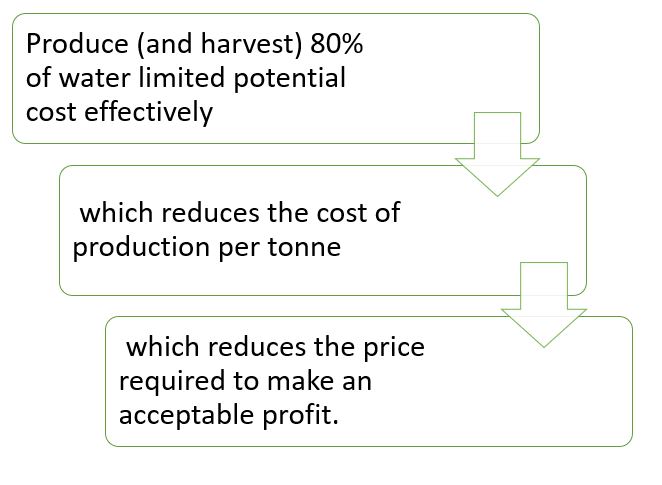
The rationale and steps for maximising the margin is as follows:
Figure 1 below illustrates a sensitivity analysis for a favourable season. The base case is the centre square of achieving 60% of water limited yield which delivers 4.1 t/Ha costing $550/Ha to produce, including fixed costs. The cost of production (breakeven price) is $135/t. A margin of $60/t would be achieved if the grain is sold at $195/t.
 A lower cost base and higher yield means the cost of production is now $95/t and the margin is $100/t. This is a $40/t increase, all from yield optimisation and whole-of-business cost management.

Figure 1 Cost of production (or breakeven price) in $/t as affected by Production Efficiency (expressed as yield t/ha ) and yield relative to water limited potential (%) and Cost Efficiency (total costs/ha).
Figure 2 Cost of production for 4 scenarios relative to the mid scenario of 60% yield achievement and mid-range costs. In the top right quadrant, the same profit can be achieved with a price that is $40/t lower than the middle scenario. In the bottom left quadrant, a grain price of $115/t more is required to achieve the same margin as in the mid-range scenario.
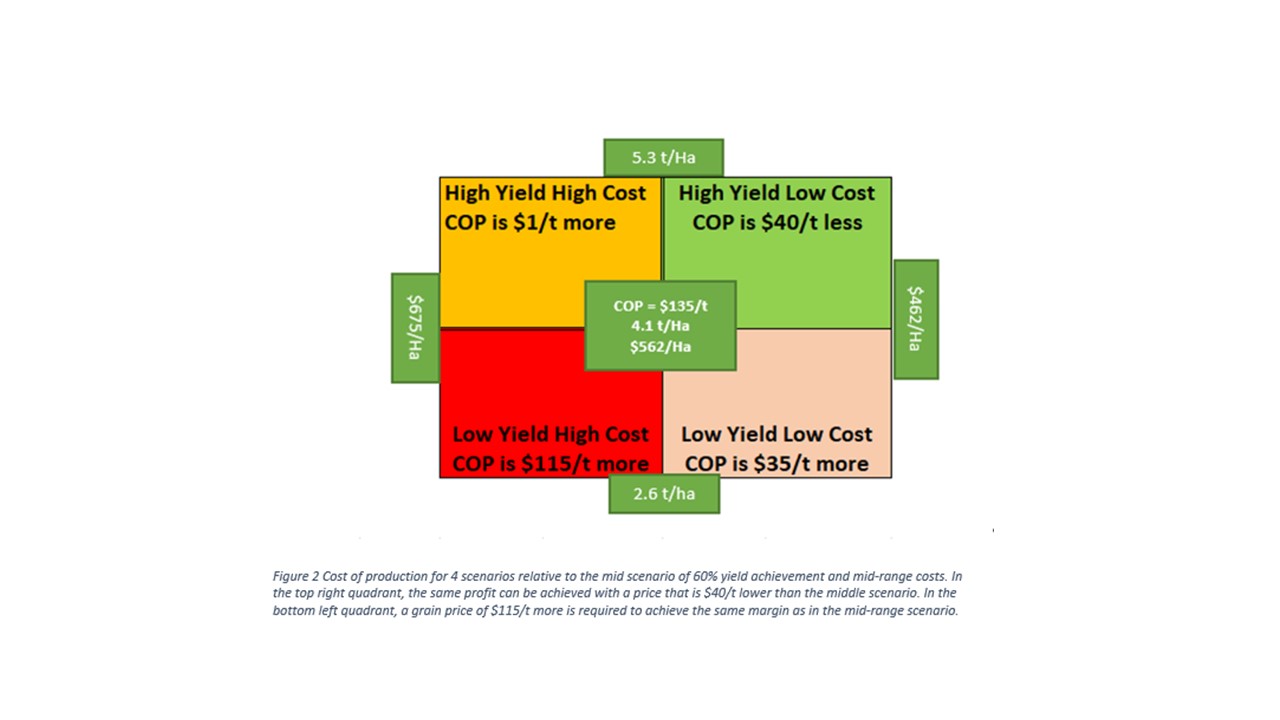
Table 1 lists some practical areas of focus for the next three months that contribute to optimising the margin.

References
https://grdc.com.au/resources-and-publications/all-publications/publications/2015/01/farming-the-business-manual – this has good templates for calculating cost of production
https://grdc.com.au/__data/assets/pdf_file/0029/373916/GrowNote-Wheat-South-15-Marketing.pdf- this outlines key selling principles.
Do this
Try something in Table 1
Acknowledgements
Ron Storey, Nathan Cattle and Hannah Jansen were the brains behind the Grow Notes Marketing Chapter. Mike Krause and Tony Hudson are responsible for the cost of production information in the provided resource.
[/fusion_toggle][fusion_toggle title=”Topic 2″ open=”no” class=”” id=”” fusion_font_family_title_font=”” fusion_font_variant_title_font=”” title_font_size=”” title_color=”” hue=”” saturation=”” lightness=”” alpha=”” fusion_font_family_content_font=”” fusion_font_variant_content_font=”” content_font_size=”” content_color=””]
Episode 5 Article 2
Five ways to be more teachable. How to enhance learning and decision making for Excellent Farming.
Introduction
Excellent Farming is nuanced and complex and not everything is knowable.
For the inexperienced farmer, there’s a lot to learn. One can’t be expected to learn or know it all straight away, regardless of family farm credentials or academic achievement. Equally when new challenges arrive even old dogs are forced to consider learning new tricks.
Some sports recruiters are more inclined to look for teachable recruits over those with raw talent but a low ability to learn due to poor interpersonal skills.
This article focuses on five actions that help us be more teachable. It comes from the latest management and leadership research. Being more teachable helps new and old farmers (and new and old advisers), get the most from learning opportunities. That way, decision making is enhanced rather than confused.
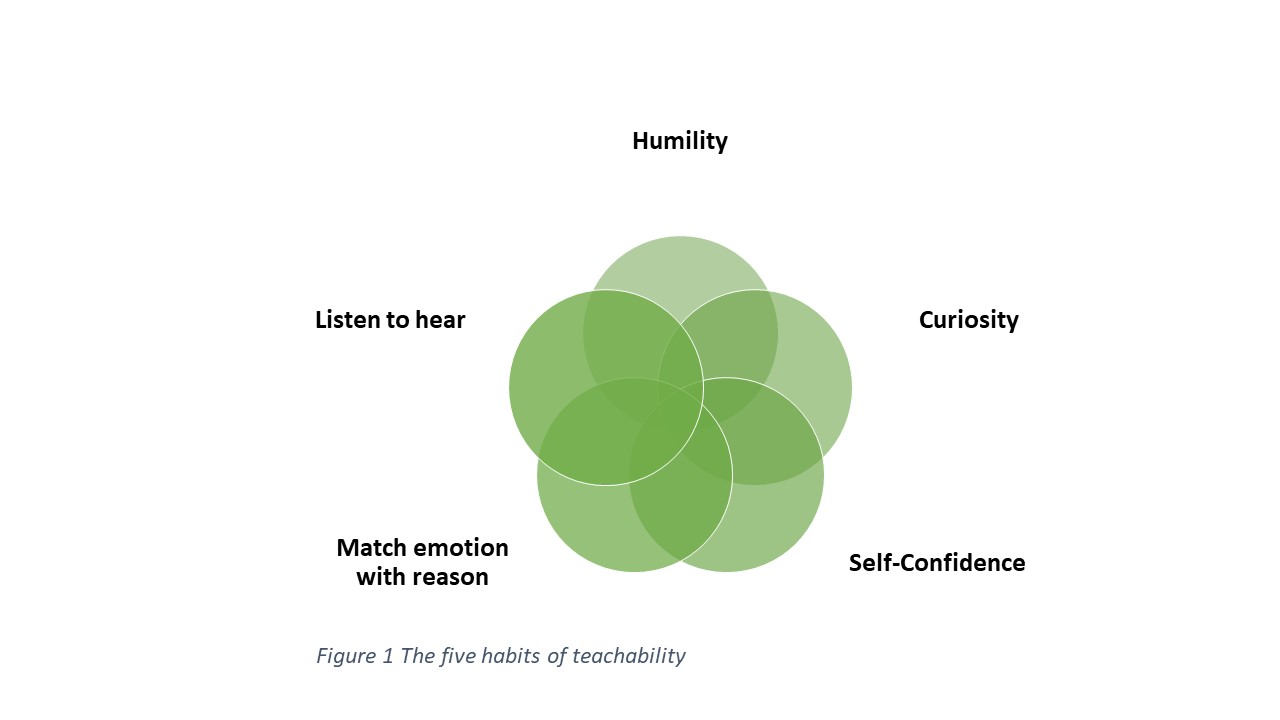
Five habits to become more teachable
- Be humble. Recognise that you can’t know everything and recognise that you can’t know what you don’t know.
In leadership research, humility is the ability to:
- accurately acknowledge one’s limitations and
- focus on the impact of others rather than purely the impact on self.
“Once we get into leadership roles, many of us think we need to have all the answers. But research teaches us that we’re far wiser to ask a lot of questions — even to reveal our own ignorance — instead!”
Mark. C. Crowley
Mark Crowley, a leadership communicator and former C.E.O, interviewed experts who investigated the role of humility in success. The research revealed that because more humble people are less confident in their skill set, they work harder to learn more and hone that skill set. In the research, Uni students with higher humility scores had better academic results than their less humble higher IQ counterparts.
James O’Toole author of “The Enlightened Capitalists” speaks about this in his book. Self- confidence is essential, he says, but ego is the biggest career derailer. Ego is also the biggest learning derailer. I was guilty of this as young Uni student studying Ag Science. I thought I knew more than I did because I came from a farm. Well guess what – I didn’t and embarrassingly, my academic record is proof of my over-confidence at that time.
Some of my favourite excellent farmers are those that are humble enough to know they don’t know everything and confident enough to think through what they’ve learnt and implement a plan that works for them.
- Be curious. When I was young, there was a science show on ABCTV on a Saturday or Sunday evening called “Why is it so?”. Professor Julius Summer would take secondary school students through classic science fundamentals and he’d always ask in a strong American accent “Why is it so?” We could all do well to ask this question a lot!
Asking why it is so, rather than assuming why it is so, can help identify what really matters and where to focus attention. Channel your inner four your old and ask why?
- Cultivate self-confidence. Self-confidence in the inner compass that prevents ego and over-confidence getting in the way. Self-confidence is not arrogance and not extroversion.
“No problem of judgment and decision making is more prevalent and more potentially catastrophic than over-confidence”
Don Moore
This was the conclusion by Don Moore, an academic at the Berkeley Business School in California. The trick is to be Perfectly Confident, the name of his new book – not too much, not too little – just right. Middle ground confidence is the perfect amount of confidence for calibrating decision making.
Some of the most self-assured peers I admire (both farmers and advisers) are introverted, humble and self-confident. Excellent Farmers are good at taking what they learn from neighbours, field days, webinars or advisor visits and discern what applies to them and what does not apply. Self-confidence fuels that discernment.
It’s also self-confidence that prevents blind following of fads and doing things without knowing why you are doing it.
Self-confidence removes the need to shift responsibility to a third party and allows one to own the decision making and own mistakes when they occur.
- Balance emotion with reasoning. Emotional regulation has a role in learning. Andrew, a farmer in North East Victoria with 30 years of experience under his belt, made an interesting observation in a video interview on how they approach the economics of precision agriculture and lessons they had learnt.
“There’s a lot of emotion in farming – too much sometimes”.
Andrew Russell
It’s hard to reason and make good technology and machinery purchasing decisions, if all we are using is the emotional side of the brain.
As Mark Manson reminds us in his book “The subtle art of not giving a ####”, three year old’s and dogs don’t have the benefit of reasoning ability. They are also prone to making messes on the carpet.
We adults have been gifted reasoning ability and it’s a weapon of mass instruction.
- Hear what’s on offer to be heard. It’s not as easy as it sounds, particularly when fear and emotion are winning the battle for control over reason
I spoke once at a field day about the optimum seeding bar row spacings for no-till farming in South East Australia. The research over decades shows that there is no one -size- fit’s- all -magic row spacing, yet it can become an obsession among growers. The optimum row spacing depends on farm location, soil type and farming system.
I delivered this message three times in 30 minute sessions in four hours to about 400 listeners. I was pretty chuffed with myself that I had unravelled a point of confusion and busted a few myths. I was hopeful the punters would lose less sleep on row spacing and concentrate on the real profit lifters.
Then a worried looking chap wandered over and said “I’m just about to get into this no-till thing on 12 inch spacings. Are you telling me I’m going to go broke?”.
It could have been my style and maybe my message wasn’t clear. Or perhaps the problem that day, in the paddock North of Birchip, was that his fears about the change were causing static on the radio and he couldn’t hear the message.
Its not just fear and emotion that cause static. Over-confidence, as we touched on earlier is a big listening derailer. James O’Toole admires leaders with an approach of service, humility and listening.
“Very few leaders are listeners. Once they get to be leaders, they start to be impressed with their own intelligence and brilliance and quit listening.”
James O’Toole
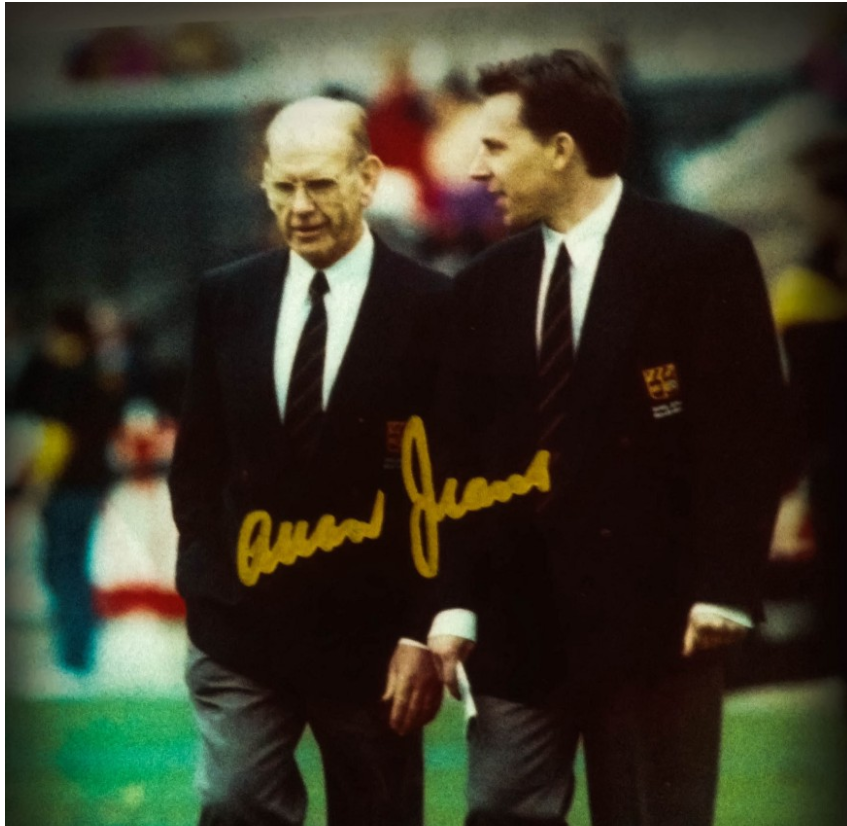 I suspect James O’Toole would have admired Alan Jeans leadership style. My favourite Alan Jeans quote is this.
“I was born with big ears, so I figured I might as well use them”
Alan Jeans (as quoted by Cam Schwab)
Cam Schwab was a very young CEO in AFL Club land who was sacked three times. He learnt the hard way about these teachability traits and has a lot of wisdom to share.
I’ve been lucky to receive some of this wisdom in person. I highly recommend young aspiring Excellent Farmers take a look at Cam’s blog at www.ceodesign.com.au
Photo Source https://www.designceo.com.au/big-ears/
Familiarity can block listening. You couldn’t get any more familiar than in a family business especially a farm where you might be living and working together. When we are familiar, we don’t always bring our best listening manners to the table. Scrolling on phones or iPads doesn’t help listening either.
When we are passionate about something, we can find ourselves formulating our next argument, rather than listening when others are talking.
Listening to hear and understand will lead to better learning and decision making outcomes, resolve tensions and hopefully contribute to happier lives and more profitable farming experiences.
Summary
The five habits to become more teachable are:
- Humility
- Curiosity
- Self-Confidence
- Balancing emotion and reason
- Listening to hear
References
https://www.designceo.com.au/allan-jeans/
http://leadernetwork.org/james_otoole_august_08.htm
http://markccrowley.com/don-moore-the-mindset-you-need-for-making-the-best-life-choices/
Manson Mark (2016) The subtle art of not giving a …. A counterintuitive approach to living a good life. MacMillan.
https://www.youtube.com/watch?v=bV0Y2-Vxpz4&list=RDCMUCR_kFbcwWy1cKLCkmcMf4lg&start_radio=1&t=164
Do This
Take the teachability quiz.
Take a moment to reflect on your learning and decision making style using the quiz below.
Now ask three people to rate you – perhaps a family colleague, an advisor, and an unrelated colleague or friend.

(1 = poor in this area, 3 = ok, 5 = excellent).
How different is your perception to that of others?
What teachability traits do you excel in?
What teachability traits can you develop further?
How will you use this knowledge to learn more and improve decision making?
[/fusion_toggle][/fusion_accordion][fusion_text columns=”” column_min_width=”” column_spacing=”” rule_style=”default” rule_size=”” rule_color=”” hue=”” saturation=”” lightness=”” alpha=”” content_alignment_medium=”” content_alignment_small=”” content_alignment=”” hide_on_mobile=”small-visibility,medium-visibility,large-visibility” sticky_display=”normal,sticky” class=”” id=”” margin_top=”” margin_right=”” margin_bottom=”” margin_left=”” fusion_font_family_text_font=”” fusion_font_variant_text_font=”” font_size=”” line_height=”” letter_spacing=”” text_transform=”none” text_color=”” animation_type=”” animation_direction=”left” animation_speed=”0.3″ animation_offset=””]
You can access all audio for all topics below or via your Podcast feed.
[/fusion_text][fusion_audio src=”https://www.thinkagri.com.au/wp-content/uploads/2022/01/TARI-E5.mp3″ loop=”off” autoplay=”off” preload=”none” hide_on_mobile=”small-visibility,medium-visibility,large-visibility” class=”” id=”” background_color=”” hue=”” saturation=”” lightness=”” alpha=”” controls_color_scheme=”” progress_color=”” max_width=”” border_size=”” border_color=”” border_radius_top_left=”” border_radius_top_right=”” border_radius_bottom_right=”” border_radius_bottom_left=”” box_shadow=”no” box_shadow_vertical=”” box_shadow_horizontal=”” box_shadow_blur=”0″ box_shadow_spread=”0″ box_shadow_color=”” animation_type=”” animation_direction=”left” animation_speed=”0.3″ animation_offset=”” /][/fusion_builder_column][/fusion_builder_row][/fusion_builder_container][fusion_global id=”361″]