
[fusion_builder_container admin_label=”Episode” hundred_percent=”no” hundred_percent_height=”no” hundred_percent_height_scroll=”no” hundred_percent_height_center_content=”yes” equal_height_columns=”no” menu_anchor=”” hide_on_mobile=”small-visibility,medium-visibility,large-visibility” status=”published” publish_date=”” class=”” id=”” link_color=”” link_hover_color=”” border_color=”” border_style=”solid” margin_top=”” margin_bottom=”” padding_top=”” padding_right=”” padding_bottom=”” padding_left=”” gradient_start_color=”” gradient_end_color=”” gradient_start_position=”0″ gradient_end_position=”100″ gradient_type=”linear” radial_direction=”center center” linear_angle=”180″ background_color=”” background_image=”” background_position=”center center” background_repeat=”no-repeat” fade=”no” background_parallax=”none” enable_mobile=”no” parallax_speed=”0.3″ background_blend_mode=”none” video_mp4=”” video_webm=”” video_ogv=”” video_url=”” video_aspect_ratio=”16:9″ video_loop=”yes” video_mute=”yes” video_preview_image=”” filter_hue=”0″ filter_saturation=”100″ filter_brightness=”100″ filter_contrast=”100″ filter_invert=”0″ filter_sepia=”0″ filter_opacity=”100″ filter_blur=”0″ filter_hue_hover=”0″ filter_saturation_hover=”100″ filter_brightness_hover=”100″ filter_contrast_hover=”100″ filter_invert_hover=”0″ filter_sepia_hover=”0″ filter_opacity_hover=”100″ filter_blur_hover=”0″ admin_toggled=”no” type=”flex”][fusion_builder_row][fusion_builder_column type=”1_1″ layout=”1_1″ spacing=”” center_content=”no” link=”” target=”_self” min_height=”” hide_on_mobile=”small-visibility,medium-visibility,large-visibility” class=”” id=”” hover_type=”none” border_color=”” border_style=”solid” border_position=”all” border_radius=”” box_shadow=”no” dimension_box_shadow=”” box_shadow_blur=”0″ box_shadow_spread=”0″ box_shadow_color=”” box_shadow_style=”” padding_top=”” padding_right=”” padding_bottom=”” padding_left=”” margin_top=”” margin_bottom=”” background_type=”single” gradient_start_color=”” gradient_end_color=”” gradient_start_position=”0″ gradient_end_position=”100″ gradient_type=”linear” radial_direction=”center center” linear_angle=”180″ background_color=”” background_image=”” background_image_id=”” background_position=”left top” background_repeat=”no-repeat” background_blend_mode=”none” animation_type=”” animation_direction=”left” animation_speed=”0.3″ animation_offset=”” filter_type=”regular” filter_hue=”0″ filter_saturation=”100″ filter_brightness=”100″ filter_contrast=”100″ filter_invert=”0″ filter_sepia=”0″ filter_opacity=”100″ filter_blur=”0″ filter_hue_hover=”0″ filter_saturation_hover=”100″ filter_brightness_hover=”100″ filter_contrast_hover=”100″ filter_invert_hover=”0″ filter_sepia_hover=”0″ filter_opacity_hover=”100″ filter_blur_hover=”0″ last=”true” border_sizes_top=”0″ border_sizes_bottom=”0″ border_sizes_left=”0″ border_sizes_right=”0″ first=”true”][fusion_text columns=”” column_min_width=”” column_spacing=”” rule_style=”default” rule_size=”” rule_color=”” content_alignment_medium=”” content_alignment_small=”” content_alignment=”” hide_on_mobile=”small-visibility,medium-visibility,large-visibility” sticky_display=”normal,sticky” class=”” id=”” font_size=”” fusion_font_family_text_font=”” fusion_font_variant_text_font=”” line_height=”” letter_spacing=”” text_color=”” animation_type=”” animation_direction=”left” animation_speed=”0.3″ animation_offset=””]
Episode Four – 7 August 2020
[/fusion_text][fusion_accordion type=”toggles” boxed_mode=”yes” divider_line=”” inactive_icon=”” active_icon=”” icon_boxed_mode=”” hide_on_mobile=”small-visibility,medium-visibility,large-visibility” class=”” id=”” border_size=”1″ border_color=”” hue=”” saturation=”” lightness=”” alpha=”” background_color=”” hover_color=”” divider_color=”” divider_hover_color=”” fusion_font_family_title_font=”” fusion_font_variant_title_font=”” title_font_size=”” title_color=”” icon_size=”” icon_color=”” icon_box_color=”” icon_alignment=”” fusion_font_family_content_font=”” fusion_font_variant_content_font=”” content_font_size=”” content_color=”” toggle_hover_accent_color=”” toggle_active_accent_color=””][fusion_toggle title=”Introduction” open=”no” class=”” id=”” fusion_font_family_title_font=”” fusion_font_variant_title_font=”” title_font_size=”” title_color=”” hue=”” saturation=”” lightness=”” alpha=”” fusion_font_family_content_font=”” fusion_font_variant_content_font=”” content_font_size=”” content_color=””]
Welcome to the fourth episode of Think Agri REAL Insights in 2020 series.
Our world in Australia remains ever uncertain as COVID-19 makes its mark, particularly in Victoria. It’s also been a dry winter and we will be a bit edgy until a decent rain occurs.
Understandably, I’m feeling a sense of heightened emotion and anxiety despite things going exceptionally well here at Think Agri. I am noticing that clients, friends, family and colleagues are also a bit concerned and edgy. We’ve never dealt with anything like this before.

This episode focusses on improving the odds of having a fully functioning family farm business. Dealing with the unspoken issues is an important step to ensure successful farm businesses and happy families.
These are difficult subjects and even more difficult if we are feeling a bit edgy about the season or the global pandemic.
The tools introduced earn their money by providing a starting point for having the unspoken conversations and addressing the elephants in the room.
In this episode:
We provide 60 thought provoking questions for you to assess how well your family farm business is functioning.
We look at the Case Study of Typical Farm Partners Pty Ltd and introduce the 4 stages of an adult farming career and a transitioning mapping process.
As always, each topic has some content and a practical activity. It’s up to you, how involved you want to get.
Happy reading, listening, thinking, and doing! Good luck Kate
[/fusion_toggle][fusion_toggle title=”Topic 1″ open=”no” class=”” id=”” fusion_font_family_title_font=”” fusion_font_variant_title_font=”” title_font_size=”” title_color=”” hue=”” saturation=”” lightness=”” alpha=”” fusion_font_family_content_font=”” fusion_font_variant_content_font=”” content_font_size=”” content_color=””]
Episode 4 Article 1
Sixty questions about you, them, the farm and the family.
Introduction
Farm business function and performance monitoring seems too hard. The thought of getting data together for benchmarking is often a barrier. While crunching numbers gives some insight into the factors contributing to the bottom line, there is an equally crucial set of subjective considerations that impact on how we function and perform efficiently.
Subjective evaluation is an opportunity to look at the functioning of the farm business team. It could be all family members or a mix of family members and employees. Quite often these less obvious factors have a big impact on farm performance, yet it is unspoken and or unrealised.

The 60 questions below are designed to get you thinking about these issues and to identify areas for improvement. There is no data collection or maths required, just your brain.
How do you see the world and your part in the farm business and workplace?
- What excites you about farming with the family?
- What worries you about farming with the family?
- When are you at your best in the farm workplace?
- When are you at your worst?
- What strengths do you bring to the farm workplace?
- What personal challenges that impact on your work do you need to address?
- How can you add value to the business by complementing the strengths of others?
- What solutions can you implement to manage your part in the farming family dynamic?
- What if anything would you like to change about your behaviour?
- How well do you manage yourself in difficult times?
How they see the world and their part in the farm business and workplace?
- What excites others in the team?
- What worries others in the team?
- What do they tell you about you and your role and impact?
- What do they tell you about when you are at your best?
How do you interact and function as a workplace team?
- How does the team look now compared to five years ago?
- What strengths do each individual and couple bring to the team?
- What strengths do the team exhibit and why?
- What capacity gaps do you see in the team?
- Are roles and responsibilities clear?
- Do roles and responsibilities work to team strengths?
- How would you describe the team function: highly functional, just functional, dysfunctional?
- How nice are you to each other?
- What issues need to be addressed to maintain and or improve team function?
- What practices of the current and historic way of operating are helpful to keep?
- What new teamwork practices could be useful to introduce?
- Are non-family member employees and family employees (who aren’t business owners) treated the same or differently when in equivalent roles?
- How effective is the team at getting the work done on time, cost effectively and harmoniously?
- How are mistakes managed?
- How are individuals remunerated?
- How close are you to optimum production potential?
- How effective is your team at using time well?
How do you function as a family business and asset ownership team?
- Is it clear who owns the business?
- Is it clear who owns the assets (particularly land)?
- Is it clear who is part of the family business and how?
- Is it clear who “owns” the debt?
- Is it clear who is legally liable and responsible for financial and compliance risks?
- Are financial freedom/independence pathways clear for individuals and couples?
- Is it clear who has spending authority for operational and capital purchases?
- Is it clear who has selling authority for produce?
- How are differences of opinion managed?
- How profitable is the business relative to opportunities presented? ($/mm or ML)
- How effectively is the asset being utilised? (% ROC (operating))
- Is there a profit opportunity to be exploited?
- Is the business entity net worth increasing?
- Are individuals’ net worth increasing?
- How are profits distributed?
- To what extent are your business decisions driven by tax management?
- To what extent are your business decisions driven by wealth creation?
- To what extent are your business decisions driven by business growth?
- To what extent are your business decisions driven by profit optimisation?
- To what extent are your business decisions driven by what your peers are doing?
Working with family
- How does farming together impact positively on family relationships?
- How does farming together challenge family relationships?
- What boundaries do you need to manage family and work relationships?
- How similar or different are the values systems of different families?
- How can these differences be managed so they have minimal impact on family or work?
A High Functioning Future: What have you learnt and what will you do next?
- Which areas (A to E) need the most attention?
- Which questions 1 to 56 need addressing?
- What is the order of priority?
- What resources do you need to address these issues?
Do this
Read through the list.
- Mark the questions you think need more attention.
- Do some thinking and jot some notes down for the critical questions.
- Print the list out and give to all the members of your family business.
- Get them to do the same.
- What themes come up?
- What opportunities will be created by tackling those themes?
[/fusion_toggle][fusion_toggle title=”Topic 2″ open=”no” class=”” id=”” fusion_font_family_title_font=”” fusion_font_variant_title_font=”” title_font_size=”” title_color=”” hue=”” saturation=”” lightness=”” alpha=”” fusion_font_family_content_font=”” fusion_font_variant_content_font=”” content_font_size=”” content_color=””]
Episode 4 Article 2
The never-ending story of Farm Succession Part 3: Mapping out Career Paths
Introduction
Farming families tell me they want succession planning to deliver something like:
“a happy extended family that farms well together, can spend important family occasions together, makes money, has enjoyment, creates wealth for those involved and continues to build opportunities for the future generations”.

Farm Succession and Strategy is more than an interview with the accountant and solicitor and changing land titles. It is more than facilitated family meetings and a plan on paper. It takes communication and consideration of where everyone is at. It’s complex and complicated and it’s the unsaid and unresolved matters that block a succession transition from one generation to the next.
This article introduces two tools: The Stages of an Adult Farming Career and a Transition Mapping Process to deal with the elephants in the room.
Case Study of Typical Farm Partners Pty Ltd
Consider the following:
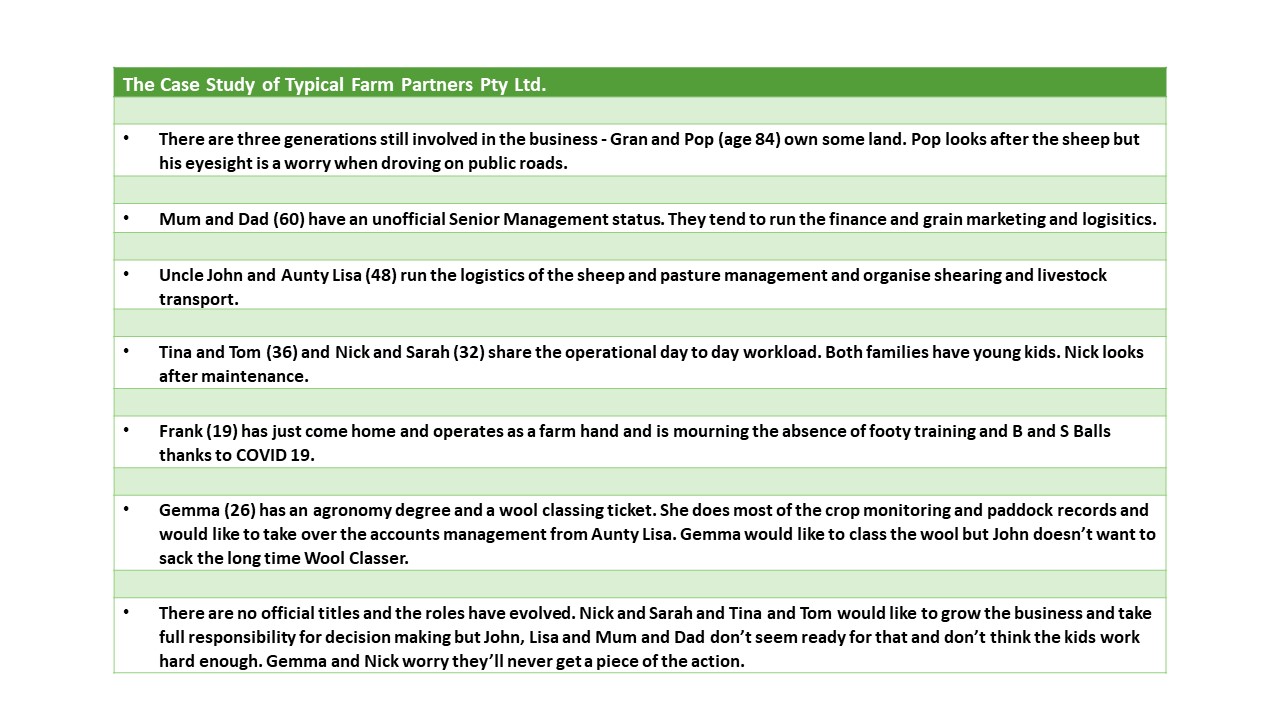
How is their Succession Tracking?
We introduced the Succession Implementation Pathway and checklist in Part Two of the series on Farm Succession (TARI 2020 Episode 2). Typical Farm Partners (TFP) self-assessment indicates there is a fair way to go even though they put a lot of effort into succession and have the structures and legalities well sorted. It can take a long time (sometimes decades) to complete the full transition from one generation to the next.
Table 1 The Succession Implementation Pathway based on Answers Dialogue and Action for TFP

The challenge for TFP is that the Sucession Plan was addressed 10 years ago specifically focussing on asset transfer from Gran and Pop to Lisa and John and Mum and Dad. The older children of the third generation were considered in terms of roles within the business but not in ownership. Gemma and Frank were not considered at all in that phase of Succession Planning.
This is not unusual. The pace of transition is influenced by the ages, stages and energy levels in the family farm dynamic. Within one generation their could be a gap between siblings or cousins of ten or more years. The older sibling is just firing up when the next sibling wants a piece of the action and it all starts again. Or, the older generation may be losing energy and wanting the younger generation to step up in their early 20s, before the younger potential farmer is ready to commit or has the skills and experience to do so.
Introducing the Four stages of an Adult Farming Life
Figure 1 provides a model for the four stages of an adult farming life:
- Intern
- Manager
- Mentor
- Elder.
I think of these as the four Farming Tours. The first is a bit like a Contiki or Topdeck tour. The next is more like Inteprid or Peregrine Adventures, the third is heading toward Trafalgar or Scenic and finally it’s Chris’s escorted Seniors tours.
The Intern Stage is either the school leaver or the returning young person who Step in to a role in the business and need to Skill Up and learn the operational side of the business. The third stage is Setting Up to move into a role with more responsibility including management and strategy. Ideally transition and succession conversations are occurring and a long term strategy is becoming clear.
The Manager stage is where one takes the lead in decision making particularly for operational and financial matters and staff management. There’s generally a Step Up phase as the previous Manager takes a step back. Then comes the Fire Up stage where growth is on the agenda as the new Manager wants to make their own mark on building a legacy. It’s then Flat out, captilising on opportunities and the most efficient use of the resource to generate returns.
Simultaneously, the previous Manager is transitioning to Mentor, taking a Step Back, Slowing Down and then ultimately Letting Go. This is an exciting and enjoyable phase, working with the younger generation. Yet, handing over the decision making baton can be hard. The lack of letting go is a common source of conflict and frustration for the younger generation or the partner of the one who is not letting go.
The final phase is that of Elder, Stepping Down entirely from control and decision making roles, Stepping Out of most, if not all ownership and Rising Up to be the wise and highly respected Elder. The Elder can be a great teacher and work mate of the the Intern.
A common source of unresolved tension is when there is a glut of Managers and no clear structures or decision making processes to provide accountability. When things go wrong, it can always be someone elses fault. Uncertainty builds as the younger ambitious Managers who are full of energy, feel that the older more tired Managers are slowing them down. The older Managers can be at different ages and stages in life too.
It seems that the most difficult transition is from Manager to Mentor to Elder for the older generation. This can be especially true for the male Elder who has been farming for 40 or 50 years (or 60 or 70 years) and is lost and afraid of losing identity and self worth (even if they don’t know it).
The same applies to older females who are actively involved and then hand over the financial responsibilities to the next generation, quite often a daughter-in-law. I met a lady last year who was a very active member of the farm business and was trying to step back from financial control. She was really struggling with identity and wondering what the future would hold. Baby sitting the grandkids was not going to be enough for her. I could see and hear the anguish as we chatted over a sausage roll in the Nhill footy sheds last July.
Figure 1 The Four Career Stages of the Family Farmer
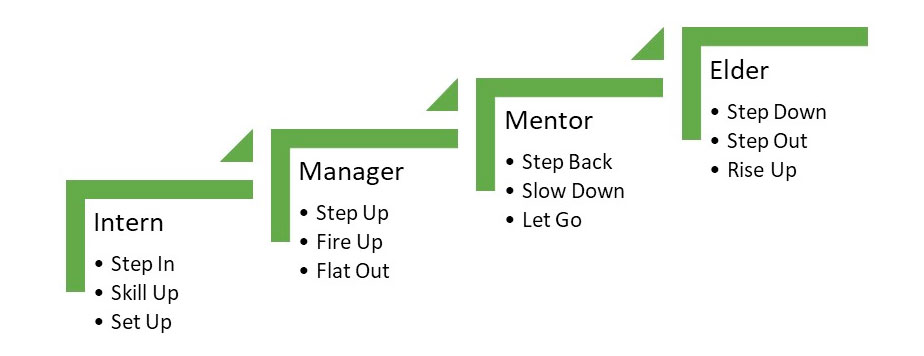
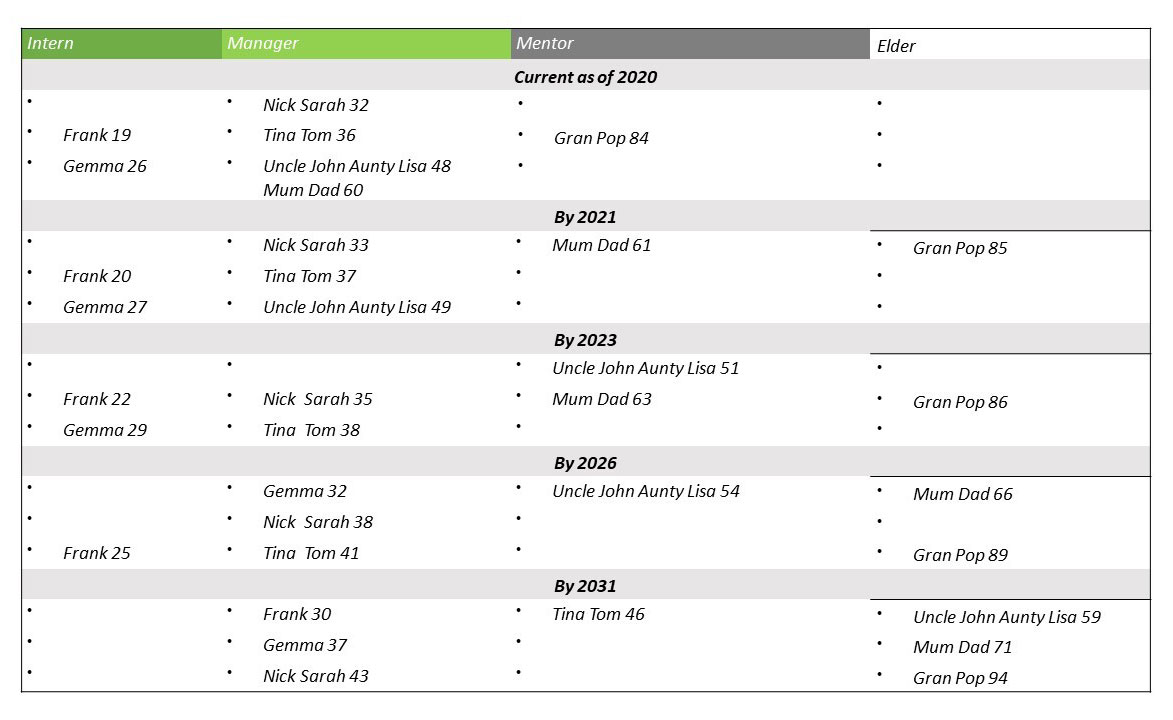
Table 2 The players of Typical Farm Partners Pty Ltd and the proposed 2023, 26 and 2030 adult career stage for better business function
Back to the Case of TPF
Naming who’s on what tour in the family business and mapping it out promotes the conversation about hierarchy, chain of command and transitioning responsibility. The way TFP currently functions includes 2 Interns, 8 Managers and 2 Mentors (Table 2). When mapped out, it became obvious to that the scene was set for all the dilemmas described above. Everyone agreed that unless something changed, the aim of all being able to have Christmas together and work together may move from a dream to a nightmare.
A Transition Map such as the one in Table 3 is one way of preventing the nightmare. The plan for TFP was developed after some facilitated and honest conversations about what the career stages could look like for each family and individual over the next ten years. It took compromise and emotional management to agree to and commence such a plan. Obviously life challenges and deaths or even divorce could alter this plan but it’s a start. Ideally it would be reviewed annually, based on an agreed set of criteria.
It won’t be easy for TFP but it will be easier than having no plan at all.
Do this: Map out your family farm members now and potentially what the future might look like.
[/fusion_toggle][/fusion_accordion][fusion_text columns=”” column_min_width=”” column_spacing=”” rule_style=”default” rule_size=”” rule_color=”” hue=”” saturation=”” lightness=”” alpha=”” content_alignment_medium=”” content_alignment_small=”” content_alignment=”” hide_on_mobile=”small-visibility,medium-visibility,large-visibility” sticky_display=”normal,sticky” class=”” id=”” margin_top=”” margin_right=”” margin_bottom=”” margin_left=”” fusion_font_family_text_font=”” fusion_font_variant_text_font=”” font_size=”” line_height=”” letter_spacing=”” text_transform=”none” text_color=”” animation_type=”” animation_direction=”left” animation_speed=”0.3″ animation_offset=””]
You can access all audio for all topics below or via your Podcast feed.
[/fusion_text][fusion_audio src=”https://www.thinkagri.com.au/wp-content/uploads/2022/01/TARI_E4_Full_Final.mp3″ loop=”off” autoplay=”off” preload=”none” hide_on_mobile=”small-visibility,medium-visibility,large-visibility” class=”” id=”” background_color=”” hue=”” saturation=”” lightness=”” alpha=”” controls_color_scheme=”” progress_color=”” max_width=”” border_size=”” border_color=”” border_radius_top_left=”” border_radius_top_right=”” border_radius_bottom_right=”” border_radius_bottom_left=”” box_shadow=”no” box_shadow_vertical=”” box_shadow_horizontal=”” box_shadow_blur=”0″ box_shadow_spread=”0″ box_shadow_color=”” animation_type=”” animation_direction=”left” animation_speed=”0.3″ animation_offset=”” /][/fusion_builder_column][/fusion_builder_row][/fusion_builder_container][fusion_global id=”361″]