
[fusion_builder_container admin_label=”Episode” hundred_percent=”no” hundred_percent_height=”no” hundred_percent_height_scroll=”no” hundred_percent_height_center_content=”yes” equal_height_columns=”no” menu_anchor=”” hide_on_mobile=”small-visibility,medium-visibility,large-visibility” status=”published” publish_date=”” class=”” id=”” link_color=”” link_hover_color=”” border_color=”” border_style=”solid” margin_top=”” margin_bottom=”” padding_top=”” padding_right=”” padding_bottom=”” padding_left=”” gradient_start_color=”” gradient_end_color=”” gradient_start_position=”0″ gradient_end_position=”100″ gradient_type=”linear” radial_direction=”center center” linear_angle=”180″ background_color=”” background_image=”” background_position=”center center” background_repeat=”no-repeat” fade=”no” background_parallax=”none” enable_mobile=”no” parallax_speed=”0.3″ background_blend_mode=”none” video_mp4=”” video_webm=”” video_ogv=”” video_url=”” video_aspect_ratio=”16:9″ video_loop=”yes” video_mute=”yes” video_preview_image=”” filter_hue=”0″ filter_saturation=”100″ filter_brightness=”100″ filter_contrast=”100″ filter_invert=”0″ filter_sepia=”0″ filter_opacity=”100″ filter_blur=”0″ filter_hue_hover=”0″ filter_saturation_hover=”100″ filter_brightness_hover=”100″ filter_contrast_hover=”100″ filter_invert_hover=”0″ filter_sepia_hover=”0″ filter_opacity_hover=”100″ filter_blur_hover=”0″ admin_toggled=”no” type=”flex”][fusion_builder_row][fusion_builder_column type=”1_1″ layout=”1_1″ spacing=”” center_content=”no” link=”” target=”_self” min_height=”” hide_on_mobile=”small-visibility,medium-visibility,large-visibility” class=”” id=”” hover_type=”none” border_color=”” border_style=”solid” border_position=”all” border_radius=”” box_shadow=”no” dimension_box_shadow=”” box_shadow_blur=”0″ box_shadow_spread=”0″ box_shadow_color=”” box_shadow_style=”” padding_top=”” padding_right=”” padding_bottom=”” padding_left=”” margin_top=”” margin_bottom=”” background_type=”single” gradient_start_color=”” gradient_end_color=”” gradient_start_position=”0″ gradient_end_position=”100″ gradient_type=”linear” radial_direction=”center center” linear_angle=”180″ background_color=”” background_image=”” background_image_id=”” background_position=”left top” background_repeat=”no-repeat” background_blend_mode=”none” animation_type=”” animation_direction=”left” animation_speed=”0.3″ animation_offset=”” filter_type=”regular” filter_hue=”0″ filter_saturation=”100″ filter_brightness=”100″ filter_contrast=”100″ filter_invert=”0″ filter_sepia=”0″ filter_opacity=”100″ filter_blur=”0″ filter_hue_hover=”0″ filter_saturation_hover=”100″ filter_brightness_hover=”100″ filter_contrast_hover=”100″ filter_invert_hover=”0″ filter_sepia_hover=”0″ filter_opacity_hover=”100″ filter_blur_hover=”0″ last=”true” border_sizes_top=”0″ border_sizes_bottom=”0″ border_sizes_left=”0″ border_sizes_right=”0″ first=”true”][fusion_text columns=”” column_min_width=”” column_spacing=”” rule_style=”default” rule_size=”” rule_color=”” hue=”” saturation=”” lightness=”” alpha=”” content_alignment_medium=”” content_alignment_small=”” content_alignment=”” hide_on_mobile=”small-visibility,medium-visibility,large-visibility” sticky_display=”normal,sticky” class=”” id=”” margin_top=”” margin_right=”” margin_bottom=”” margin_left=”” fusion_font_family_text_font=”” fusion_font_variant_text_font=”” font_size=”” line_height=”” letter_spacing=”” text_transform=”none” text_color=”” animation_type=”” animation_direction=”left” animation_speed=”0.3″ animation_offset=””]
Think Agri Real Insights
Season 3, Episode 13
April 2022
[/fusion_text][fusion_accordion type=”toggles” boxed_mode=”yes” divider_line=”” inactive_icon=”” active_icon=”” icon_boxed_mode=”” hide_on_mobile=”small-visibility,medium-visibility,large-visibility” class=”” id=”” border_size=”1″ border_color=”” hue=”” saturation=”” lightness=”” alpha=”” background_color=”” hover_color=”” divider_color=”” divider_hover_color=”” fusion_font_family_title_font=”” fusion_font_variant_title_font=”” title_font_size=”” title_color=”” icon_size=”” icon_color=”” icon_box_color=”” icon_alignment=”” fusion_font_family_content_font=”” fusion_font_variant_content_font=”” content_font_size=”” content_color=”” toggle_hover_accent_color=”” toggle_active_accent_color=””][fusion_toggle title=”Introduction” open=”no” class=”” id=”” fusion_font_family_title_font=”” fusion_font_variant_title_font=”” title_font_size=”” title_color=”” hue=”” saturation=”” lightness=”” alpha=”” fusion_font_family_content_font=”” fusion_font_variant_content_font=”” content_font_size=”” content_color=””]

Introduction
Welcome back to another episode of Think Agri Real Insights and a warm hello to those that have recently joined us. The year seems to be flying by and there is a high chance you’re underway with winter cropping. This month we concentrate on simplifying the thinking and problem solving, while keeping an eye on the metrics that matter.
In this episode of Think Agri REAL Insights:
- Topic 1 uses patterns to unravel the complexity of what really drives profit and what factors are under your control.
- Topic 2 uses the pattern of plant available water capture convert and collect to filter and focus on the must do tasks.
- Topic 3 paints the picture of creating a four star experience for your emerging crop and how to avoid low ratings through training operators and aiming for understanding and power behind the why.
You will find suggestions for action for those who want to go that one step further and all audio is accessible while on the road if it suits.
It’s up to you, how involved you want to get.
Stay well, farm well.
Kate
[fusion_audio src=”https://www.thinkagri.com.au/wp-content/uploads/2022/04/TARI_Intro_E13_mixdown.mp3″ loop=”off” autoplay=”off” preload=”none” hide_on_mobile=”small-visibility,medium-visibility,large-visibility” class=”” id=”” background_color=”” hue=”” saturation=”” lightness=”” alpha=”” controls_color_scheme=”” progress_color=”” max_width=”” border_size=”” border_color=”” border_radius_top_left=”” border_radius_top_right=”” border_radius_bottom_right=”” border_radius_bottom_left=”” box_shadow=”no” box_shadow_vertical=”” box_shadow_horizontal=”” box_shadow_blur=”0″ box_shadow_spread=”0″ box_shadow_color=”” animation_type=”” animation_direction=”left” animation_speed=”0.3″ animation_offset=””][/fusion_audio]
[/fusion_toggle][fusion_toggle title=”Topic 1 – The patterns of excellent farming – what really drives profit?” open=”no” class=”” id=”” fusion_font_family_title_font=”” fusion_font_variant_title_font=”” title_font_size=”” title_color=”” hue=”” saturation=”” lightness=”” alpha=”” fusion_font_family_content_font=”” fusion_font_variant_content_font=”” content_font_size=”” content_color=””]
Introduction
The year so far has shown commodity prices at a high and yield potential is promising, with no sign of any nasty climate indicators (yet). At the same time, the Ukraine situation and Covid continue to disrupt the supply chain, which adds an uncomfortable risk. It may be tempting to load up on high priced commodity crops like canola, or crop every paddock on the farm. Yet, history and the law of diminishing returns means that farm business in reality is not so simple. As we know, every farm is different which adds to the complexity. Maybe it’s just me, but this year smacks of complexity, uncertainty and stress but also offers a massive opportunity.
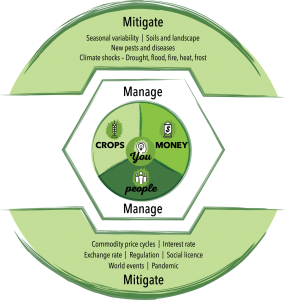
How can we tame the situation?
“Patterns tame complexity” is a phrase that caught my attention this week while flicking through one of the many books on the reading list. Wendy Elford narrowed down complexity as a change that creates a challenge that then evokes us to make a choice. She went further to say if you can spot the patterns, it helps navigate through this cycle of change/challenge/choice. The reality is we go through this cycle of change/challenge/choice continuously without even knowing it.
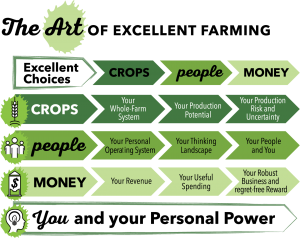
To steady the ship and focus your perspective and priorities, I’ve collated the consistent patterns that analysis of farm financial and technical data from the early 1990s to 2021 consistently reveals.
These patterns are further distilled into the excellent farming framework. The thirty to fifty year farmers no doubt do this intuitively the sub ten year farmers may find this a useful guide to make sense of their elders intuitive decision making or to stimulate discussion on potential improvements.
[fusion_table fusion_table_type=”1″ fusion_table_rows=”” fusion_table_columns=”” hide_on_mobile=”small-visibility,medium-visibility,large-visibility” class=”” id=”” animation_type=”” animation_direction=”left” animation_speed=”0.3″ animation_offset=””]
| Critical Profit Drivers | What can you control? |
|---|---|
CROPS |
|
| Agronomically sound land use | Stick to the course of a rotation that manages weeds, diseases, soil fertility and financial risk.
Use this season to bank nitrogen and water for next season by reducing exposure to cereal on cereal and canola on cereal. Add a green manure cover crop in (eg vetch or fenugreek or field peas). |
| Production Efficiency – kg per ha per mm of rainfall | Create and realise yield potential: Conserving moisture (ruthless summer weed control), discard outclassed varieties, astute nitrogen management (and other nutrients), time of sowing, crop protection. |
| Unique characteristics of farm and business (The Farm Effect) | Know the facts of your business intimately
Avoid the distraction of other people’s business Understand the context of case studies or neighbourly chats |
| Timely and well executed operations with attention to detail. | Forward planning and organisation are as critical as machinery capacity. Procurement organisation is critical this year. Maintain attention to detail. |
PEOPLE (including You) |
|
| Astute, timely and flexible decision-making and action despite uncertainty. | Utilise decision making support tools including advisers, facts and soil testing. Service your thinking machinery and manage your information diet. |
| Spend more time on strategy, planning, management and research. | Be guided by your ultimate goal and what’s most important to you. |
| Motivated and accept responsibility for decisions. | Own your choices. I caution over deferring responsibility to agronomy and marketing advisors. It’s your farm, your debt, your opportunity. They propose a course of action, you decide if it’s best for you. |
| Relationship managers and socially apt. | It’s impossible to farm alone. Disagreement and indecision cause costly delays.
Communication and consensus accelerates decision making and implementation. Keep chipping away at the strategic people issues like strategic planning. |
| Keen formal and informal learners. | Social media has been a game changer but it can be a distraction. Have 1.5 eyes within your business and have half an eye remaining aware of changing circumstances in volatile times.
Be alert, not alarmed and prioritise learning that relates to things within your control. |
MONEY |
|
| Use people, machinery and capital efficiently | Efficiency is more than width and speed of machinery. Effective Efficiency does not always equal easy or simple and it still requires attention to detail. Once you’ve spent the money on machinery and people, make sure it’s used effectively and efficiently. |
| Fixed and variable cost awareness and management | Input cost management does not always equal cost reduction. Allocate input expenditure to where the most likely returns are. Test the effect of rotation tweaks on input costs. |
| Liquidity (cash reserves) | Cash is king, reserve some surplus as a safety net. |
| Robust business that can handle shocks – drought, price crash, frost events | Deploy surplus to increase net worth and ensure a solid business that can mobilise reserves if need be and ride out the tough times. |
[/fusion_table]
References
Elford W (2007) in Ideas: original perspectives on life and business from leading thinkers Vol 2 Thought Leaders Limited Seaforth NSW www.thoughtleaders.com.au
Voght S 2016 http://grainproducerssa.com.au/uploads/media/SESSION_2_-_Grains_-_Simon_Vogt__Rural_Directions.pdf
Kingwel et al 2013 https://nccarf.edu.au/broadacre-farmers-adapting-changing-climate/
Graetz et al 2018 https://www.mla.com.au/contentassets/49579f2874944d76b3fa8b74022f3aef/l.mxf.0001_final_report.pdf
Doudle S, et al 2009 Farmer’s capacity to adapt to climate change—SA case studies. Agricultural Science 21 , 13–19
Bryant M, 2016 https://grdc.com.au/resources-and-publications/grdc-update-papers/tab-content/grdc-update-papers/2016/09/what-is-driving-my-profitability
Beever and McCarthy 2004 Business health indicators for professional farmers Farm 500
Malcolm, B 2010 Pursuing growth without regret in risky crop farming
Audio
[fusion_audio src=”https://www.thinkagri.com.au/wp-content/uploads/2022/04/TARI_E13T1_mixdown.mp3″ loop=”off” autoplay=”off” preload=”none” hide_on_mobile=”small-visibility,medium-visibility,large-visibility” class=”” id=”” background_color=”” hue=”” saturation=”” lightness=”” alpha=”” controls_color_scheme=”” progress_color=”” max_width=”” border_size=”” border_color=”” border_radius_top_left=”” border_radius_top_right=”” border_radius_bottom_right=”” border_radius_bottom_left=”” box_shadow=”no” box_shadow_vertical=”” box_shadow_horizontal=”” box_shadow_blur=”0″ box_shadow_spread=”0″ box_shadow_color=”” animation_type=”” animation_direction=”left” animation_speed=”0.3″ animation_offset=””][/fusion_audio]
[/fusion_toggle][fusion_toggle title=”Topic 1 – Suggested Actions” open=”no” class=”” id=”” fusion_font_family_title_font=”” fusion_font_variant_title_font=”” title_font_size=”” title_color=”” hue=”” saturation=”” lightness=”” alpha=”” fusion_font_family_content_font=”” fusion_font_variant_content_font=”” content_font_size=”” content_color=””]
Take a breath, check in with the patterns in your business.
Which areas are you doing well in?
Which areas could do with some attention?
Keep remembering why you do what you do.
[/fusion_toggle][fusion_toggle title=”Topic 2 – Cropping Patterns” open=”no” class=”” id=”” fusion_font_family_title_font=”” fusion_font_variant_title_font=”” title_font_size=”” title_color=”” hue=”” saturation=”” lightness=”” alpha=”” fusion_font_family_content_font=”” fusion_font_variant_content_font=”” content_font_size=”” content_color=””]
Introduction
Depending on your state of origin, winter crop planting, seeding or sowing has begun or is getting very close. For ease of use in this space, I’ll use the ecumenical term cropping.
This article continues the theme of patterns to simplify the thinking and problem solving, while keeping an eye on the metrics that matter.
Linking the big picture to ground level
Dryland cropping is a game of water capture, convert and collect.
In amongst the complexity described in Topic 1, your farming and family goals rely on:
- Capturing rainfall.
- Converting the plant-available water into produce.
- Collecting that produce and ultimately exchanging it for cash.

This model reminds us to focus on jobs that:
- Create the biggest water bucket possible.
- Get the highest conversion rate possible for every millimetre of water to as many kilograms of produce as possible.
- Ensure the quantities produced in the paddock are collected and their value is realised in cash terms.
In a world of noise and distraction, use these three principles to filter out the nice to do tasks and focus on the must do tasks.
Audio
[fusion_audio src=”https://www.thinkagri.com.au/wp-content/uploads/2022/04/TART_E13T2_mixdown.mp3″ loop=”off” autoplay=”off” preload=”none” hide_on_mobile=”small-visibility,medium-visibility,large-visibility” class=”” id=”” background_color=”” hue=”” saturation=”” lightness=”” alpha=”” controls_color_scheme=”” progress_color=”” max_width=”” border_size=”” border_color=”” border_radius_top_left=”” border_radius_top_right=”” border_radius_bottom_right=”” border_radius_bottom_left=”” box_shadow=”no” box_shadow_vertical=”” box_shadow_horizontal=”” box_shadow_blur=”0″ box_shadow_spread=”0″ box_shadow_color=”” animation_type=”” animation_direction=”left” animation_speed=”0.3″ animation_offset=””][/fusion_audio]
[/fusion_toggle][fusion_toggle title=”Topic 2 – Suggested Actions” open=”no” class=”” id=”” fusion_font_family_title_font=”” fusion_font_variant_title_font=”” title_font_size=”” title_color=”” hue=”” saturation=”” lightness=”” alpha=”” fusion_font_family_content_font=”” fusion_font_variant_content_font=”” content_font_size=”” content_color=””]
Here’s some things to think about.
- How much soil moisture have you got right now in each paddock?
- Have you checked your rainfall in the last six months versus average?
- How good have you been at controlling summer weeds?
- What data do you have? Have you dug any holes?
- Do you have enough diversity and flexibility to
- take advantage of above average rainfall without exposing yourself to too much risk early on?
- to manage the impact of a dry season and/or frost or heat shock?
- To manage input supply shocks
- How does your urea supply match demand?
- Is this the year to drop out cereal stubbles in favour of legumes (pasture, fodder, green manure or pulse crop) or a stubble retained fallow.
- Have you soil tested all your paddocks that may need nitrogen? This is the year to do it.
- What about other inputs?
- (The procurement specialists suggest inputs are acquired 3 months earlier than you normally would.)
- What crop protection strategies might you need?
- Will you be able to access fungicide if you need it?
[/fusion_toggle][fusion_toggle title=”Topic 3 – Creating a four star experience for your emerging crop” open=”no” class=”” id=”” fusion_font_family_title_font=”” fusion_font_variant_title_font=”” title_font_size=”” title_color=”” hue=”” saturation=”” lightness=”” alpha=”” fusion_font_family_content_font=”” fusion_font_variant_content_font=”” content_font_size=”” content_color=””]
Introduction
Have you planted the seed the right way up? Are you aiming for seedbed utopia – a place where perfectly distributed plants are evenly spaced and germinate all at once? The good news is that seedbed utopia is not required to reach water limited yield potential.
This article provides some practical tools for some training and delegation of responsibilities to improve plant establishment landscape.
Think about your seedbed as a resort for plants – are you going for a two star, six star or four star rating? Experience and experiments suggest that four star is enough and six star isn’t actually necessary. However, the consequence of roughing it can be costly.
Think about your seedbed as a resort for plants – are you going for a two star, six star or four star rating? Experience and experiments suggest that four star is enough and six star isn’t actually necessary. However, the consequence of roughing it can be costly.

Avoiding two star experiences for your crop
1. Take the time to train and teach your operators.
In my mentoring work, it’s not uncommon to witness inexperienced machinery operators who are unaware of what’s at stake as they go about their daily duties. And it’s not uncommon for Farm leaders to bemoan the mistakes of their operators.
The experienced person has a lot of knowledge in their head and the inexperienced person doesn’t have that knowledge. And the experienced person can forget that sometimes.
Operators can’t learn via osmosis. They need to be taught-everything! Time invested in training machinery operators delivers the return of avoiding two star crop establishment.
Training is teaching, which is not just telling. Some practical ways to transfer knowledge are below.
1.1 Capture some video footage explaining the important maintenance and monitoring checks and why those things are important
When talking through these points it is helpful to mention what you look for, what the expectations are and why it’s important. When people understand why they need to do something, they’re more likely to do it.
1.2 Put the videos in a space where they can be accessed
For example, google drive, WhatsApp or a private Facebook group for your sowing team.
1.3 Consider the learning styles
Voice recordings are another option if video seems too hard. Not everyone can learn by hearing messages though. Ask the people you’re trying to skill up how they learn, and whether they’re a visual learner, an auditory learner or whether they need to read things to comprehend it.
Auditory learners will respond well to your voice or video recordings where you are talking alongside them.
Visual learners might need a diagram on a whiteboard or a photo of a diagram. Even just a little list of prompts and video footage will benefit more than just you talking.
Teaching doesn’t need realms of paper. If you want to draw up a checklist, think about drawing it on your whiteboard instead and capturing an image of that.
1.4 Some topics of interest for new operators
- The key components of the seeding rig and the daily machine checks.
- What checks need to be done during the day while seeding.
- The importance of getting seeding depth right and helpful questions to ask if they’re not sure around seeding depth.
- Talk through the crop plan and the particulars for certain paddocks or crop type.
- Seeding depth and the consequences of getting it wrong.
- Why timely sowing is critical and the importance of maintenance checks of machinery to avoid breakdowns.
- What’s the dollar impact if you lose two days due to a breakdown that could have been avoided?
1.5 The benefit teaching brings to you
Teaching builds understanding. Sharing your knowledge helps your team understand why they do what they do.
Sharing that knowledge and teaching rather than issuing daily commands builds trust. You’ll have more faith in your team, your team will trust that you’re a willing teacher and, most importantly, that they’re a valued part of the team.
P.S. Keep the recordings short.
2. Spread the load with a crop establishment task force
Enhance the odds of creating a four star experience by dividing responsibilities among the team into three critical periods. Or if you are a solo team, thinking about the three critical periods will avoid unpleasant surprises.
- Minister for Pre-sowing
- Minister for during sowing
- Minister for Post-sowing
Cropping is the ultimate multitasking exercise and as seeding programs get bigger, pre-sowing, sowing and post-sowing activities need to happen all at once.
At Risk times during cropping

The minister for pre-sowing has the responsibility of ensuring weeds don’t get out of control on the paddocks due for sowing later in the program. Moisture has a habit of disappearing in paddocks waiting their turn to be sown as the fresh autumn growth fires up after the opening rains. Soil based fungal diseases like rhizoctonia and pythium build up and N and P are consumed by the weeds. Yield potential can sneak away.
With cereal grain prices potentially between $300 and $400/t and oilseeds and pulses at least double that: every millimetre of plant available water after the first 60 to 100 mm (evaporative loss) represents between $6 to $12/ha. Saving millimetres of water counts.
At sowing
Plant establishment and maximising the length of the growing season are two yield potential foundations. The minister for sowing takes on the responsibility of the attention to detail required for these foundations.
Hallmarks of a smooth cropping program include:
- being well organised
- resisting the temptation to rush and cut corners
- Know how many days of sowing are ahead and include a contingency factor for the inevitable breakdowns.
The Minister for sowing holds a primary role and responsibility that all this happens.
Post Sowing
The minister for post sowing monitors, monitors, monitors.
It’s about making sure the early sown crops are checked for pests and for emergence in general and that any post sowing priorities are built into the program. The sooner a muck up is discovered, the easier it is to fix.
Conclusion
Sharing knowledge and responsibility among the team sets up your four star plant establishment experience.
Audio
[fusion_audio src=”https://www.thinkagri.com.au/wp-content/uploads/2022/04/TARI_E13T3_mix.mp3″ loop=”off” autoplay=”off” preload=”none” hide_on_mobile=”small-visibility,medium-visibility,large-visibility” class=”” id=”” background_color=”” hue=”” saturation=”” lightness=”” alpha=”” controls_color_scheme=”” progress_color=”” max_width=”” border_size=”” border_color=”” border_radius_top_left=”” border_radius_top_right=”” border_radius_bottom_right=”” border_radius_bottom_left=”” box_shadow=”no” box_shadow_vertical=”” box_shadow_horizontal=”” box_shadow_blur=”0″ box_shadow_spread=”0″ box_shadow_color=”” animation_type=”” animation_direction=”left” animation_speed=”0.3″ animation_offset=””][/fusion_audio]
[/fusion_toggle][fusion_toggle title=”Topic 3 – Suggested Actions” open=”no” class=”” id=”” fusion_font_family_title_font=”” fusion_font_variant_title_font=”” title_font_size=”” title_color=”” hue=”” saturation=”” lightness=”” alpha=”” fusion_font_family_content_font=”” fusion_font_variant_content_font=”” content_font_size=”” content_color=””]
Set up some information videos for staff and consider designating three areas of oversight- pre, mid and post cropping.
[/fusion_toggle][/fusion_accordion][fusion_title title_type=”text” rotation_effect=”bounceIn” display_time=”1200″ highlight_effect=”circle” loop_animation=”off” highlight_width=”9″ highlight_top_margin=”0″ before_text=”” rotation_text=”” highlight_text=”” after_text=”” title_link=”off” link_url=”” link_target=”_self” hide_on_mobile=”small-visibility,medium-visibility,large-visibility” sticky_display=”normal,sticky” class=”” id=”” content_align_medium=”” content_align_small=”” content_align=”left” size=”1″ animated_font_size=”” fusion_font_family_title_font=”” fusion_font_variant_title_font=”” font_size=”” line_height=”” letter_spacing=”” text_transform=”” text_color=”” hue=”” saturation=”” lightness=”” alpha=”” animated_text_color=”” text_shadow=”no” text_shadow_vertical=”” text_shadow_horizontal=”” text_shadow_blur=”0″ text_shadow_color=”” margin_top_medium=”” margin_right_medium=”” margin_bottom_medium=”” margin_left_medium=”” margin_top_small=”” margin_right_small=”” margin_bottom_small=”” margin_left_small=”” margin_top=”” margin_right=”” margin_bottom=”” margin_left=”” margin_top_mobile=”” margin_bottom_mobile=”” gradient_font=”no” gradient_start_color=”” gradient_end_color=”” gradient_start_position=”0″ gradient_end_position=”100″ gradient_type=”linear” radial_direction=”center center” linear_angle=”180″ highlight_color=”” style_type=”default” sep_color=”” link_color=”” link_hover_color=”” animation_type=”” animation_direction=”left” animation_speed=”0.3″ animation_offset=””]
You can access all audio for all topics below or via your Podcast feed.
[/fusion_title][fusion_audio src=”https://www.thinkagri.com.au/wp-content/uploads/2022/04/TARI_E13_Full_mixdown.mp3″ loop=”off” autoplay=”off” preload=”none” hide_on_mobile=”small-visibility,medium-visibility,large-visibility” class=”” id=”” background_color=”” hue=”” saturation=”” lightness=”” alpha=”” controls_color_scheme=”” progress_color=”” max_width=”” border_size=”” border_color=”” border_radius_top_left=”” border_radius_top_right=”” border_radius_bottom_right=”” border_radius_bottom_left=”” box_shadow=”no” box_shadow_vertical=”” box_shadow_horizontal=”” box_shadow_blur=”0″ box_shadow_spread=”0″ box_shadow_color=”” animation_type=”” animation_direction=”left” animation_speed=”0.3″ animation_offset=”” /][/fusion_builder_column][/fusion_builder_row][/fusion_builder_container][fusion_global id=”361″]