
[fusion_builder_container hundred_percent=”no” hundred_percent_height=”no” hundred_percent_height_scroll=”no” hundred_percent_height_center_content=”yes” equal_height_columns=”no” menu_anchor=”” hide_on_mobile=”small-visibility,medium-visibility,large-visibility” status=”published” publish_date=”” class=”” id=”” border_color=”” border_style=”solid” margin_top=”” margin_bottom=”” padding_top=”” padding_right=”” padding_bottom=”” padding_left=”” gradient_start_color=”” gradient_end_color=”” gradient_start_position=”0″ gradient_end_position=”100″ gradient_type=”linear” radial_direction=”center center” linear_angle=”180″ background_color=”” background_image=”” background_position=”center center” background_repeat=”no-repeat” fade=”no” background_parallax=”none” enable_mobile=”no” parallax_speed=”0.3″ background_blend_mode=”none” video_mp4=”” video_webm=”” video_ogv=”” video_url=”” video_aspect_ratio=”16:9″ video_loop=”yes” video_mute=”yes” video_preview_image=”” filter_hue=”0″ filter_saturation=”100″ filter_brightness=”100″ filter_contrast=”100″ filter_invert=”0″ filter_sepia=”0″ filter_opacity=”100″ filter_blur=”0″ filter_hue_hover=”0″ filter_saturation_hover=”100″ filter_brightness_hover=”100″ filter_contrast_hover=”100″ filter_invert_hover=”0″ filter_sepia_hover=”0″ filter_opacity_hover=”100″ filter_blur_hover=”0″ admin_label=”Episode” admin_toggled=”no” type=”flex”][fusion_builder_row][fusion_builder_column type=”1_1″ layout=”1_1″ spacing=”” center_content=”no” link=”” target=”_self” min_height=”” hide_on_mobile=”small-visibility,medium-visibility,large-visibility” class=”” id=”” hover_type=”none” border_color=”” border_style=”solid” border_position=”all” border_radius=”” box_shadow=”no” dimension_box_shadow=”” box_shadow_blur=”0″ box_shadow_spread=”0″ box_shadow_color=”” box_shadow_style=”” padding_top=”” padding_right=”” padding_bottom=”” padding_left=”” margin_top=”” margin_bottom=”” background_type=”single” gradient_start_color=”” gradient_end_color=”” gradient_start_position=”0″ gradient_end_position=”100″ gradient_type=”linear” radial_direction=”center center” linear_angle=”180″ background_color=”” background_image=”” background_image_id=”” background_position=”left top” background_repeat=”no-repeat” background_blend_mode=”none” animation_type=”” animation_direction=”left” animation_speed=”0.3″ animation_offset=”” filter_type=”regular” filter_hue=”0″ filter_saturation=”100″ filter_brightness=”100″ filter_contrast=”100″ filter_invert=”0″ filter_sepia=”0″ filter_opacity=”100″ filter_blur=”0″ filter_hue_hover=”0″ filter_saturation_hover=”100″ filter_brightness_hover=”100″ filter_contrast_hover=”100″ filter_invert_hover=”0″ filter_sepia_hover=”0″ filter_opacity_hover=”100″ filter_blur_hover=”0″ last=”true” border_sizes_top=”0″ border_sizes_bottom=”0″ border_sizes_left=”0″ border_sizes_right=”0″ first=”true”][fusion_text columns=”” column_min_width=”” column_spacing=”” rule_style=”default” rule_size=”” rule_color=”” hide_on_mobile=”small-visibility,medium-visibility,large-visibility” class=”” id=”” animation_type=”” animation_direction=”left” animation_speed=”0.3″ animation_offset=””]
Episode One – 23 December 2019
[/fusion_text][fusion_accordion type=”toggles” boxed_mode=”yes” divider_line=”” inactive_icon=”” active_icon=”” icon_boxed_mode=”” hide_on_mobile=”small-visibility,medium-visibility,large-visibility” class=”” id=”” border_size=”1″ border_color=”” hue=”” saturation=”” lightness=”” alpha=”” background_color=”” hover_color=”” divider_color=”” divider_hover_color=”” fusion_font_family_title_font=”” fusion_font_variant_title_font=”” title_font_size=”” title_color=”” icon_size=”” icon_color=”” icon_box_color=”” icon_alignment=”” fusion_font_family_content_font=”” fusion_font_variant_content_font=”” content_font_size=”” content_color=”” toggle_hover_accent_color=”” toggle_active_accent_color=””][fusion_toggle title=”Intro” open=”no” class=”” id=”” fusion_font_family_title_font=”” fusion_font_variant_title_font=”” title_font_size=”” title_color=”” hue=”” saturation=”” lightness=”” alpha=”” fusion_font_family_content_font=”” fusion_font_variant_content_font=”” content_font_size=”” content_color=””]
Think Agri Real Insights Episode 1- Introduction
Welcome to the very first episode of Think Agri REAL Insights. The purpose of this digital publication is to explore what really matters when it comes to generating returns from Agriculture and explore the habits of those that do it well.
For years I’ve been fascinated by Farm businesses that consistently perform above their peers regardless of seasonal conditions. The decision makers in these businesses seem to have some mysterious power that helps them make good decisions at the right time. And what’s even more interesting higher returning farm business make a lot more money than their peers- to the tune of roughly double the average return.
So, what is the magic power? Management! Management that ensures production is technically good, efficient and on time and management that ensures some commercial astuteness and management that utilises the resources at their disposal including team members and service providers.
And what underpins management? Effective Thinking and Decision Making.
So, in this episode we take a look at three components of effective thinking.
- Thought Drafting to sharpen the focus on what you can control and acknowledge what you cant.
- Resilience, which is more than a fad and in fact, acts like an autosteer for effective thinking.
- Scenario analysis to help navigate decision making through uncertainty.
Each topic has some content, a practical activity and some reference material. It’s up to you, how involved you want to get.
The articles are a 7 to 10 minute read or listen and the activity might take 10 minutes to 20 minutes. My suggestion is two read an article every two weeks and do the activity the week after. So, by the time the next episode is out, you’ll have some new thinking tools under your belt.
We round off the episode with an accountability planner to guide your through the experience.
Happy reading, listening, thinking, and doing! Merry Christmas Kate
[fusion_separator style_type=”none” hide_on_mobile=”small-visibility,medium-visibility,large-visibility” class=”” id=”” sep_color=”” top_margin=”20″ bottom_margin=”” border_size=”0″ icon=”” icon_circle=”” icon_circle_color=”” width=”” alignment=”center”][/fusion_separator]
AUDIO
[fusion_separator style_type=”none” hide_on_mobile=”small-visibility,medium-visibility,large-visibility” class=”” id=”” sep_color=”” top_margin=”20″ bottom_margin=”” border_size=”0″ icon=”” icon_circle=”” icon_circle_color=”” width=”” alignment=”center”][/fusion_separator]
[/fusion_toggle][fusion_toggle title=”Topic 1″ open=”no” class=”” id=”” fusion_font_family_title_font=”” fusion_font_variant_title_font=”” title_font_size=”” title_color=”” hue=”” saturation=”” lightness=”” alpha=”” fusion_font_family_content_font=”” fusion_font_variant_content_font=”” content_font_size=”” content_color=””]
Thought drafting: Prioritise time and energy to achieve more and stress less
It’s hot. For grain growers, harvest is either finished way too soon, or you’re smack in the middle of it frustrated by code red fire days. For irrigated dairy farmers, it’s a been a tough run. The stress is relentless for those enduring extended droughts.
Regardless of industry sector and level of involvement, either directly farming or advising or investing, you wouldn’t be human if the thoughts weren’t buzzing at this time of year.
“When will it rain?“
“When will I get time to buy some for Christmas presents?”
“Will I have enough cash to purchase next year’s inputs?”
“Donald Trump impeached-that’s big!”
“When will they (neighbour, client, tenant) fix that fence?”
The all you can eat thought buffet offers a bottomless plate of things to be concerned about. This is particularly true for the curious or those prone to worry.
Thought Drafting is useful trick for choosing which thoughts to focus on when faced with the all-you can-think buffet. Thought Drafting is an adaptation of Stephen R Covey’s Circle of Concern and Influence. (www.franklincovey.com).
In the Seven Habits of Highly Effective People, Covey’s Number 1 habit was to be proactive and specifically choosing where to focus time and energy. Covey introduced the concept of Circle of Concern and Influence where you create a list of what’s concerning you, then identify which thoughts you can influence and focus your attention on those.
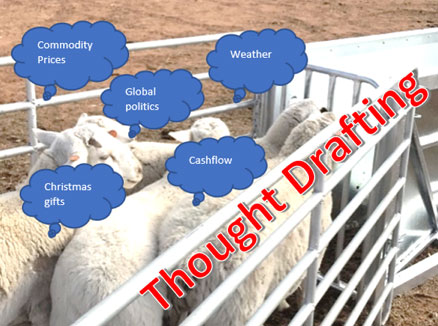
I call this process Thought Drafting because It’s a bit like sorting sheep by running them through a drafting race. By drafting off the concerns we cannot influence, we can use the time and energy freed up to get important stuff done.
Focussing on what really matters improves productivity and reduces stress so you get more things done on time. For example, a 10% improvement in your own productivity is like employing someone with the same skill set for 6 weeks of the year-for farmers, that’s an extra staff member over cropping or harvest.
Now let’s draft the thoughts we talked about earlier:
- Donald Trump comes through the race and gets sent straight to the Concern but can’t influence paddock. The gate is open at the other end, so those thoughts can hopefully wander off.
- Your spouse’s Christmas gift gets drafted into the Influence pen and then into the under your direct Control pen. This is a small pen to make containment and handling easier. Once in there, action can be taken.
- Cashflow goes into the Influence pen and some proactive choices will result in good planning, advice sought in a timely manner if required and cashflow management strategies implemented.
It turns out that people involved in farm businesses that generate higher than average returns are pretty good at Though Drafting. In a national study, across all 14 major grain growing regions, higher performing grain businesses returned around twice that of the average in each region. Qualitative surveys found the decision makers in the better performing businesses were good at prioritising issues and making timely decisions. This study, ’The integration of technical data and profit drivers for more informed decisions’ was funded by the Grains Research and Development Corporation and managed by Rural Directions Pty Ltd.
Clients have found Thought Drafting to be a simple way to improve their effectiveness and reduce stress. One Client described the exercise as enjoyable, challenging and profitable.
Could Thought Drafting improve your quality of life and business performance?
[fusion_separator style_type=”none” hide_on_mobile=”small-visibility,medium-visibility,large-visibility” class=”” id=”” sep_color=”” top_margin=”20″ bottom_margin=”” border_size=”0″ icon=”” icon_circle=”” icon_circle_color=”” width=”” alignment=”center”][/fusion_separator]
AUDIO
[fusion_separator style_type=”none” hide_on_mobile=”small-visibility,medium-visibility,large-visibility” class=”” id=”” sep_color=”” top_margin=”20″ bottom_margin=”” border_size=”0″ icon=”” icon_circle=”” icon_circle_color=”” width=”” alignment=”center”][/fusion_separator]
References
https://www.franklincovey.com/the-7-habits/habit-1.html
Let’s Do This
- Open a note in your phone or tablet or grab a piece of paper or notebook.
- List the things on your mind that seem to be hanging around- they are the concerns-
- Now draft off the things you are concerned about but can’t influence by putting a line through them.
- What’s left are in the influence pen. Circle items in the list that you can directly influence through your own actions. That’s your control pen and its up to you do something about what’s in that pen
- The remainder are what you can influence. These items need your actions and the actions of others so can take longer to sort out.
- Now write your “To Do” list and just as importantly your “To don’t” list.
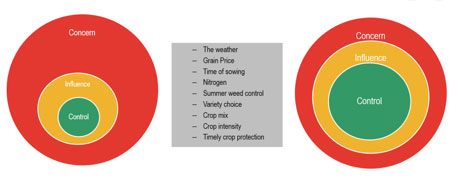
A modified model of Coveys Circle of Influence and a list of issues commonly talked about by grain growers. Which do you have the least influence over? Which do you spend most of your time thinking about? What changes can you make?
Keeping yourself accountable
Now:
What might you do differently now that you know about Thought Drafting?
In six weeks:
Did you achieve the change? (It’s ok if this didn’t happen-don’t beat yourself up).
What $ value did this action deliver?
What surprised you about this action?
What barriers did you face? Whats next?
[fusion_button link=”https://www.thinkagri.com.au/wp-content/uploads/2019/12/Episode-1-Exercise-1-Thought-drafting-Prioritise-time-and-energy-to-achieve-more-and-stress-less.pdf” text_transform=”” title=”” target=”_blank” link_attributes=”” alignment=”” modal=”” hide_on_mobile=”small-visibility,medium-visibility,large-visibility” class=”” id=”” color=”default” button_gradient_top_color=”” button_gradient_bottom_color=”” button_gradient_top_color_hover=”” button_gradient_bottom_color_hover=”” accent_color=”” accent_hover_color=”” type=”” bevel_color=”” border_width=”” border_radius=”” border_color=”” border_hover_color=”” size=”” stretch=”default” icon=”” icon_position=”left” icon_divider=”no” animation_type=”” animation_direction=”left” animation_speed=”0.3″ animation_offset=””]Download Exercise 1[/fusion_button]
[/fusion_toggle][fusion_toggle title=”Topic 2″ open=”no” class=”” id=”” fusion_font_family_title_font=”” fusion_font_variant_title_font=”” title_font_size=”” title_color=”” hue=”” saturation=”” lightness=”” alpha=”” fusion_font_family_content_font=”” fusion_font_variant_content_font=”” content_font_size=”” content_color=””]
 More than a fad! Resilience is auto steer for the working brain
We hear the word resilient a lot, resilient communities, build resilience, be more resilient etc, etc. If you are like me and suffer intolerance to overused words and fads, you could be suffering from resilience fatigue.
Here’s, the thing though, ignore resilience at your peril. When framed in the right context, building resilience is indeed a very powerful strategy for not only surviving or coping but thriving at work and in business.
We live in a complex fast paced world, where demands at home and at work (whether on farm or elsewhere), just keep on growing exponentially. Being able to adapt to changing circumstances and maintain the effort, is a key trait of decisions makers in highly effective farm business and essentially boils down to resilience.

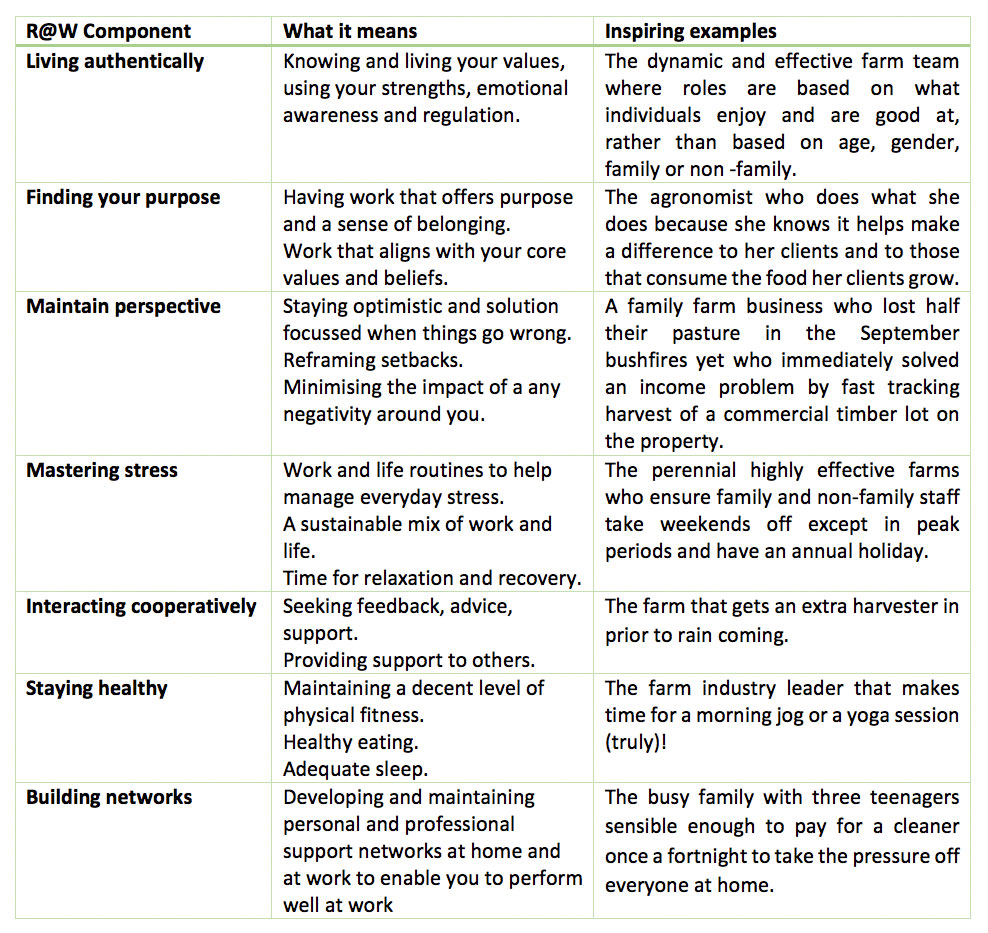
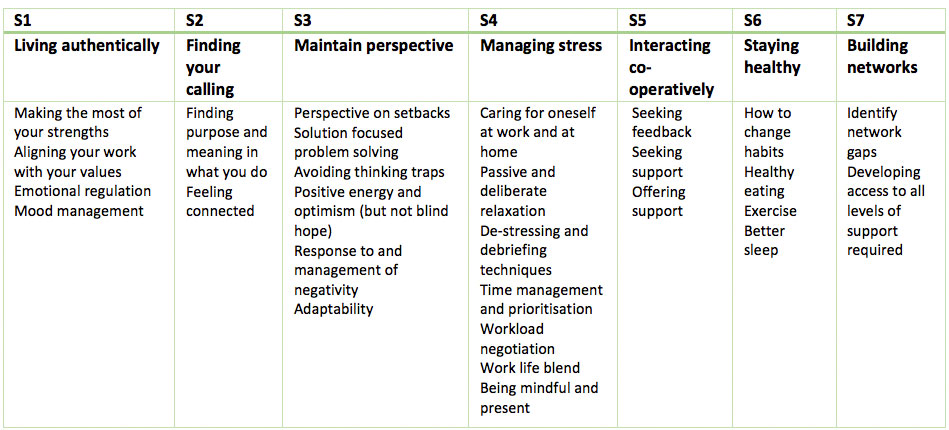
Table 1 Resilience at Work (McEwan 2016).
Resilience is like an autosteer for the brain that helps us navigate through complexity. It helps us stay well and be productive at work over the long term. It starts with mastering stress, allows us to make better decisions, adapt to change and be more proactive, which ties back to Stephen Covey’s first habit of highly effective people mentioned in Thought Drafting.
Building resilience improves adaptability and flexibility and work performance. Kathryn McEwen, an Adelaide based organisational psychologist and University of SA biometrician Dr Peter Windwood have untangled what helps people be productive at work and stay well in a sustainable way. Their research led to the Resilience at Work Scale (R@W). Their initial study based on survey work and sophisticated statistical analysis, uncovered seven key components of resilience at work (Figure 1, Table 1).
Figure 1 The resilience at work scale (McEwan 2016)
McEwan (2016) also developed the R@W Toolkit: practical tools that helps you implement meaningful change to build resilience and be more productive at work and stay well. The key strategies are summarised in Table 2. Other studies have shown training to understand these tools and put strategies in place has increased resilience (Rogerson 2016). This is important, it shows we are not born resilient or other wise and we can learn to be more resilient. Resilience is a state at a time, not an inherent trait. It will vary with life’s pressures. Sailing can be smoother when resilience strategies are understood and implemented.
Table 2. Practical strategies for working towards resilience at work (McEwan 2016).
In Summary
- Resilience is one of the secret ingredients of highly effective farm business decision makers
- Resilience tactics can be taught and make a difference to decision making if implemented
- Building resilience improves personal wellbeing and workplace and business outcomes.
[fusion_separator style_type=”none” hide_on_mobile=”small-visibility,medium-visibility,large-visibility” class=”” id=”” sep_color=”” top_margin=”20″ bottom_margin=”” border_size=”0″ icon=”” icon_circle=”” icon_circle_color=”” width=”” alignment=”center”][/fusion_separator]
AUDIO
[fusion_separator style_type=”none” hide_on_mobile=”small-visibility,medium-visibility,large-visibility” class=”” id=”” sep_color=”” top_margin=”20″ bottom_margin=”” border_size=”0″ icon=”” icon_circle=”” icon_circle_color=”” width=”” alignment=”center”][/fusion_separator]
References
McEwan K 2016. Building your resilience. How to thrive in a challenging job. Mindset Publications www.workingwithresilience.com.au
Windwood PC, Colon R, McEwan K (2013) A practical measure of workplace resilience: developing the resilience at work scale. J Occupational Environmental Medicine 2013 55 1205-12
Rogerson S, Meir, R, Cowley-McHattan Z, McEwan K and Pastoors R (2016) A randomize control pilot trial investigating the impact of a Workplace resilience program during a time of significant organizational change J Occupational Environmental Medicine 2013 58 329-34 205-12
Let’s Do This
Resilience quick self-assessment
- Score yourself out of 5 for each component :1 is not so good, 3 is good enough, 5 is absolutely smashing it.
- Look at where you’ve scored highly and where you have scored lower.
- Use Table 2 to pick some strategies you might try.
- How can you use the areas you do well in to bolster the areas for improvement?
The biggest impact will be from small shifts. Big promises to yourself are harder to keep!
Good Luck
[fusion_button link=”https://www.thinkagri.com.au/wp-content/uploads/2019/12/Episode-1-Exercise-2-More-than-a-fad-Resilience-is-auto-steer-for-the-working-brain-.pdf” text_transform=”” title=”” target=”_self” link_attributes=”” alignment=”” modal=”” hide_on_mobile=”small-visibility,medium-visibility,large-visibility” class=”” id=”” color=”default” button_gradient_top_color=”” button_gradient_bottom_color=”” button_gradient_top_color_hover=”” button_gradient_bottom_color_hover=”” accent_color=”” accent_hover_color=”” type=”” bevel_color=”” border_width=”” border_radius=”” border_color=”” border_hover_color=”” size=”” stretch=”default” icon=”” icon_position=”left” icon_divider=”no” animation_type=”” animation_direction=”left” animation_speed=”0.3″ animation_offset=””]Download Exercise 2[/fusion_button]
[/fusion_toggle][fusion_toggle title=”Topic 3″ open=”no” class=”” id=”” fusion_font_family_title_font=”” fusion_font_variant_title_font=”” title_font_size=”” title_color=”” hue=”” saturation=”” lightness=”” alpha=”” fusion_font_family_content_font=”” fusion_font_variant_content_font=”” content_font_size=”” content_color=””]
Scenario analysis, a critical tool for managing uncertainty
One of the things I’ve noticed in the last two decades is how the changes in rainfall from year to year seem more pronounced and less predictable. It literally can be drought, fires and flood in the same twelve months). And it’s not just the weather that’s volatile- global political instability has had its mark on commodity prices too and then there’s that constant threat of losing glyphosate. If you’re in the irrigation game, life’s even more uncertain, with a heady mix of rainfall driven river inflows, several States and the Federal bureaucracy. What could possibly go wrong?
So, with this level of volatility, how can we possibly get our planning right. The trick is to shift the thinking to possibilities rather than trying to find the one correct answer.
In the words of a very famous Thinker Edward DeBono –
“In the future, instead of striving to be right at a high cost, it will be more appropriate to be flexible and plural at a lower cost. If you cannot accurately predict the future, then you must flexibly be prepared to deal with various possible futures. “
Scenario analysis is a useful tool to prepare your business to capture opportunity when it presents and at the same time manage downside risk.
For downside scenarios it’s a bit like having a bushfire plan, you hope you never need to use it, but its there if required and you have the appropriate measures in place.
Sorting through possible futures and making plans to deal with those outcomes comes more naturally to some than others. With a bit of practice though, it’s a simple process to implement by following a few steps. Below are some tips and tricks to work through uncertain outcomes and create some plans.
Tip 1. Be less fearful of adverse events – they are going to happen anyway!
What stops us from scenario planning is fear. So, the first step to Scenario planning is to move from fear toward acceptance that there are several possible futures, some which are brilliant and others which are less pleasant.
Tip 2. Use what you know to plan for the unknown
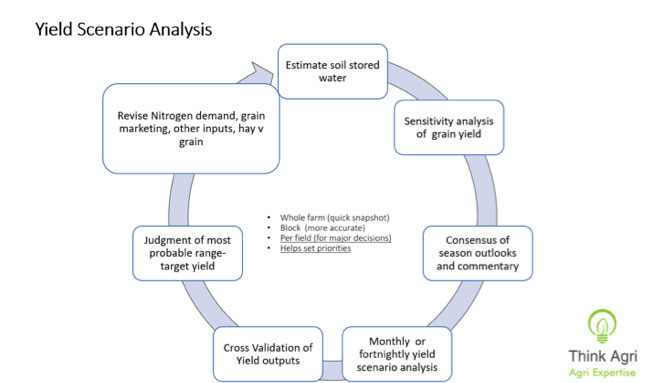
Let’s take the example of a process for generating grain yield scenarios based on the information on hand at the time.
The key steps are
- Assess the current situation
- What are three situations that could occur? Bad Ok Good
- What do we know about the odds of it being Bad Ok or Good?
- What outcomes could arise from those situations?
- What do we need to plan for if it’s Bad, OK, Good?
- At regular intervals, repeat the process.
Tip 3. Use tools and resources to validate gutfeel
Highly effective farmers are naturally good at this process and tend do it intuitively. The good news is, it can become a habit by utilising those around you to help with the process and using support tools like Yield Profit Lite, Yield Profit or ipaddock yield and The Break, CliMate and BOM forecast materials. Or just the back of the envelope!
Sometimes intuition can lead us astray, particularly if we are “tired and emotional” and our flight and fight response steers us in the wrong direction. Travis Bradberry, author of Emotional Intelligence 2.0 reported on a brain imaging study in California where a coin tossing prediction exercise, showed that people armed with prior information, used the rational side of their brain and those without supporting information, used the limbic or emotional side of the brain. The point being that good information can help engage the rational side of the brain.
The level of validation required depends on the size of the prize. Small decisions may not need a formal process, but when there are lots of dollars at stake, it is wise to test the gutfeel.
Applications
This process helps put things in place like teeing up hay contractors, ordering urea, talking to the bank about finance.
I used it last week to estimate likely irrigation water during the coming months for an organisation I volunteer at. We could have deferred the decision until after Christmas and New Year and lost a bit of sleep. Instead, following this process, we assessed the current situation, looked at weather forecasts, likely water use and water pricing. A course of action was chosen on the balance of probabilities. The final outcome won’t be known for some months, but I feel better knowing having taken a position to protect against the worst-case scenario.
[fusion_separator style_type=”none” hide_on_mobile=”small-visibility,medium-visibility,large-visibility” class=”” id=”” sep_color=”” top_margin=”20″ bottom_margin=”” border_size=”0″ icon=”” icon_circle=”” icon_circle_color=”” width=”” alignment=”center”][/fusion_separator]
AUDIO
[fusion_separator style_type=”none” hide_on_mobile=”small-visibility,medium-visibility,large-visibility” class=”” id=”” sep_color=”” top_margin=”20″ bottom_margin=”” border_size=”0″ icon=”” icon_circle=”” icon_circle_color=”” width=”” alignment=”center”][/fusion_separator]
Reference
Do This
Pick a scenario you are worried about and try this process.
[/fusion_toggle][fusion_toggle title=”Accountability” open=”no” class=”” id=””]
Activity and Accountability Planner

[fusion_button link=”https://www.thinkagri.com.au/wp-content/uploads/2019/12/Episode-1-Your-Accountability-Plan.pdf” text_transform=”” title=”” target=”_blank” link_attributes=”” alignment=”” modal=”” hide_on_mobile=”small-visibility,medium-visibility,large-visibility” class=”” id=”” color=”default” button_gradient_top_color=”” button_gradient_bottom_color=”” button_gradient_top_color_hover=”” button_gradient_bottom_color_hover=”” accent_color=”” accent_hover_color=”” type=”” bevel_color=”” border_width=”” border_radius=”” border_color=”” border_hover_color=”” size=”” stretch=”default” icon=”” icon_position=”left” icon_divider=”no” animation_type=”” animation_direction=”left” animation_speed=”0.3″ animation_offset=””]Download Activity and Accountability Planner[/fusion_button]
[/fusion_toggle][/fusion_accordion][fusion_text columns=”” column_min_width=”” column_spacing=”” rule_style=”default” rule_size=”” rule_color=”” hue=”” saturation=”” lightness=”” alpha=”” content_alignment_medium=”” content_alignment_small=”” content_alignment=”” hide_on_mobile=”small-visibility,medium-visibility,large-visibility” sticky_display=”normal,sticky” class=”” id=”” margin_top=”” margin_right=”” margin_bottom=”” margin_left=”” fusion_font_family_text_font=”” fusion_font_variant_text_font=”” font_size=”” line_height=”” letter_spacing=”” text_transform=”none” text_color=”” animation_type=”” animation_direction=”left” animation_speed=”0.3″ animation_offset=””]
You can access all audio for all topics below or via your Podcast feed.
[/fusion_text][fusion_audio src=”https://www.thinkagri.com.au/wp-content/uploads/2022/01/TARI_E1_Final.mp3″ loop=”off” autoplay=”off” preload=”none” hide_on_mobile=”small-visibility,medium-visibility,large-visibility” class=”” id=”” background_color=”” hue=”” saturation=”” lightness=”” alpha=”” controls_color_scheme=”” progress_color=”” max_width=”” border_size=”” border_color=”” border_radius_top_left=”” border_radius_top_right=”” border_radius_bottom_right=”” border_radius_bottom_left=”” box_shadow=”no” box_shadow_vertical=”” box_shadow_horizontal=”” box_shadow_blur=”0″ box_shadow_spread=”0″ box_shadow_color=”” animation_type=”” animation_direction=”left” animation_speed=”0.3″ animation_offset=”” /][/fusion_builder_column][/fusion_builder_row][/fusion_builder_container][fusion_global id=”361″]