
[fusion_builder_container hundred_percent=”no” hundred_percent_height=”no” hundred_percent_height_scroll=”no” hundred_percent_height_center_content=”yes” equal_height_columns=”no” menu_anchor=”” hide_on_mobile=”small-visibility,medium-visibility,large-visibility” status=”published” publish_date=”” class=”” id=”” border_color=”” border_style=”solid” margin_top=”” margin_bottom=”” padding_top=”” padding_right=”” padding_bottom=”” padding_left=”” gradient_start_color=”” gradient_end_color=”” gradient_start_position=”0″ gradient_end_position=”100″ gradient_type=”linear” radial_direction=”center center” linear_angle=”180″ background_color=”” background_image=”” background_position=”center center” background_repeat=”no-repeat” fade=”no” background_parallax=”none” enable_mobile=”no” parallax_speed=”0.3″ background_blend_mode=”none” video_mp4=”” video_webm=”” video_ogv=”” video_url=”” video_aspect_ratio=”16:9″ video_loop=”yes” video_mute=”yes” video_preview_image=”” filter_hue=”0″ filter_saturation=”100″ filter_brightness=”100″ filter_contrast=”100″ filter_invert=”0″ filter_sepia=”0″ filter_opacity=”100″ filter_blur=”0″ filter_hue_hover=”0″ filter_saturation_hover=”100″ filter_brightness_hover=”100″ filter_contrast_hover=”100″ filter_invert_hover=”0″ filter_sepia_hover=”0″ filter_opacity_hover=”100″ filter_blur_hover=”0″ admin_label=”Episode” admin_toggled=”no” type=”flex”][fusion_builder_row][fusion_builder_column type=”1_1″ layout=”1_1″ spacing=”” center_content=”no” link=”” target=”_self” min_height=”” hide_on_mobile=”small-visibility,medium-visibility,large-visibility” class=”” id=”” hover_type=”none” border_color=”” border_style=”solid” border_position=”all” border_radius=”” box_shadow=”no” dimension_box_shadow=”” box_shadow_blur=”0″ box_shadow_spread=”0″ box_shadow_color=”” box_shadow_style=”” padding_top=”” padding_right=”” padding_bottom=”” padding_left=”” margin_top=”” margin_bottom=”” background_type=”single” gradient_start_color=”” gradient_end_color=”” gradient_start_position=”0″ gradient_end_position=”100″ gradient_type=”linear” radial_direction=”center center” linear_angle=”180″ background_color=”” background_image=”” background_image_id=”” background_position=”left top” background_repeat=”no-repeat” background_blend_mode=”none” animation_type=”” animation_direction=”left” animation_speed=”0.3″ animation_offset=”” filter_type=”regular” filter_hue=”0″ filter_saturation=”100″ filter_brightness=”100″ filter_contrast=”100″ filter_invert=”0″ filter_sepia=”0″ filter_opacity=”100″ filter_blur=”0″ filter_hue_hover=”0″ filter_saturation_hover=”100″ filter_brightness_hover=”100″ filter_contrast_hover=”100″ filter_invert_hover=”0″ filter_sepia_hover=”0″ filter_opacity_hover=”100″ filter_blur_hover=”0″ last=”true” border_sizes_top=”0″ border_sizes_bottom=”0″ border_sizes_left=”0″ border_sizes_right=”0″ first=”true”][fusion_text columns=”” column_min_width=”” column_spacing=”” rule_style=”default” rule_size=”” rule_color=”” hide_on_mobile=”small-visibility,medium-visibility,large-visibility” class=”” id=”” animation_type=”” animation_direction=”left” animation_speed=”0.3″ animation_offset=””]
Episode One – 5 March 2020
[/fusion_text][fusion_accordion type=”toggles” boxed_mode=”yes” divider_line=”” inactive_icon=”” active_icon=”” icon_boxed_mode=”” hide_on_mobile=”small-visibility,medium-visibility,large-visibility” class=”” id=”” border_size=”1″ border_color=”” hue=”” saturation=”” lightness=”” alpha=”” background_color=”” hover_color=”” divider_color=”” divider_hover_color=”” fusion_font_family_title_font=”” fusion_font_variant_title_font=”” title_font_size=”” title_color=”” icon_size=”” icon_color=”” icon_box_color=”” icon_alignment=”” fusion_font_family_content_font=”” fusion_font_variant_content_font=”” content_font_size=”” content_color=”” toggle_hover_accent_color=”” toggle_active_accent_color=””][fusion_toggle title=”Intro” open=”no” class=”” id=”” fusion_font_family_title_font=”” fusion_font_variant_title_font=”” title_font_size=”” title_color=”” hue=”” saturation=”” lightness=”” alpha=”” fusion_font_family_content_font=”” fusion_font_variant_content_font=”” content_font_size=”” content_color=””]
Think Agri Real Insights 2020 Episode 1- Introduction
Welcome to the second episode of Think Agri REAL Insights, the first episode for the 2020 series. The purpose of this digital publication is to take a practical look at the key fundamentals of sustainable and profitable agriculture, in other words EXCELLENT FARMING. There’s plenty of distraction and recipes for saviour on offer these days, particularly on social media. This platform gets back to basics and uses an evidence-based approach to focus on practical ways of thinking and doing, to improve your bottom line.
Some farm businesses consistently perform above their peers, regardless of seasonal conditions. The decision makers in these businesses seem to have some mysterious power that helps them make good decisions, at the right time. And what’s even more interesting, higher returning farm businesses make a lot more money than their peers – to the tune of roughly double the average return.
So, what is the magic power? Management! Management that ensures production is technically good, efficient and on time and management that ensures commercial astuteness and effectively utilises the resources at their disposal including team members and service providers.
And what underpins management? Effective Thinking and Decision Making.
In this episode, we take a look at decisions made early in the dryland cropping year that can have far reaching effects in six to 8 months, explore one of the key personal ingredients to successful thinking and decision making and tackle one of the toughest issues in family farming-succession.
- Decisions now that will make a dryland cropping life easier in six months’ time – soil testing.
- Emotional intelligence EI- the management X factor that’s as important as business acumen and farming skill.
- Succession Planning– never too soon to start, and never finished.
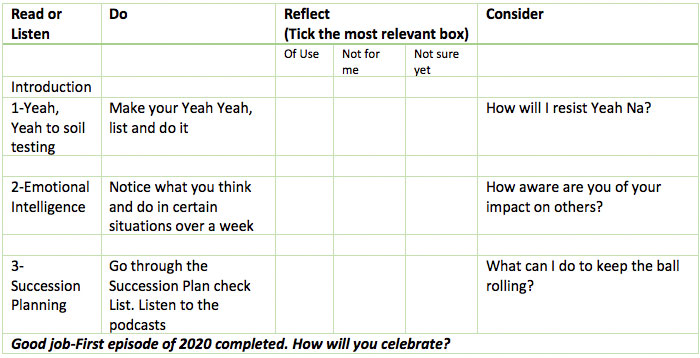
Each topic has some content, a practical activity and some reference material. It’s up to you, how involved you want to get.
The articles are a 7 to 10 minute read or listen and the activity might take 10 minutes to 20 minutes. My suggestion is to read an article every two weeks and do the activity the week after. So, by the time the next episode is out, you’ll have some new thinking tools under your belt.
We round off the episode with an accountability planner to guide your through the experience.
Happy reading, listening, thinking, and doing! Good luck in your planning and preparation Kate
AUDIO
[/fusion_toggle][fusion_toggle title=”Topic 1″ open=”no” class=”” id=”” fusion_font_family_title_font=”” fusion_font_variant_title_font=”” title_font_size=”” title_color=”” hue=”” saturation=”” lightness=”” alpha=”” fusion_font_family_content_font=”” fusion_font_variant_content_font=”” content_font_size=”” content_color=””]
Pre-season soil testing on soil nitrogen and plant available water and other 1%ers – Less Yeah, Na and more Yeah, Yeah.
It’s a sunny winters day. Farmer Joe and agronomist Agrow are inspecting paddocks. The season’s looking good, there’s money to be made and the forecast is promising. The question of Nitrogen is the topic of discussion.
They lean against the back of the ute. Joe makes a cuppa from his thermos and pulls out some banana cake while Agrow starts doing some back of the envelope sums. What are the odds of this forecast coming to fruition? What’s our likely yield range?
What’s the likely N demand, what’s the likely soil supply, which paddocks are the most important, how much mineralisation? How much N needs to be applied?
After a while, Agrow asks Joe – “Have you got those 0-60 cm soil N and PAW results handy”? Joe responds, “yeah we talked about it,” pauses for a moment and continues “nah mate, didn’t have time”.
Agrow smiles and nods then with banana cake and a cup of tea in tow ponders how to help Joe capture most of the $4M potential revenue on offer when the best decision support tool at her disposal is a piece of banana cake”.
Sound familiar? Most cropping farmers and agronomists have some variation of the banana cake conversation each year. Those with deep soil N and PAW results can make far more informed decisions.
Some solid science conducted across Australia suggests Joe and his peers are missing out, by not prioritising soil N and Plant available water testing.
A Birchip Cropping Group CSIRO study led by Dr Harm Van Rees and Dr Roger Lawes, surveyed 250 paddocks in Australia’s wheat growing regions between 2015 to 2018. They found that 40% of the wheat crops grown and yielded were at least 0.46 t/ha below potential because of nitrogen deficiency. In a similar study, Dr Roger Armstrong and colleagues monitored 136 paddocks from 2013 to 2016 and determined the big four grain yield drivers where N fertiliser applied, previous crop type, sowing date and variety. (Moisture conserved prior to sowing was not measured in this study). Nitrogen fertiliser rate was by far the most dominant factor with a strong influence on Water Use efficiency.
There are 14 to 50 days to prepare for winter crop and pasture sowing depending on the location. The jobs list is expanding rapidly and through necessity, a few jobs will drop off. Are we dropping off the right jobs and keeping the ones that will make our decisions easier in a few months’ time and help us manage risk and increase returns?
We are wired to do what’s obvious in the here and now and this risks not doing jobs that could have a major impact on the business further down the track, jobs like deep N soil and plant available water testing.
One trick to avoid this trap is to think a few months forward and ask:
What will I wish I’d said yeah to instead of nah?
The list below is a subsample of the many moments of truths I’ve witnessed in the decade I spent traversing paddocks, sharing banana cake and black tea. I hope this helps.

What’s on your March and April yeah list that you and your agronomist will be thankful for in July and August.
| Do more of (Yeah) | For this benefit |
| Start earlier on machinery set up for sowing | Crops sown as close to optimum time as practical Optimises yield potential |
| Spray summer or autumn weeds when there’s “not much there” | Reduced rates of knockdowns at sowing due to monster weeds, less chance of blockages at sowing, keeps in-crop control costs down, conserves moisture |
| Deep N soil testing more paddocks | Less guessing, easier and more accurate N decisions |
| Deep soil testing for starting moisture | Less guessing, easier yield potential estimation |
| Install soil moisture probe | Less guessing, easier yield potential estimation |
| Made room for fertiliser and get in home sooner rather than later | Less chance of being caught short when its needed |
| Herbicide resistance testing for one or more of annual ryegrass, wild oats, brome grass, wild radish, sow thistle | Less chance of nasty surprises and ineffective results from spraying |
| Surface soil sampling for P, K, pH, cations etc | Less chance of over or under use of starter fertiliser (NPKS) |
AUDIO
[/fusion_toggle][fusion_toggle title=”Topic 2″ open=”no” class=”” id=”” fusion_font_family_title_font=”” fusion_font_variant_title_font=”” title_font_size=”” title_color=”” hue=”” saturation=”” lightness=”” alpha=”” fusion_font_family_content_font=”” fusion_font_variant_content_font=”” content_font_size=”” content_color=””]
People skills and emotional Intelligence – Good enough for Warren Buffet – good enough for me!
Regardless of agricultural sector, the top 20 or 25% of farm businesses can return around double that of the average and the difference between the best and the rest, is that the best are able to nail productivity and profit focus and people skills. Production drivers get a lot of attention, as do financial matters but in agriculture, the topic of people skills, particularly personal skills and the impact on business returns, has had less attention.
In an effort to assist farmers move from good to excellent, I am passionate about trying to understand what sits behind the people skills and superior decision-making ability of highly successful, farm businesses. It’s more than simply intuition or intellectual intelligence, so what it is? Evidence mainly from other industries would suggest that Emotional Intelligence a major contributor.
Emotional intelligence is the ability to monitor one’s own and others’ emotions, to understand them and to use that information to guide one’s thinking and actions (Salovey & Mayer, 1990).

Practical examples include being able to problem solve and put plans into action, being able to calm down or calm down others, being able to stay hopeful after a setback and motivate others, to stay positive.
Some interesting findings on EI and management effectiveness and business performance include:
- A strong correlation between management effectiveness and emotional intelligence with self-awareness is the most critical factor. One study concluded that a 1% change in EI score could amount to a 25% increase in management effectiveness.
- EI can explain why one person’s intuition can lead to a better outcome than another’s. (Why some are always luckier than others). EI was highly correlated with Intuition on the MBTI scale.
- Family firms with individuals exhibiting high EI were able to handle the complex dynamic of family and business more effectively.
- A study of Welsh dairy farmers measured EI as well as, the traditional finance and production measures. The highly profitable farmers making 2.7 times the group average profit scored highly in the EI skills including teamwork and collaboration, conscientiousness, developing others, and leadership. They used emotion and intuition to communicate, were relaxed and interested in employee’s wellbeing, planned well ahead, had succession in hand and had interests away from the farm.
Having strong EI is a bit like a footballer who can read the play, be in the right spot at the right time, know when to stay out of the play and when to get involved, to have the highest impact. Is it time to be attacking in the game or to be defensive? It starts with being aware of your own emotions as they are happening and to use that awareness to be adapt your behavior. You are not on the field alone, so you need to notice what others in your team and the opposition are doing and then manage those interactions, to achieve the best possible outcome. Depending on the game, this could be to minimize a loss or make sure you get the win.
The good news is, EI skills can be taught and with effort can improve.
While productivity and profit focus are equally important, management of self and others impacts on profit by helping us:
- focus on what we can control while acknowledging what we can’t control and mitigating risk of those uncontrollable, such as the weather and global markets.
- manage uncertainty and make constructive decisions under pressure.
- understand and get the best out of our team and family members.
- be organised and implement important tasks in a timely manner.
- seek advice from others, distil that advice and take ownership of the final decision.
- be less judging of ourselves and others and know when to give ourselves and others support.
If this sounds a bit to gooey, just remember Warren Buffet said, “the best investment you’ll make, is in the development of yourself”. Good enough for Warren, good enough for me. Could Emotional Intelligence improve your quality of life and business performance?
AUDIO
References
https://www.franklincovey.com/the-7-habits/habit-1.html
Malik ME Qaiser R Munir Y (2011)The Impact of Leader’s Emotional Quotient on organizational effectiveness: Evidence from Industrial and banking sectors of Pakistan. International Journal of Business and Social Science Vol. 2 No. 18.
Higgs, M. (2001), “Is there a relationship between the Myers‐Briggs type indicator and emotional intelligence?”, Journal of Managerial Psychology, Vol. 16 No. 7, pp. 509-533. https://doi.org/10.1108/EUM0000000006165
Gómez Betancourt, G., C. Botero, I., Bernardo Betancourt Ramirez, J. and Piedad López Vergara, M. (2014), “Emotional intelligence in family firms: Its impact on interpersonal dynamics in the family, business and ownership systems”, Journal of Family Business Management, Vol. 4 No. 1, pp. 4-23.
Can ‘EQ’ improve farm performance? https://dairy.ahdb.org.uk/news/dairyleader-articles/december-2015/can-eq-improve-farm-performance/#.Xl7ZPagzZPY
Let’s Do This
The first step to building better emotional Intelligence is self awareness. Try these two activities:
- Notice when you work well, when you are most content, when you are cranky and what your triggers are, what do you need to be your best version of self, at work and around family and friends. Put a few notes in the phone.
- Send a text to 3 or 4 people you live with, work with or socialise with, for some honest feedback. When am I at my best, when I am I most challenging to be around, what’s three words you would use to describe me.
Keeping yourself accountable
Now:
What might you do differently now that you know more about Emotional Intelligence?
In six weeks:
Did you achieve the change? (It’s ok if this didn’t happen, don’t beat yourself up).
What $ value did this action deliver?
What surprised you about this action?
What barriers did you face? Whats next?
[/fusion_toggle][fusion_toggle title=”Topic 3″ open=”no” class=”” id=”” fusion_font_family_title_font=”” fusion_font_variant_title_font=”” title_font_size=”” title_color=”” hue=”” saturation=”” lightness=”” alpha=”” fusion_font_family_content_font=”” fusion_font_variant_content_font=”” content_font_size=”” content_color=””]
The never-ending story of farm succession
I was privileged to witness a colleague in the Thought Leaders Business School share that he was facing prostate surgery after a recent cancer diagnosis. There were over 100 people in the room. It was an emotional moment but in true style, this generous motivator and elite performance expert, turned the focus on us and sent a clear message for the men in the room, to head to the GP for a prostate check in and for the women to influence the men important to them.
Facing succession planning is a bit like that trip to the GP, necessary personal management, not always pleasant but capable of changing your life for the better and leaving a lasting impact on your family and business.
Succession planning is great an opportunity to ensure a family farm business thrives into the future. It keeps families functioning, creates clear direction for the farm business and it can be quite exciting and rewarding.
The unpleasantness lies in not doing it and the worry of the unknown causes concern for all involved. A poorly executed succession is a far greater threat to the growth of your farm and business and family, than the prospect of drought or poor grain prices. Poorly executed succession ruins family Christmas and family relationships, forever.
It’s a tricky subject, because it’s part of a change system and it involves family systems and 65% of farmers are a personality type that is resistant to change.
Succession planning is a process not an event and for multigeneration farms, it never really ends. It involves humans and emotions and can be stressful. There will be an outcome eventually for each generation transfer and if done well, it will be fair and equitable but it may not necessarily be equal.
A while back I facilitated a family discussion to get the succession process started. Their feedback was “money can’t buy what you’ve just done Kate” and they’ve had me back once or twice a year since, to help keep the ball rolling.
On another occasion, I was facilitating a conference session where younger farmers were sharing their experiences of farm succession and transfer of responsibilities from one generation to the other. I asked one 30 something year old, what advice he had for his younger self. His response was to show more patience, tolerance and respect to the older generation, because you don’t always know what you don’t know, particularly in your 20s.
So, when is the best time to start? An old Chinese proverb says “The best time to plant a tree was twenty years ago. The second-best time is, now”.
Kids grow up fast and the prospect of what to do with the farm can sneak up quickly. It can seem all too hard, but once you start to unpack it, particularly with some outside expertise, it’s not as hard as it seems.
Young adults quickly become adults with family responsibility and wealth creation needs of their own. Is it really ok for a 40 or 50-year-old to feel scrutinised by farming partners over holiday budgets and school fees, because the previous generation found succession too hard?
Some tips to ensure succession planning achieves the desired outcome include:
- Start with talking to each other before seeking external advice. Don’t assume what the farming and non-farming kids might have on their mind and don’t assume what farming Mum and Dad, have on their mind-ASK!
- Consider hiring a facilitator if communicating with family members feels awkward or is not possible due to tense relationships.
- A good place to start is having your business accounts in order. Knowing how the business has performed in recent times and knowing your net position also makes finding the solutions a lot easier.
- Every family and every business is different and working with your trusted advisors, there will be business and legal solutions, that suit you.
- It helps to present the same information when talking with each of your advisory team (your accountant, solicitor, business consultant or banker). A joint meeting with the key advisers in the same room can fast track progress and minimise confusion.
- Be prepared to invest in this process, there are generations of hard work and family relationships at stake.
- Most importantly, it helps to have patience and be respectful to those involved in the process with you.
Some resources.
http://www.thefarmtable.com.au/succession-planning-resources/
AUDIO
Let’s Do This
Make a start today.
- Check out the resource list above.
- Go through the list below and score from 1 to 3 if applicable or tick NA if not applicable.
- 1 is none or not much progress, 2 is making reasonable progress, 3 is excellent progress.
- If you score mostly 2s and 3s keep up the good work.
- If you score mostly 1s and 2s, it is time to tackle the elephant, one mouthful at a time.
- Pick one topic from the list and make a start.
- If you are still not convinced, jot down the risks of not progressing succession in your business.
| Your Succession checklist | NA | 1 | 2 | 3 |
| We have started talking with family members. | ||||
| We have a clear understanding of the pros and cons of our current business structures. | ||||
| We know the financial position of the business and the net worth of individuals involved and the value of our land. | ||||
| Farming family members know, understand and accept, the succession plan and the estate plan. | ||||
| Non-farming family members know, understand and accept, the succession plan and the estate plan. | ||||
| We have sought specialist advice from our trusted advisers or a succession specialist. | ||||
| We have engaged a facilitator to assist family conversations. | ||||
| We have appropriate business structures for our situation. | ||||
| Leadership and operational roles and responsibilities are clear. | ||||
| There is clarity about the timing of one generation stepping back and the other stepping up, in farm business decision making. | ||||
| Our structures and systems allow for financial independence for personal matters for each generation. | ||||
| We understand any capital gains or compliance implications of land transfer decisions. | ||||
| We have our estate planning and will, under control. |
AUDIO
Keeping yourself accountable
Now:
What might you do differently now after doing this exercise?
In six weeks:
Did you achieve the change? (It’s ok if this didn’t happen, don’t beat yourself up).
What $ value did this action deliver?
What surprised you about this action?
What barriers did you face? What’s next?
Keeping yourself accountable
Now:
What might you do differently now after doing this exercise?
In six weeks:
Did you achieve the change? (It’s ok if this didn’t happen, don’t beat yourself up).
What $ value did this action deliver?
What surprised you about this action?
What barriers did you face? What’s next?
[/fusion_toggle][fusion_toggle title=”Accountability” open=”no” class=”” id=””]
Activity and Accountability Planner
[/fusion_toggle][/fusion_accordion][fusion_text columns=”” column_min_width=”” column_spacing=”” rule_style=”default” rule_size=”” rule_color=”” hue=”” saturation=”” lightness=”” alpha=”” content_alignment_medium=”” content_alignment_small=”” content_alignment=”” hide_on_mobile=”small-visibility,medium-visibility,large-visibility” sticky_display=”normal,sticky” class=”” id=”” margin_top=”” margin_right=”” margin_bottom=”” margin_left=”” fusion_font_family_text_font=”” fusion_font_variant_text_font=”” font_size=”” line_height=”” letter_spacing=”” text_transform=”none” text_color=”” animation_type=”” animation_direction=”left” animation_speed=”0.3″ animation_offset=””]
You can access all audio for all topics below or via your Podcast feed.
[/fusion_text][fusion_audio src=”https://www.thinkagri.com.au/wp-content/uploads/2022/01/TARI_E1.1_Final.mp3″ loop=”off” autoplay=”off” preload=”none” hide_on_mobile=”small-visibility,medium-visibility,large-visibility” class=”” id=”” background_color=”” hue=”” saturation=”” lightness=”” alpha=”” controls_color_scheme=”” progress_color=”” max_width=”” border_size=”” border_color=”” border_radius_top_left=”” border_radius_top_right=”” border_radius_bottom_right=”” border_radius_bottom_left=”” box_shadow=”no” box_shadow_vertical=”” box_shadow_horizontal=”” box_shadow_blur=”0″ box_shadow_spread=”0″ box_shadow_color=”” animation_type=”” animation_direction=”left” animation_speed=”0.3″ animation_offset=”” /][/fusion_builder_column][/fusion_builder_row][/fusion_builder_container][fusion_global id=”361″]