
[fusion_builder_container admin_label=”Episode” hundred_percent=”no” hundred_percent_height=”no” hundred_percent_height_scroll=”no” hundred_percent_height_center_content=”yes” equal_height_columns=”no” menu_anchor=”” hide_on_mobile=”small-visibility,medium-visibility,large-visibility” status=”published” publish_date=”” class=”” id=”” link_color=”” link_hover_color=”” border_color=”” border_style=”solid” margin_top=”” margin_bottom=”” padding_top=”” padding_right=”” padding_bottom=”” padding_left=”” gradient_start_color=”” gradient_end_color=”” gradient_start_position=”0″ gradient_end_position=”100″ gradient_type=”linear” radial_direction=”center center” linear_angle=”180″ background_color=”” background_image=”” background_position=”center center” background_repeat=”no-repeat” fade=”no” background_parallax=”none” enable_mobile=”no” parallax_speed=”0.3″ background_blend_mode=”none” video_mp4=”” video_webm=”” video_ogv=”” video_url=”” video_aspect_ratio=”16:9″ video_loop=”yes” video_mute=”yes” video_preview_image=”” filter_hue=”0″ filter_saturation=”100″ filter_brightness=”100″ filter_contrast=”100″ filter_invert=”0″ filter_sepia=”0″ filter_opacity=”100″ filter_blur=”0″ filter_hue_hover=”0″ filter_saturation_hover=”100″ filter_brightness_hover=”100″ filter_contrast_hover=”100″ filter_invert_hover=”0″ filter_sepia_hover=”0″ filter_opacity_hover=”100″ filter_blur_hover=”0″ type=”flex”][fusion_builder_row][fusion_builder_column type=”1_1″ layout=”1_1″ spacing=”” center_content=”no” link=”” target=”_self” min_height=”” hide_on_mobile=”small-visibility,medium-visibility,large-visibility” class=”” id=”” hover_type=”none” border_color=”” border_style=”solid” border_position=”all” border_radius=”” box_shadow=”no” dimension_box_shadow=”” box_shadow_blur=”0″ box_shadow_spread=”0″ box_shadow_color=”” box_shadow_style=”” padding_top=”” padding_right=”” padding_bottom=”” padding_left=”” margin_top=”” margin_bottom=”” background_type=”single” gradient_start_color=”” gradient_end_color=”” gradient_start_position=”0″ gradient_end_position=”100″ gradient_type=”linear” radial_direction=”center center” linear_angle=”180″ background_color=”” background_image=”” background_image_id=”” background_position=”left top” background_repeat=”no-repeat” background_blend_mode=”none” animation_type=”” animation_direction=”left” animation_speed=”0.3″ animation_offset=”” filter_type=”regular” filter_hue=”0″ filter_saturation=”100″ filter_brightness=”100″ filter_contrast=”100″ filter_invert=”0″ filter_sepia=”0″ filter_opacity=”100″ filter_blur=”0″ filter_hue_hover=”0″ filter_saturation_hover=”100″ filter_brightness_hover=”100″ filter_contrast_hover=”100″ filter_invert_hover=”0″ filter_sepia_hover=”0″ filter_opacity_hover=”100″ filter_blur_hover=”0″ last=”true” border_sizes_top=”0″ border_sizes_bottom=”0″ border_sizes_left=”0″ border_sizes_right=”0″ first=”true”][fusion_text columns=”” column_min_width=”” column_spacing=”” rule_style=”default” rule_size=”” rule_color=”” hide_on_mobile=”small-visibility,medium-visibility,large-visibility” class=”” id=”” animation_type=”” animation_direction=”left” animation_speed=”0.3″ animation_offset=””]
Episode Two – 30 April 2020
[/fusion_text][fusion_accordion type=”toggles” boxed_mode=”yes” divider_line=”” inactive_icon=”” active_icon=”” icon_boxed_mode=”” hide_on_mobile=”small-visibility,medium-visibility,large-visibility” class=”” id=”” border_size=”1″ border_color=”” hue=”” saturation=”” lightness=”” alpha=”” background_color=”” hover_color=”” divider_color=”” divider_hover_color=”” fusion_font_family_title_font=”” fusion_font_variant_title_font=”” title_font_size=”” title_color=”” icon_size=”” icon_color=”” icon_box_color=”” icon_alignment=”” fusion_font_family_content_font=”” fusion_font_variant_content_font=”” content_font_size=”” content_color=”” toggle_hover_accent_color=”” toggle_active_accent_color=””][fusion_toggle title=”Intro” open=”no” class=”” id=”” fusion_font_family_title_font=”” fusion_font_variant_title_font=”” title_font_size=”” title_color=”” hue=”” saturation=”” lightness=”” alpha=”” fusion_font_family_content_font=”” fusion_font_variant_content_font=”” content_font_size=”” content_color=””]
Welcome to the second episode of Think Agri REAL Insights in 2020 series. The world has changed significantly since our last episode with the global spread of Covid-19 Coronavirus. Our own lives are impacted in a way we haven’t seen in Australia since World War 2. Agriculture in general has been spared the rod compared to other sectors thus far. It’s also started raining again and the cropping is in full swing.
Think Agri turns 5 today and I’m delighted to be transitioning the business to deliver service more widely via the REAL Insights subscription.
In this episode:
We continue further down the succession planning path and look at implementation.
We put forward the case for increasing the emphasis on planning and provide a quick process to empty the head and convert thoughts to plans
We give an example of how seasonal forecasts can be used to develop target yield ranges for planning and decision making.
Each topic has some content, a practical activity and some reference material. It’s up to you, how involved you want to get.
Happy reading, listening, thinking, and doing! Good luck Kate
[/fusion_toggle][fusion_toggle title=”Topic 1″ open=”no” class=”” id=”” fusion_font_family_title_font=”” fusion_font_variant_title_font=”” title_font_size=”” title_color=”” hue=”” saturation=”” lightness=”” alpha=”” fusion_font_family_content_font=”” fusion_font_variant_content_font=”” content_font_size=”” content_color=””]
Think Agri Real Insights 2020 Episode 1- Article 1
The never-ending story of Farm Succession Part 2: The Succession Implementation Pathway
Farming families tell me they want succession planning to deliver something like:
“a happy extended family that farms well together, can spend important family occasions together, makes money, has enjoyment, creates wealth for those involved and continues to build opportunities for the future generations”.

What I usually encounter is one of three scenarios:
- There is no plan.
There is uncertainty and unresolved tension. If this is you, check out the article in Episode 1 which provides a checklist and some suggestions of where to start.
- There is a plan. (Well done!)
There is some clarity, lots of good intentions, but implementation is drawn out and unresolved tension escalates over time.
You might have a snazzy succession and farm business plan with clarity and vision. Everyone seems on the same page for rearranging assets, a business structure is drawn up and implemented, tax issues understood and acceptance and understanding exists from the non-farming crew. Succession plan done. Good job! Or is it?
Back on the ranch, in the day to day of farming, all is not well and there is tension simmering like an old fashion kettle on the stove. There are unpleasant boil overs and spits of steam burning people in the firing line, particularly during the pressure of sowing, harvest or shearing. The non-farming siblings notice the phone calls to the farming siblings end up in the sins of Joe or Jane and visits home aren’t as much fun, as they used to be.
So, how can it be that the hard yards of succession planning aren’t rewarded with a high functioning family business but instead, it feels like a mess.
The answer is that the Plan isn’t entirely complete. You’ve clarified the end result – what’s the farm going to look like, who owns it, who runs it and in some cases the estate plan is also clear – who gets what, when Mum and Dad die. What is missing is the Implementation Pathway.
A plan without a pathway is like assembling an IKEA filing cabinet without instructions.
You have a picture of what it should look like and you might get there in the end but it is time consuming, frustrating and usually involves swearwords and possibly tears. There’s bits left over and then one day when you think things are fine, it gets wobbly and could even collapse.
- There is a plan tailored to the family and farm business needs AND there is a Succession Implementation Pathway. (Super Well Done)
The Implementation Pathway is the instruction manual for an enduring succession process.
New systems are put in place to manage communication and farm records, expectations on working hours, roles and responsibilities are clear. The strategic, tactical and operational jobs get managed. The risk is balanced with reward. Families can still have Christmas together and farming is enjoyable.
An effective succession implementation pathway consists of ANSWERS DIALOGUE AND ACTION
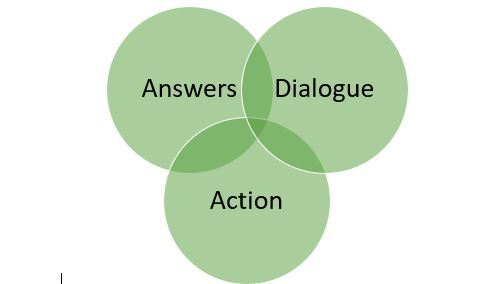
The critical components of a Succession Implementation Pathway
ANSWERS
Does the succession plan actually solve the underlying problems?
Are there unspoken problems that require answers sooner rather than later?
For example, part of a succession plan may be to purchase more land to sustain an extra family entering the business. There is an unspoken problem. The farm is underperforming in its current state due to poor timeliness of operations. Acquiring more land won’t address that problem. It will just exacerbate it by creating a bigger underperforming business with higher levels of financial risk.
In this case, the first part of the answer is to talk about the unspoken problem and rectify the timeliness issue to improve profits. It could be that plant and equipment is long overdue for an upgrade or that are other aspects of the business such as contracting are preventing the home farm tasks being done on time.
DIALOGUE
Dialogue among the family is the key ingredient for firstly identifying the issues that need to be addressed, creating solutions to address those issues then ensuring that the solutions are implemented.
In any business, honest, open and respectful communication underpins success. The trouble is most of us haven’t been taught how to have difficult or courageous conversations and it’s easy to inflame a situation inadvertently.
Facilitators, independent Board Chairs or Business Consultants can often assist families to have more constructive dialogue. Scheduled meetings rather than adhoc interactions, also help promote constructive dialogue. Scheduled meetings don’t need to last long, reduce time wasted in adhoc discussions and save on unnecessary phone calls.
ACTION
Strategic action converts answers and dialogue into results. Consider the Jones, they’ve put a sophisticated succession plan in place with robust business structures. There’s a plan for Jane to transition into the farm business to join Mum, Dad and brother Joe and his wife. Months ago, it was identified that communication of day to day tasks could be an issue, as Dad and Joe are used to working together and just get up and go. Nothing was ever implemented to address that concern and Jane’s never really sure what she should be doing day to day. She’s not game to ask as she doesn’t want to step on Joes toes. Joe feels like Jane isn’t pulling her weight and their relationship is suffering.
A simple solution is to nut out which tasks Jane will be responsible for and to put a system of communication in place, like a quick catch up first thing on a Monday. Simple action to avoid a lot of angst. Succession Implementation does not have to be hard; it just needs an investment of time and attention.
The reward for effort of a functional business and a functional family will be above and beyond some of the urgent but not so important daily operational chores, that seem to grab our attention and take priority. Good luck.
Let’s Do This
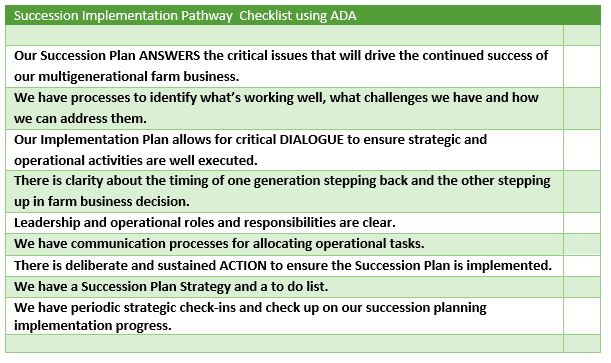
Keeping yourself accountable
Now:
What aspect of the check list needs to take higher priority for you?
In six weeks:
Did you achieve the change? (It’s ok if this didn’t happen-don’t beat yourself up).
What $ value did this action deliver?
What surprised you about this action?
What barriers did you face? What’s next?
AUDIO
[/fusion_toggle][fusion_toggle title=”Topic 2″ open=”no” class=”” id=”” fusion_font_family_title_font=”” fusion_font_variant_title_font=”” title_font_size=”” title_color=”” hue=”” saturation=”” lightness=”” alpha=”” fusion_font_family_content_font=”” fusion_font_variant_content_font=”” content_font_size=”” content_color=””]
Think Agri Real Insights 2020 Episode 2- Article 2
Planning contributes to production and profit
In 2014 I attended the GRDC Cropping Updates in Western Australia and one presentation has always stuck in my mind. Professor Ross Kingwell illustrated the pathways to strong farming performance using sophisticated statistical analysis of the production and profitability and sociology of over 250 farm business in WA from 2001 to 2011. There were considerable differences in operating return on capital, farm profit and production efficiency. Strong businesses had 2.5 x the operating return that less secure businesses had. The finding that stuck in my mind was:
“the farmer’s skill in organization and time management is a significant positive influence on farm performance. Furthermore, this skill is in turn positively affected by the farm family’s human capacity, and training that enhances human capacity.”
One of the components Ross referred to was management and planning. Strong farm businesses manage complexity through planning and planning, can make you money.

Doing farm stuff like tractor work, machinery maintenance and even fencing is more fun for most of us than the hard thinking and monotony of sitting still long enough, to nut out a plan. As businesses have got bigger and more complex, doing without planning sometimes has unintended consequences and we end up chasing our tails in a circle of busyness and costly production mistakes can happen.
I’d love a dollar for every time I’ve seen an Ag Specialist promote the merits of having a plan. The collect shoulder sag of the audience can’t be missed and there is an audible groan. You can feel the ‘nup, not for me, I’m too busy vibe’ .
It could be the big strategy stuff like a business plan, or a succession plan or more tactical matters like a feed budget or a crop rotation plan. Drilling down further, it might just be a paddock by paddock Nitrogen plan or operational plan for the week ahead to share in a toolbox meeting. It doesn’t have to be fancy – something on the back of an envelope, in the diary or the notes page of your phone serves you better, than leaving it all in your head.
Basically, our heads aren’t big enough to store everything. Our heads are like the top draw in the kitchen or the glove box in the ute. If they get overloaded, they become less useful. Planning is like cleaning out the top draw in the kitchen. You take out all the mess, sort it out into like groups then place what you need to keep neatly back in the draw for quick access as required.
Sometimes it’s hard to know where to start so to assist that process, I’ve provided 5 steps.
- Starting – Empty the top draw by talking it out or jotting down what’s on your mind.
- Sorting – What issues are related and can be dealt with together.
- Syphoning – What can you filter out and not worry about, leaving behind only the critical stuff.
- Staging – This is where you take the critical information and put it in some logical order. Like finalising the cropping program and what order you’ll tackle sowing.
- Soldering – This is putting the finishing touches on it and publishing it electronically or on pen and paper. It could be as simple as an email with a list of paddocks and likely sowing order -nonetheless it’s a plan that’s out of your head!
Of course, all plans are just that. A plan. They’ll need adapting and adjusting as things change and a plan is useless without action. A 20 mm rain event might mean a change in sowing sequence. With a head that’s not as full, we are better placed to respond well to changing circumstances and implement with intent.
Let’s Do This
Pick an issue you’ve been thinking about a lot but haven’t decided how to move forward and try the 5 Step approach.
Kingwell R, Xayavong V, Islam N 2014, A deeper understanding of farm productivity.
AUDIO
[/fusion_toggle][fusion_toggle title=”Topic 3″ open=”no” class=”” id=”” fusion_font_family_title_font=”” fusion_font_variant_title_font=”” title_font_size=”” title_color=”” hue=”” saturation=”” lightness=”” alpha=”” fusion_font_family_content_font=”” fusion_font_variant_content_font=”” content_font_size=”” content_color=””]
Think Agri Real Insights 2020 Episode 2- Article 3
2020 Yield Scenario Analysis example
For cropping farmers, the 2020 season is upon us and we have had an early break with considerable rainfall over the past few weeks and the cropping program is underway for most. Already, minds are wandering to what might happen over the next few months. Some readers will be rebounding from two very dry seasons, yet keen to make the most of this season should it be favourable. Others will be following a very favourable year despite a very dry spring and have moderate stores of soil water.
It’s timely to put scenario analysis techniques into action to look at range of outcomes and avoid acting on gutfeel alone, as depending on your experience last year there could be some unconscious negative or positive bias.
In this article I step through a process for generating grain yield scenarios based on the information on hand at the time using 2 locations. Kaniva in the West Wimmera and Mitiamo in Northern Vic.
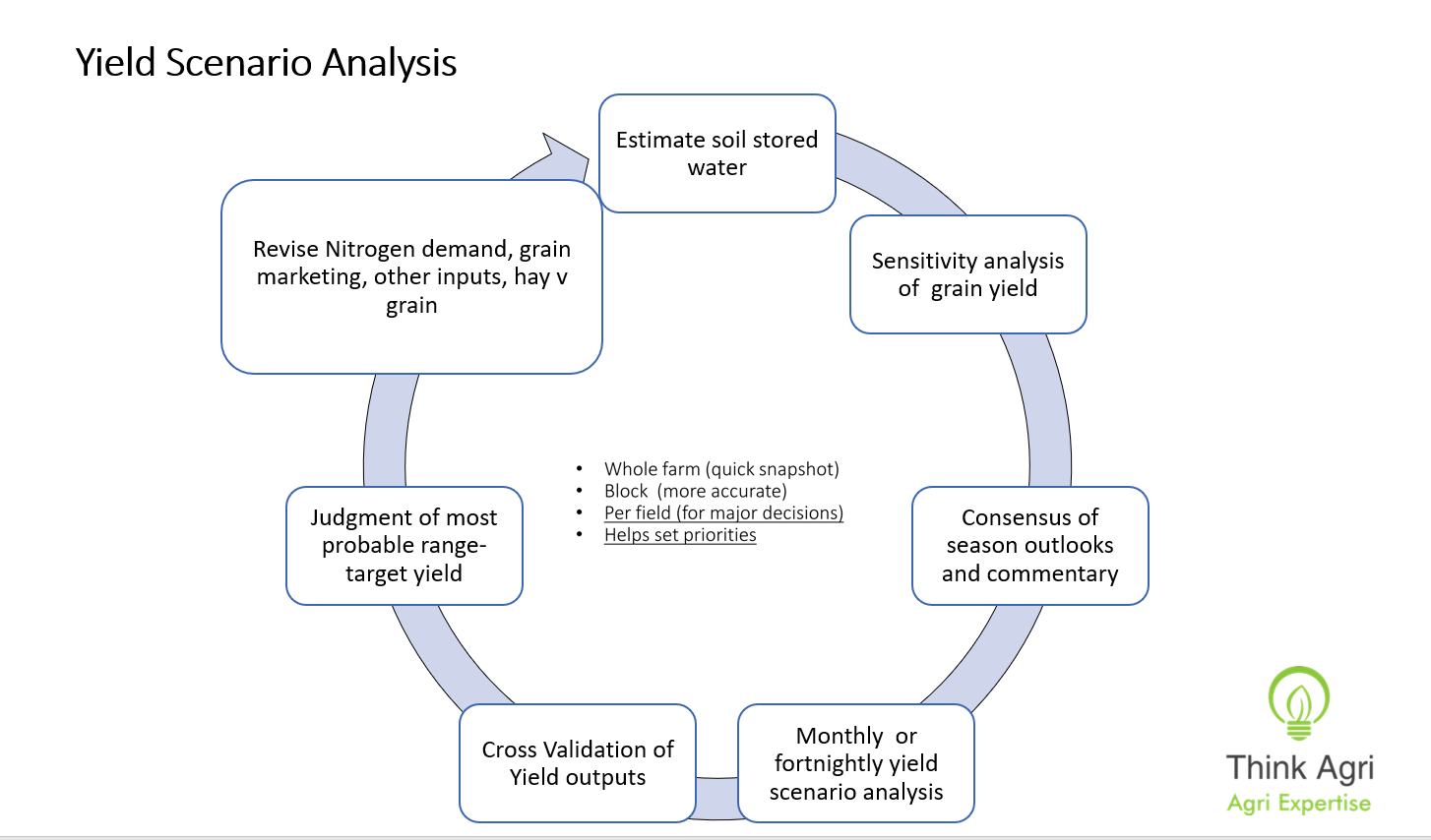
- Assess the current situation and estimate stored water.
I use the CliMate app to check seasonal progress relative to previous years starting from November the previous year as a surrogated for including summer rainfall.
Echuca has had 215 mm since November which is 66mm above median rainfall since 2000. 183mm of this has been since January (Decile 8). At Mitiamo we are tracking well above average for soil water where weeds have been controlled.
Kaniva is tracking 18 mm above median for the last 5 months, despite being 46 mm above average from January. (Decile 7 for years since 2000). Kaniva should be tracking just above average for soil water if weed control has been effective.
- Sensitivity analysis for grain yield?
A simple tool to use is Yield prophet Lite which is a Downloadable App that calculates yield based on different rainfall scenarios.
For Mitiamo, estimated soil water is 84 mm and the estimated yield potential for wheat is 3.2 t/Ha with Decile 2 to 3 May to October rainfall and 4.5 t/Ha for Decile 4 to 7 May to October rainfall. Both these are well above the average yield of 2.5 t/Ha that would be the budget yield in this region. I have used 18 kg/Ha for wheat water use efficiency rather than 22/kg/ha/mm and major shocks such as frost or heat aren’t factored in.
At Kaniva estimated soil water is 42 mm and wheat potential yield is 3.5 t/Ha using Decile 2-3 rainfall and 4.8 t/Ha for Decile 4 -7 rainfall. These numbers assume unlimited N supply.
- Consensus of season outlooks and commentary
So, what are the odds of having a Decile 2 to 3 or Decile 4 to 7 scenario for the rest of the growing season? My first step is to check out the Bureau of Meteorology climate model summary and commentary and refer to the Agriculture Victoria Climate Decision Support Tools, particularly The Fast Break.
At present, most models are on the same page for later in the season as shown in the dashboard below. The predictive skill of the various models is not as strong for the Spring as it is for Winter at this point in time. The models are trending toward the La Nina end of neutral and the negative Indian Ocean Dipole end of neutral. The consensus for rainfall outlook is average to slightly wetter for winter and slightly wetter for Spring. Forecast outlooks are more probable when models are in consensus. Just as important, is what the models aren’t saying. No models are suggesting a very dry Winter or Spring for Victoria.
Remember though, the climate system is a complex beast with influenced by more than just IOD and ENSO and we are talking in probabilities so a 70% chance of exceeding median rainfall means 3 in 10 years could be less than median and 7 could be greater.
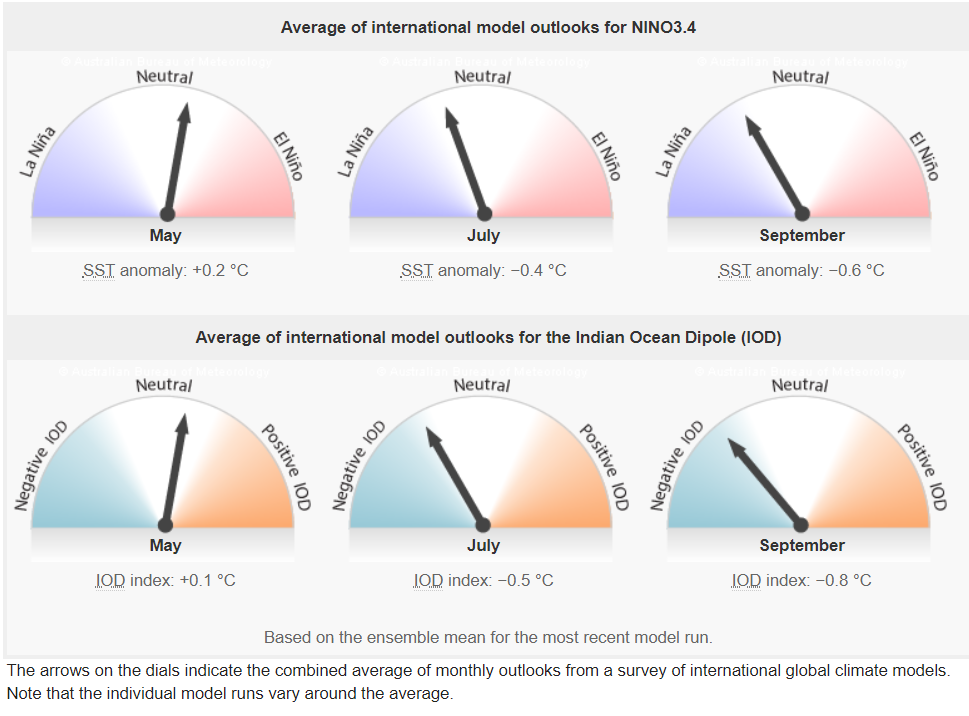
Summary of International Model outlooks for ENSO (NINO3.4) and Indian Ocean Dipole (Source: bom.gov.au).
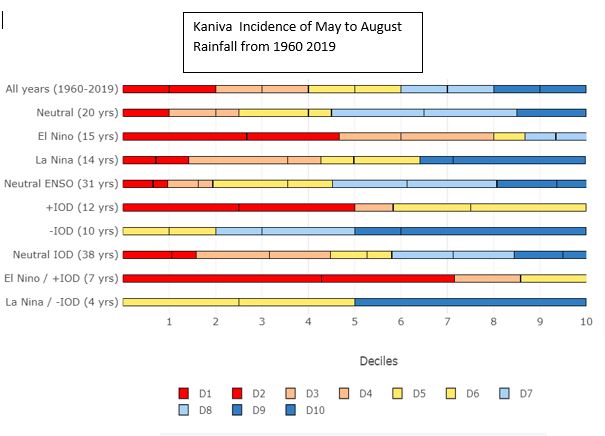
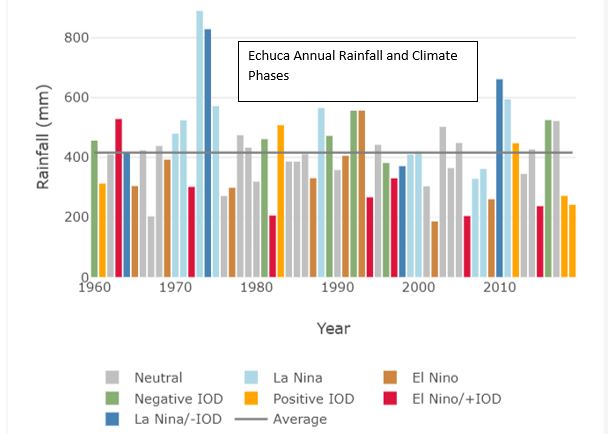
Another really useful climate tool is forecasts4profit ( https://climatetool.forecasts4profit.com.au/ ) which displays the incidence of rainfall for a given location based on the ENSO or IOD phase.
For Echuca (a surrogate for Mitiamo), there have been 10 IOD is negative, ENSO neutral years since 1960 rainfall has been May to October rainfall 9 of those 10 years have exceeded median rainfall. There have been 20 years of both neutral ENSO and IOD and 14 of those years have been equal to over greater than median rainfall for May to October. A disclaimer though, the past does not indicate the future.
At Kaniva, 8 of the 10 IOD negative years have exceeded Median rainfall May to October and 14 of the 20 neutral ENSO and IOD years have been equal to over greater than median rainfall for May to October. A disclaimer though, the past does not indicate the future.
For interest sake I have included annual rainfall in chronological order for both locations. It is a reminder that La Nina doesn’t always produce above average rainfall


4 to 6. Judgement of possible target yield range, cross validation and regular repeats of the process
For the two locations above, water limited yield potential estimates at this early stage of the season are average to above. This is a theoretical exercise and field observation and regular revision based on rainfall to date and climate outlook updates are essential for this exercise to be of practical use. These estimates do not factor in frost or heat shock incidence.
That said, I highly recommend a process like this to inform decisions.
- Management considerations
Given the analysis above, questions one might ask are:
- Is my crop mix appropriate?
- Am I overexposed to hay if the Spring is wet?
- Which paddocks may need additional Nitrogen and how much if favourable conditions continue?
- What crop protection strategies will I need? Will I be able to access fungicide if required?
- REPEAT at regular intervals.
To get the full value of this process, it must be repeated after rainfall events and each month when the forecasts are updated.
Do This
Download CLiMATe and Yield Prophet Lite from your apps store
Check out https://climatetool.forecasts4profit.com.au/
Subscribe to ENSO Updates via www.BOM.gov.au
AUDIO
[/fusion_toggle][fusion_toggle title=”Audio” open=”no” class=”” id=”” fusion_font_family_title_font=”” fusion_font_variant_title_font=”” title_font_size=”” title_color=”” hue=”” saturation=”” lightness=”” alpha=”” fusion_font_family_content_font=”” fusion_font_variant_content_font=”” content_font_size=”” content_color=””]
You can access all audio for all topics below or via your Podcast feed.
[/fusion_toggle][/fusion_accordion][/fusion_builder_column][/fusion_builder_row][/fusion_builder_container][fusion_global id=”361″]