
[fusion_builder_container admin_label=”Episode” hundred_percent=”no” hundred_percent_height=”no” hundred_percent_height_scroll=”no” hundred_percent_height_center_content=”yes” equal_height_columns=”no” menu_anchor=”” hide_on_mobile=”small-visibility,medium-visibility,large-visibility” status=”published” publish_date=”” class=”” id=”” link_color=”” link_hover_color=”” border_color=”” border_style=”solid” margin_top=”” margin_bottom=”” padding_top=”” padding_right=”” padding_bottom=”” padding_left=”” gradient_start_color=”” gradient_end_color=”” gradient_start_position=”0″ gradient_end_position=”100″ gradient_type=”linear” radial_direction=”center center” linear_angle=”180″ background_color=”” background_image=”” background_position=”center center” background_repeat=”no-repeat” fade=”no” background_parallax=”none” enable_mobile=”no” parallax_speed=”0.3″ background_blend_mode=”none” video_mp4=”” video_webm=”” video_ogv=”” video_url=”” video_aspect_ratio=”16:9″ video_loop=”yes” video_mute=”yes” video_preview_image=”” filter_hue=”0″ filter_saturation=”100″ filter_brightness=”100″ filter_contrast=”100″ filter_invert=”0″ filter_sepia=”0″ filter_opacity=”100″ filter_blur=”0″ filter_hue_hover=”0″ filter_saturation_hover=”100″ filter_brightness_hover=”100″ filter_contrast_hover=”100″ filter_invert_hover=”0″ filter_sepia_hover=”0″ filter_opacity_hover=”100″ filter_blur_hover=”0″ admin_toggled=”no” type=”flex”][fusion_builder_row][fusion_builder_column type=”1_1″ layout=”1_1″ spacing=”” center_content=”no” link=”” target=”_self” min_height=”” hide_on_mobile=”small-visibility,medium-visibility,large-visibility” class=”” id=”” hover_type=”none” border_color=”” border_style=”solid” border_position=”all” border_radius=”” box_shadow=”no” dimension_box_shadow=”” box_shadow_blur=”0″ box_shadow_spread=”0″ box_shadow_color=”” box_shadow_style=”” padding_top=”” padding_right=”” padding_bottom=”” padding_left=”” margin_top=”” margin_bottom=”” background_type=”single” gradient_start_color=”” gradient_end_color=”” gradient_start_position=”0″ gradient_end_position=”100″ gradient_type=”linear” radial_direction=”center center” linear_angle=”180″ background_color=”” background_image=”” background_image_id=”” background_position=”left top” background_repeat=”no-repeat” background_blend_mode=”none” animation_type=”” animation_direction=”left” animation_speed=”0.3″ animation_offset=”” filter_type=”regular” filter_hue=”0″ filter_saturation=”100″ filter_brightness=”100″ filter_contrast=”100″ filter_invert=”0″ filter_sepia=”0″ filter_opacity=”100″ filter_blur=”0″ filter_hue_hover=”0″ filter_saturation_hover=”100″ filter_brightness_hover=”100″ filter_contrast_hover=”100″ filter_invert_hover=”0″ filter_sepia_hover=”0″ filter_opacity_hover=”100″ filter_blur_hover=”0″ last=”true” border_sizes_top=”0″ border_sizes_bottom=”0″ border_sizes_left=”0″ border_sizes_right=”0″ first=”true”][fusion_text columns=”” column_min_width=”” column_spacing=”” rule_style=”default” rule_size=”” rule_color=”” content_alignment_medium=”” content_alignment_small=”” content_alignment=”” hide_on_mobile=”small-visibility,medium-visibility,large-visibility” sticky_display=”normal,sticky” class=”” id=”” margin_top=”” margin_right=”” margin_bottom=”” margin_left=”” font_size=”” fusion_font_family_text_font=”” fusion_font_variant_text_font=”” line_height=”” letter_spacing=”” text_transform=”none” text_color=”” animation_type=”” animation_direction=”left” animation_speed=”0.3″ animation_offset=””]
Think Agri Real Insights
Season 3, Episode 11
January 2022
[/fusion_text][fusion_accordion type=”toggles” boxed_mode=”yes” divider_line=”” inactive_icon=”” active_icon=”” icon_boxed_mode=”” hide_on_mobile=”small-visibility,medium-visibility,large-visibility” class=”” id=”” border_size=”1″ border_color=”” hue=”” saturation=”” lightness=”” alpha=”” background_color=”” hover_color=”” divider_color=”” divider_hover_color=”” fusion_font_family_title_font=”” fusion_font_variant_title_font=”” title_font_size=”” title_color=”” icon_size=”” icon_color=”” icon_box_color=”” icon_alignment=”” fusion_font_family_content_font=”” fusion_font_variant_content_font=”” content_font_size=”” content_color=”” toggle_hover_accent_color=”” toggle_active_accent_color=””][fusion_toggle title=”Introduction” open=”no” class=”” id=”” fusion_font_family_title_font=”” fusion_font_variant_title_font=”” title_font_size=”” title_color=”” hue=”” saturation=”” lightness=”” alpha=”” fusion_font_family_content_font=”” fusion_font_variant_content_font=”” content_font_size=”” content_color=””]

Introduction
Happy New Year and welcome to year three of the COVID economy. A client told me last year that the most valuable thing Kate Burke can do is be the calm voice of reason amongst the emotion and uncertainty of the ever changing COVID situation. As we embark on the business of 2022, it seems that message is still valid.
So with that in mind, this eleventh episode of TARI and the first for 2022 contains practical tools for navigating the continued uncertainty of the COVID economy and the implications on everyday living and on the business of farming. Input costs are eye watering and taking the shine off potential earnings. Land prices seem overwhelming for those feeling the pressure to expand.
Navigating this maze requires you to be functioning well and your team to be functioning well. I see a lot of potential to improve team function. Functional teams can decide and act quickly in times of rapid change.
Three examples where high team function pays dividends are:
- securing inputs
- capturing grain selling opportunities
- agreeing whether to participate or not in land buying opportunities.
The tools in this episode are designed to:
- raise awareness of the current issues impacting you
- encourage acceptance of what cannot be changed,
- steer toward agreeance of the issues to be resolved and possible strategies
- culminate in actions that move you, your family and business partners closer toward to your personal and business goals
To set the scene, Topic 1 tackles one of the most commonly cited sources of worry and aims to take the emotion out of viewing climate information. The climate concepts covered help interpret the summaries created by the Bureau of Meteorology and Agriculture Victoria Climate risk team.
Topic 2 is a tool for checking the personal thinking dynamics that impact every day of the business on how you are feeling and where your thinking landscape is at.
Topic 3 provides a team function assessment tool. How well are you travelling as a farm business team, an agribusiness team or a family team? What are the potential areas for improvement?
Developing a habit of checking in with yourself, the family and the business will ensure that you stay well and farm well, worry less and prosper more.
Stay well, farm well and good luck!
Kate
[/fusion_toggle][fusion_toggle title=”Topic 1 – Climate Driver Refresher and Update on Seasonal Forecast” open=”no” class=”” id=”” fusion_font_family_title_font=”” fusion_font_variant_title_font=”” title_font_size=”” title_color=”” hue=”” saturation=”” lightness=”” alpha=”” fusion_font_family_content_font=”” fusion_font_variant_content_font=”” content_font_size=”” content_color=””]
Introduction
Previous episodes have discussed the climate mood concept which looks at the influence of the atmosphere and ocean physics of both the Indian and Pacific Oceans. The climate moods are classified using the two most well-known Climate Indicators, the Indian Ocean Dipole (IOD) and El Nino Southern Oscillation (ENSO). (See Episode 4, Article 3 and Episode 9, Article 1 for fuller explanations).
Topic 1 introduces a third climate driver and provides an update on the current seasonal outlook.
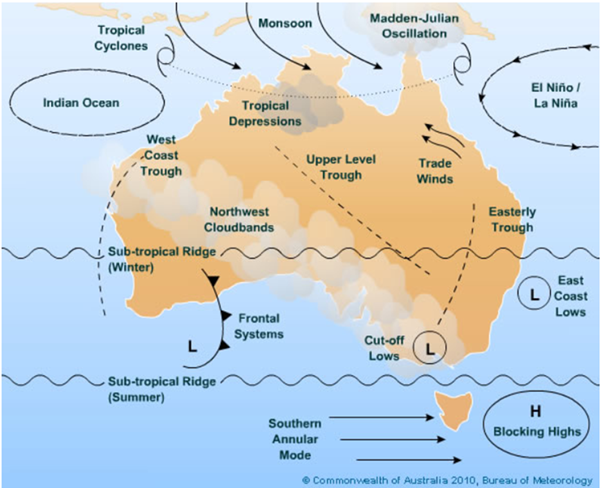
Many drivers of climate
As the map below shows, there are many more climate drivers and how they all interact at any moment in time is why no two climate events are the same.
Introducing SAM
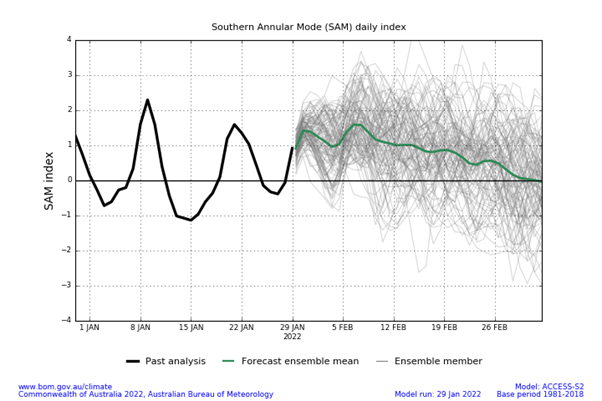
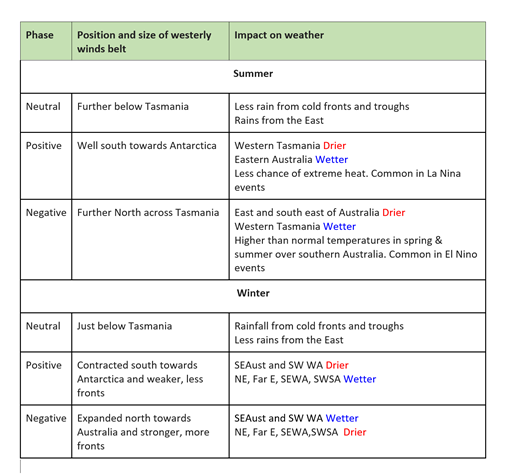
The Southern Annular Mode, or SAM, is a climate driver that influences rainfall and temperature in certain parts of Australia. The SAM refers to the size and position of a belt of the westerly winds in the southern ocean. The location of those winds also depends on where the subtropical ridge (STR) is sitting. Winds are associated with storms and cold fronts moving west to east that bring rainfall with them to southern Australia. Each SAM phase only lasts one to two weeks normally but can sometimes last longer and the frequency of events is random with between a week to a few months elapsing between events.
The SAM is significant because it can partly explain the variation in the weather between regions within the combination of ENSO and IOD. For example, the late break and the winter rains matched up with SAM patterns, as did the late spring and early summer rain in 2021. For February SAM is forecast to be in a positive phase for the next few weeks before returning to neutral. This may mean wetter than normal conditions for much of Eastern Australia but less rainfall for Western Tasmania.
ENSO and IOD are considered primary climate drivers a bit like nitrogen and phosphorus being primary nutrients with the biggest impact on plant growth. SAM is one of the secondary drivers, think sulphur or potassium and like sulphur or potassium, in some regions, its impact might limit the influence of the primary driver.
The impact of SAM is different in winter and summer because the STR sits in a different position during these times. It’s complex!
Currently Active Climate Drivers
La Nina in full swing.
+ SAM likely for early February.
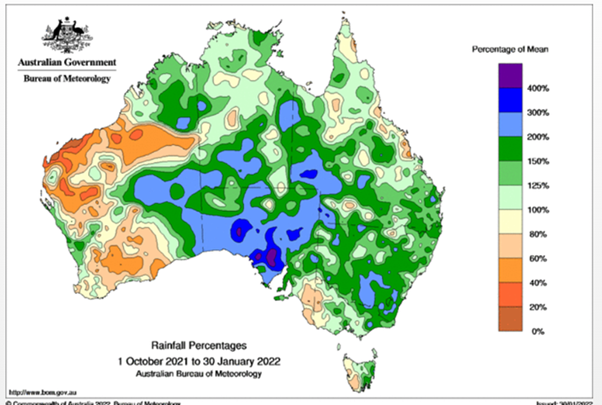
Both would suggest higher than average rainfall likely in many parts of Australia.
21/22 Summer season rainfall to date
Summary of International model averaging La Nina expected to continue for Autumn

[/fusion_toggle][fusion_toggle title=”Topic 1 – Suggested Actions” open=”no” class=”” id=”” fusion_font_family_title_font=”” fusion_font_variant_title_font=”” title_font_size=”” title_color=”” hue=”” saturation=”” lightness=”” alpha=”” fusion_font_family_content_font=”” fusion_font_variant_content_font=”” content_font_size=”” content_color=””]
Practical implications for 2022
- Prioritise summer weed control
Areas experiencing wetter than average conditions have an opportunity to capture plant available water and yield potential through timely summer and autumn weed control.
Timely weed control will also capture the soil fertility boost that coincides with wetter than average summer and autumn and reduce the risk of crop disease and insect pressure.
- Secure chemical and fertiliser
Previous wet summers have historically increased demand on chemical inputs and fertiliser.
This could add further pressure on security and cost of input supplies. Delaying procurement of chemicals in particular, in the hope that prices may soften, could increase the risk of not getting what you need on the farm by the time you need to use it. It may be prudent to secure product as early as possible if you have not done so already.
[/fusion_toggle][fusion_toggle title=”Topic 2 – Your Thinking Landscape Checklist” open=”no” class=”” id=”” fusion_font_family_title_font=”” fusion_font_variant_title_font=”” title_font_size=”” title_color=”” hue=”” saturation=”” lightness=”” alpha=”” fusion_font_family_content_font=”” fusion_font_variant_content_font=”” content_font_size=”” content_color=””]
Your Thinking Landscape Checklist
This exercise aims to increase your self awareness. Self awareness increases the likelihood of excellent choice making.
Your Thinking Landscape describes your peace of mind and your view of reality. It influences your ability to decide and act in ways that are useful to you, your close contacts and your farm business.
If you are mostly grounded and occasionally in the other landscapes, keep doing what you are doing.
If you are rarely in the grounded landscape, what choices can you make to spend more time in the grounded paddock. Who can you chat to about those choices?
How often did you graze in each paddock this month? (For each paddock tick the box that matches most closely)
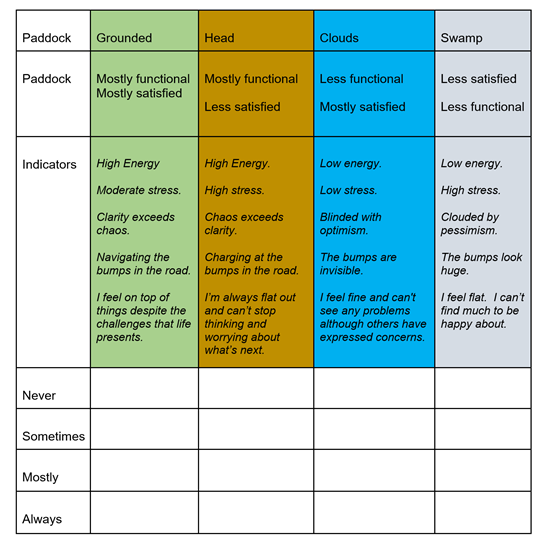
If you want to go one step further, please see the suggested actions for Topic 2.
[/fusion_toggle][fusion_toggle title=”Topic 2 – Suggested Actions” open=”no” class=”” id=”” fusion_font_family_title_font=”” fusion_font_variant_title_font=”” title_font_size=”” title_color=”” hue=”” saturation=”” lightness=”” alpha=”” fusion_font_family_content_font=”” fusion_font_variant_content_font=”” content_font_size=”” content_color=””]
If you want to go one step further, these questions might help
Complete the table in Topic 2 alongside these questions below.
What’s been going on that explains your thinking landscape?
What actions within your control can help you spend more time in the grounded paddock?
What circumstances send you out of the grounded paddocks?
What issues if resolved would open the gate to the grounded paddock?
What actions will you take because of this audit?
[/fusion_toggle][fusion_toggle title=”Topic 3 – How Functional is Your Team? ” open=”no” class=”” id=”” fusion_font_family_title_font=”” fusion_font_variant_title_font=”” title_font_size=”” title_color=”” hue=”” saturation=”” lightness=”” alpha=”” fusion_font_family_content_font=”” fusion_font_variant_content_font=”” content_font_size=”” content_color=””]
Introduction
When a farm business seeks help with strategy, it’s usually because there is some level of dissatisfaction with the status quo. Most often the issues raised are operational or financial and sometimes it’s about people shortages or sorting succession.
Many of the issues raised are symptoms of delayed decision making or team conflict which impacts on the timely implementation of operations and business management. Passive communication and unresolved issues are common causes of the visible problems.
Family businesses are tricky because the workplace team has an underlying family dynamic. And even in non-family businesses, there are still organisational dynamics that affect how a team functions.
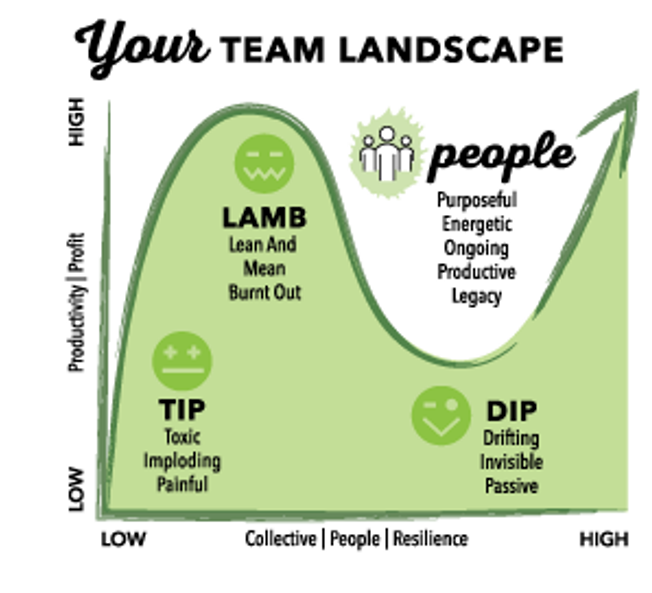
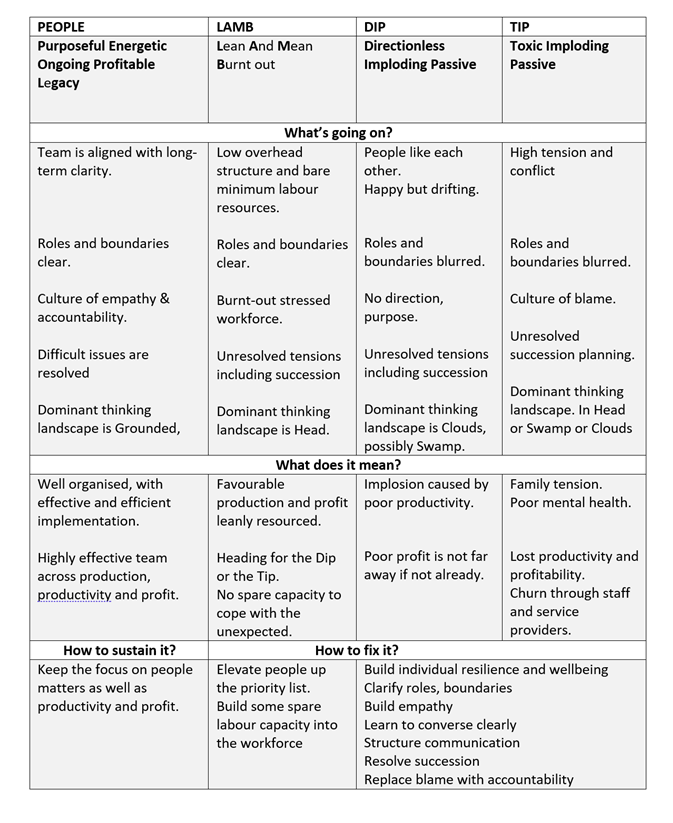
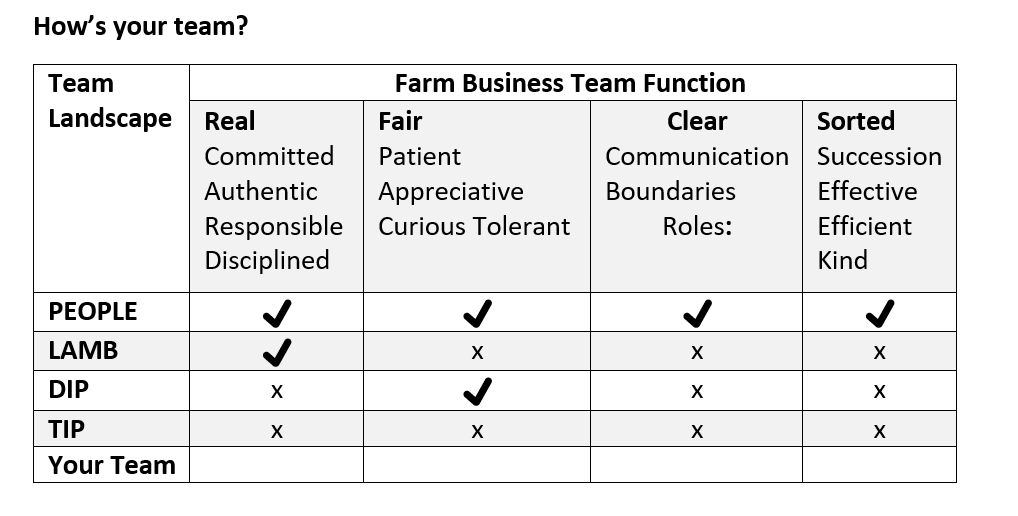
This topic describes the different team landscapes I see in my travels and provides some tips for assessing your own Team Landscape and moving toward a PEOPLE team.
Productivity, profitability and collective people resilience are not mutually exclusive
A high functioning team supports a productive and profitable business and the people involved display a collective level of resilience to sustain the business in the long term and to thrive as human beings. This is a PEOPLE team.
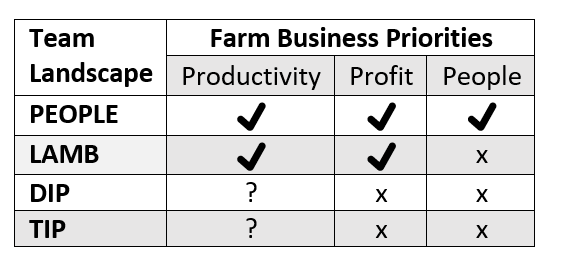
Traditional business thinking and farm management hasn’t focused a lot on people but emphasised efficiency. LAMB teams are productive and profitable but risk burning out.
The least functional teams are the TIP and the DIP teams. Communication is passive, implosion will happen one day. DIP teams lack direction, TIP teams may be focused but it’s a toxic place to be.
[/fusion_toggle][fusion_toggle title=”Topic 3 – Suggested Actions” open=”no” class=”” id=”” fusion_font_family_title_font=”” fusion_font_variant_title_font=”” title_font_size=”” title_color=”” hue=”” saturation=”” lightness=”” alpha=”” fusion_font_family_content_font=”” fusion_font_variant_content_font=”” content_font_size=”” content_color=””]
How’s your team?
Think about the table below and give honest feedback about how your farm business team is currently functioning.
[/fusion_toggle][/fusion_accordion][fusion_title title_type=”text” rotation_effect=”bounceIn” display_time=”1200″ highlight_effect=”circle” loop_animation=”off” highlight_width=”9″ highlight_top_margin=”0″ before_text=”” rotation_text=”” highlight_text=”” after_text=”” title_link=”off” link_url=”” link_target=”_self” hide_on_mobile=”small-visibility,medium-visibility,large-visibility” sticky_display=”normal,sticky” class=”” id=”” content_align_medium=”” content_align_small=”” content_align=”left” size=”1″ animated_font_size=”” fusion_font_family_title_font=”” fusion_font_variant_title_font=”” font_size=”” line_height=”” letter_spacing=”” text_transform=”” text_color=”” hue=”” saturation=”” lightness=”” alpha=”” animated_text_color=”” text_shadow=”no” text_shadow_vertical=”” text_shadow_horizontal=”” text_shadow_blur=”0″ text_shadow_color=”” margin_top_medium=”” margin_right_medium=”” margin_bottom_medium=”” margin_left_medium=”” margin_top_small=”” margin_right_small=”” margin_bottom_small=”” margin_left_small=”” margin_top=”” margin_right=”” margin_bottom=”” margin_left=”” margin_top_mobile=”” margin_bottom_mobile=”” gradient_font=”no” gradient_start_color=”” gradient_end_color=”” gradient_start_position=”0″ gradient_end_position=”100″ gradient_type=”linear” radial_direction=”center center” linear_angle=”180″ highlight_color=”” style_type=”default” sep_color=”” link_color=”” link_hover_color=”” animation_type=”” animation_direction=”left” animation_speed=”0.3″ animation_offset=””]
You can access all audio for all topics below or via your Podcast feed.
[/fusion_title][fusion_audio src=”https://www.thinkagri.com.au/wp-content/uploads/2022/02/TARI_E11_FullFinal.mp3″ loop=”off” autoplay=”off” preload=”none” hide_on_mobile=”small-visibility,medium-visibility,large-visibility” class=”” id=”” background_color=”” hue=”” saturation=”” lightness=”” alpha=”” controls_color_scheme=”” progress_color=”” max_width=”” border_size=”” border_color=”” border_radius_top_left=”” border_radius_top_right=”” border_radius_bottom_right=”” border_radius_bottom_left=”” box_shadow=”no” box_shadow_vertical=”” box_shadow_horizontal=”” box_shadow_blur=”0″ box_shadow_spread=”0″ box_shadow_color=”” animation_type=”” animation_direction=”left” animation_speed=”0.3″ animation_offset=”” /][/fusion_builder_column][/fusion_builder_row][/fusion_builder_container][fusion_global id=”361″]