
[fusion_builder_container admin_label=”Episode” hundred_percent=”no” hundred_percent_height=”no” hundred_percent_height_scroll=”no” hundred_percent_height_center_content=”yes” equal_height_columns=”no” menu_anchor=”” hide_on_mobile=”small-visibility,medium-visibility,large-visibility” status=”published” publish_date=”” class=”” id=”” link_color=”” link_hover_color=”” border_color=”” border_style=”solid” margin_top=”” margin_bottom=”” padding_top=”” padding_right=”” padding_bottom=”” padding_left=”” gradient_start_color=”” gradient_end_color=”” gradient_start_position=”0″ gradient_end_position=”100″ gradient_type=”linear” radial_direction=”center center” linear_angle=”180″ background_color=”” background_image=”” background_position=”center center” background_repeat=”no-repeat” fade=”no” background_parallax=”none” enable_mobile=”no” parallax_speed=”0.3″ background_blend_mode=”none” video_mp4=”” video_webm=”” video_ogv=”” video_url=”” video_aspect_ratio=”16:9″ video_loop=”yes” video_mute=”yes” video_preview_image=”” filter_hue=”0″ filter_saturation=”100″ filter_brightness=”100″ filter_contrast=”100″ filter_invert=”0″ filter_sepia=”0″ filter_opacity=”100″ filter_blur=”0″ filter_hue_hover=”0″ filter_saturation_hover=”100″ filter_brightness_hover=”100″ filter_contrast_hover=”100″ filter_invert_hover=”0″ filter_sepia_hover=”0″ filter_opacity_hover=”100″ filter_blur_hover=”0″ admin_toggled=”no” type=”flex”][fusion_builder_row][fusion_builder_column type=”1_1″ layout=”1_1″ spacing=”” center_content=”no” link=”” target=”_self” min_height=”” hide_on_mobile=”small-visibility,medium-visibility,large-visibility” class=”” id=”” hover_type=”none” border_color=”” border_style=”solid” border_position=”all” border_radius=”” box_shadow=”no” dimension_box_shadow=”” box_shadow_blur=”0″ box_shadow_spread=”0″ box_shadow_color=”” box_shadow_style=”” padding_top=”” padding_right=”” padding_bottom=”” padding_left=”” margin_top=”” margin_bottom=”” background_type=”single” gradient_start_color=”” gradient_end_color=”” gradient_start_position=”0″ gradient_end_position=”100″ gradient_type=”linear” radial_direction=”center center” linear_angle=”180″ background_color=”” background_image=”” background_image_id=”” background_position=”left top” background_repeat=”no-repeat” background_blend_mode=”none” animation_type=”” animation_direction=”left” animation_speed=”0.3″ animation_offset=”” filter_type=”regular” filter_hue=”0″ filter_saturation=”100″ filter_brightness=”100″ filter_contrast=”100″ filter_invert=”0″ filter_sepia=”0″ filter_opacity=”100″ filter_blur=”0″ filter_hue_hover=”0″ filter_saturation_hover=”100″ filter_brightness_hover=”100″ filter_contrast_hover=”100″ filter_invert_hover=”0″ filter_sepia_hover=”0″ filter_opacity_hover=”100″ filter_blur_hover=”0″ last=”true” border_sizes_top=”0″ border_sizes_bottom=”0″ border_sizes_left=”0″ border_sizes_right=”0″ first=”true”][fusion_text columns=”” column_min_width=”” column_spacing=”” rule_style=”default” rule_size=”” rule_color=”” hue=”” saturation=”” lightness=”” alpha=”” content_alignment_medium=”” content_alignment_small=”” content_alignment=”” hide_on_mobile=”small-visibility,medium-visibility,large-visibility” sticky_display=”normal,sticky” class=”” id=”” margin_top=”” margin_right=”” margin_bottom=”” margin_left=”” fusion_font_family_text_font=”” fusion_font_variant_text_font=”” font_size=”” line_height=”” letter_spacing=”” text_transform=”none” text_color=”” animation_type=”” animation_direction=”left” animation_speed=”0.3″ animation_offset=””]
Think Agri Real Insights
Season 3, Episode 12
March 2022
[/fusion_text][fusion_accordion type=”toggles” boxed_mode=”yes” divider_line=”” inactive_icon=”” active_icon=”” icon_boxed_mode=”” hide_on_mobile=”small-visibility,medium-visibility,large-visibility” class=”” id=”” border_size=”1″ border_color=”” hue=”” saturation=”” lightness=”” alpha=”” background_color=”” hover_color=”” divider_color=”” divider_hover_color=”” fusion_font_family_title_font=”” fusion_font_variant_title_font=”” title_font_size=”” title_color=”” icon_size=”” icon_color=”” icon_box_color=”” icon_alignment=”” fusion_font_family_content_font=”” fusion_font_variant_content_font=”” content_font_size=”” content_color=”” toggle_hover_accent_color=”” toggle_active_accent_color=””][fusion_toggle title=”Introduction” open=”no” class=”” id=”” fusion_font_family_title_font=”” fusion_font_variant_title_font=”” title_font_size=”” title_color=”” hue=”” saturation=”” lightness=”” alpha=”” fusion_font_family_content_font=”” fusion_font_variant_content_font=”” content_font_size=”” content_color=””]

Introduction
Episode 12 of Think Agri Real Insights hones in on planning and deep thinking for problem solving.
Topic 1 tackles the topic of letting go. It’s one of the biggest barriers to succession planning progression and, in many cases, it comes down to a subconscious fear of identity loss. It’s a fixable thing though and some tools to fix it are included. It takes some thinking and some planning but it’s worth it.
Topic 2 encourages you to think differently about time in this era of people shortages. Where do you lose time, where can you make it and where can you fold it. A little bit of thinking and planning goes a long way toward making time.
Topic 3 moves into the 22 seasonal opportunities and getting the balance between capturing opportunity as cost effectively as possible in the current circumstances.
Happy thinking, planning and farming. Stay well, farm well.
Kate
[/fusion_toggle][fusion_toggle title=”Topic 1 – Letting go is hard to do. Why is this So?” open=”no” class=”” id=”” fusion_font_family_title_font=”” fusion_font_variant_title_font=”” title_font_size=”” title_color=”” hue=”” saturation=”” lightness=”” alpha=”” fusion_font_family_content_font=”” fusion_font_variant_content_font=”” content_font_size=”” content_color=””]
Introduction
It’s that time of year when there’s a lot of discussions around succession planning and how to navigate all the complexities that come alongside. I was recently looking at an article in the Company Director Magazine and the following quote grabbed my attention ‘Families that can define 10 to 20 year aspirations and 6 to 12 months initiatives with a clear line of sight from one initiative to the other, were more likely to stay ahead of the game’.
The article was authored by Denise Cullen and she was interpreting a report written by the Deloitte group called Planning Beyond the Horizon, a multi-generational outlook report into the role of family enterprises.
Soberly that same report, cautioned that without the right planning and preparation, some family enterprises may fail to successfully transition to the second generation. The process becomes even more challenging for the third or fourth generation. As many farms are now into their fifth and even sixth generation, no wonder this stuff is so hard.
When our identity is wrapped up in what we do
So why is it so hard? Why can’t we get Mum and Dads to talk about this? Why does dad just shut down at the prospect?
We’ve previously discussed the various stages of a farmers life cycle. From intern, when you first get onto the farm to manager to mentor and then to elder.
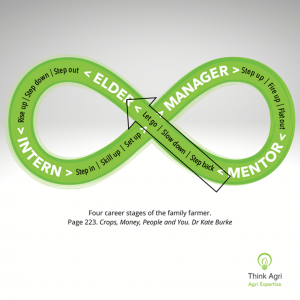
It’s quite a big shift to go from manager to mentor. It requires stepping back, slowing down and ultimately letting go. The conflict between family members often comes when the mentors get stuck and still want to do the managing and the day to day decision-making.
Why is it so hard to step back, slow down and let go?
Our self worth is wrapped up in what we do in our careers. Whether it’s me as somebody who’s been an industry service provider for a long time or whether it’s you on the family farm. What we do becomes blurred with who we think we are. Our sense of identity and self esteem wrapped up in what we do.
Circles of Self-Esteem
Jo Eady, a leadership expert from Rural Scope developed the concept of circles of self-esteem to help her own father prepare for moving off the farm and into town. Jo talks about the circle of what we do and the circle of who we are. Our self-esteem can suffer, if those circles are out of balance. For example, if the “what we do” circle is really large and the “who we are” circle is quite small.
Re-fencing your identity
Think of it as two paddocks. After a long career, the “Do” paddock can seem a lot bigger than the “Are” Paddock. An identity that allows one to move on from a career needs the “Are” paddock expanded to match or exceed the “do” paddock.
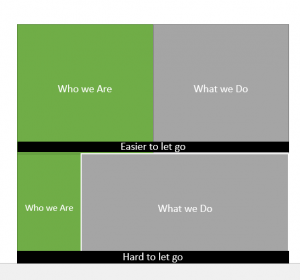
It’s quite an interesting exercise to work through the identity of us as humans, rather than of what we do in our day to day lives. I think this is one key in being comfortable in letting go.
One of the things that is well documented is that individuals that have interests outside the farm such as sporting interests or community interests seem to have less problems with letting go. The issue of succession causes less angst because their identity and self worth isn’t completely tied up in the farm.
Grace McCleod spoke poignantly about identity in a recent podcast on the Humans of Agriculture, Her family farming journey came to a quicker halt than she had envisaged. While processing what this meant, Grace’s brother offered the following: “You’ll always be a farmer, but you are not the farm”.
How do you identify and what is your identity tied up with and what does this mean for you?
Summing up
Stepping back, slowing down and letting go is an inevitable task when transferring responsibility to the next generation.
This process of moving from manager to mentor is easier if your sense of identity is balanced between who you are and what you do and not dominated by what you do.
[/fusion_toggle][fusion_toggle title=”Topic 1 – Suggested Actions” open=”no” class=”” id=”” fusion_font_family_title_font=”” fusion_font_variant_title_font=”” title_font_size=”” title_color=”” hue=”” saturation=”” lightness=”” alpha=”” fusion_font_family_content_font=”” fusion_font_variant_content_font=”” content_font_size=”” content_color=””]
Follow the link to the PDF below and fill out the attached table (example shown).
[fusion_table fusion_table_type=”1″ fusion_table_rows=”” fusion_table_columns=”” hide_on_mobile=”small-visibility,medium-visibility,large-visibility” class=”” id=”” animation_type=”” animation_direction=”left” animation_speed=”0.3″ animation_offset=””]
Fill out the attached table for yourself, with example shown below.
| Words that describe who I am | Words that describe what I do |
|---|---|
| Example:
Caring, funny, hard working, honest, determined |
Example:
Tractor driving, business negotiations,wool classing, organising,crop growing |
[/fusion_table]
[/fusion_toggle][fusion_toggle title=”Topic 2 – Unlock time and gain more effective hours” open=”no” class=”” id=”” fusion_font_family_title_font=”” fusion_font_variant_title_font=”” title_font_size=”” title_color=”” hue=”” saturation=”” lightness=”” alpha=”” fusion_font_family_content_font=”” fusion_font_variant_content_font=”” content_font_size=”” content_color=””]
Introduction
Reviewing the use of time and unlocking ineffective time is more essential than ever given the current people shortage in agriculture.
Every social media outlet, every newspaper is teaming with advertisements for staff required to join rural businesses. Every conversation I have with clients has a component about addressing the need for more people. There is too much to do and not enough people to do it.
To put it simply, the search for help from outside the business is hard work, time consuming and there is much competition at the moment.
I suggest preceding the external search with a review of time effectiveness within the business.
Improving the effectiveness of the team and ourselves unlocks time and frees up extra help sitting right there under our noses.
A 10% increase in effectiveness for a five person team is the same as recruiting someone for 5 days a fortnight. Not only are there wages savings, there is more productivity across the farm.
Consider if a 10% increase in personal and team effectiveness translates to a 10% increase in hectares sown per day. This drops 1 day off the program for every 10 days of sowing. For example, if the estimated time to complete sowing is 40 sowing days, a 10% increase in daily sown area reduces the program to 36 days. This becomes really significant if there are wet weather days thrown in and it can help manage fatigue.
The bottom line impact of timely sowing is well documented and with grain prices at extreme highs, any production improvement will have an even greater impact.
Effective time use
The quantity of time doesn’t change, but how you perceive it will. There are always 60 seconds in a minute, 60 minutes in an hour and 24 hours in a day. The difference is in the choices we make about what is most important and of value to us.
James Clear the author of Atomic Habits says “in our age of constant distraction, it’s stupidly easy to split our attention between what we should be doing and what society bombards us with”.
Becoming more effective boils down to four themes.
- Effective time use
- Effective communication
- Effective organisation and
- Effective decision-making

There’s time makers and there’s time takers.
Time takers include
- confusion among the team of who’s doing what.
- No clear plan of attack of what needs to be done by when.
- Indecision about various aspects of the business, particularly among the business partners.
- Distraction.
At a practical level, some classic time takers are excessive phone use and being too “busy” to communicate with your team. How often are the calls on your phone during the day actually not related to work and your team is left not knowing what they’re doing because you’re preoccupied doing something else?
Time makers include clear communication, good planning and organisation alongside timely decision-making.
Prioritising planning and communication are the time makers that provide the greatest returns.
A classic time maker is being disciplined about having regular toolbox meetings first thing in the morning, a WhatsApp group with clear instructions, or at least a weekly catch up about what’s coming up for the week. A clear plan of what’s coming up for the week and for the day are vital for making those catch ups effective.
Slowing down long enough to get some plans out of your head and onto a note in your phone, a notebook, a laptop or a white board will be a game changer if you tend to be more of an intuitive operator.
Time folders are opportunities to unlock time and it’s where the really clever stuff happens.
A timefolder could be combining a team meeting with a crop inspection or a working bee to tidy up the workshop.
It could be taking time out to go for a run and get some plans clear in your head.
One of the three pillars of excellent farming is passionate, effective people. Passion is a time folder. Passion fuels motivation and self-regulation, which in turn improves personal effectiveness with our time and our team.
Summing up
Identifying time takers, time makers and time folders can unlock time and improve time effectiveness and farm productivity. In a labour constrained environment, choosing to stop some time takers and start some time makers or folders is an untapped opportunity.
[fusion_table fusion_table_type=”1″ fusion_table_rows=”” fusion_table_columns=”” hide_on_mobile=”small-visibility,medium-visibility,large-visibility” class=”” id=”” animation_type=”” animation_direction=”left” animation_speed=”0.3″ animation_offset=””]
Time takers |
Time makers |
Time folders |
|---|---|---|
| Undisciplined phone use | Sleep | Saying No to multiple life demands |
| Decision fatigue | Scheduling calls and meetings | Turn off emails and phone notifications |
| Ignoring mental exhaustion | Calendar maintenance | Delegate and automate |
| Scrolling social media | Avoiding interruptions | Tackle harder tasks first |
| Multitasking | Tidy workshop and office | 80/20 rule |
| Procrastination and lack of motivation | Prioritising the money making tasks and the medium term important strategic tasks | Leave small parts of the day for the unexpected |
| Gossip and drama | Weekly team meetings | Conduct a time audit |
| Piling instead of filing in the office, the ute and the workshop | Keeping phone calls to under 15 minutes | Recognise concern v influence v control |
| Rushing | Exercise | Set reasonable expectations |
| Perfectionism | Messaging groups such as Whatsapp for communicating jobs | A well thought out logistics plan with 20% contingency |
| Conflict | Mobile meetings |
[/fusion_table]
[/fusion_toggle][fusion_toggle title=”Topic 2 – Suggested Actions” open=”no” class=”” id=”” fusion_font_family_title_font=”” fusion_font_variant_title_font=”” title_font_size=”” title_color=”” hue=”” saturation=”” lightness=”” alpha=”” fusion_font_family_content_font=”” fusion_font_variant_content_font=”” content_font_size=”” content_color=””]
Construct a list of time takers, time makers and time folders.
What will you stop doing?
What will you start doing?
Helpful resources:
https://www.piedmont.org/living-better/15-ways-to-find-more-time-in-your-day
https://www.cleverchecklist.com/blog/thoughts/mechanics-of-time-management/
[/fusion_toggle][fusion_toggle title=”Topic 3 – Price spikes, cost spikes and seasonal opportunity in 2022″ open=”no” class=”” id=”” fusion_font_family_title_font=”” fusion_font_variant_title_font=”” title_font_size=”” title_color=”” hue=”” saturation=”” lightness=”” alpha=”” fusion_font_family_content_font=”” fusion_font_variant_content_font=”” content_font_size=”” content_color=””]
Introduction
This year is shaping up to be one of those “unprecedented” years in terms of uncertainty of supply for inputs and excruciating prices for fuel and fertiliser. The invoices coming in have big numbers on them and are hard to swallow.
On the glass half full side, commodity prices are strong and the seasonal outlook signals are very promising. Experience tells us that a La Nina summer provides a solid soil water profile to draw upon in the winter growing season. Summer rainfall events have been sporadic in some places but the forecast of the La Nina event lasting into April provides a strong base for crop yield potential.
The good news is that no models are forecasting either El Nino or IOD positive at this stage which eliminates the worst kind of seasons for southern Australia. A cautionary note though, that the models have a harder time making predictions at this time of year when the ocean and atmospheric conditions are getting themselves organised and in a reset phase.
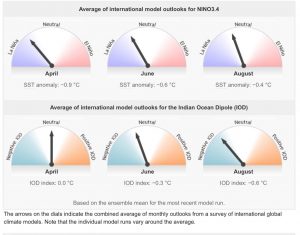
http://www.bom.gov.au/climate/model-summary/#tabs=Overview
This article joins the dots between strong commodity prices, extreme pricing of some inputs and a promising climate outlook to answer what might it mean on the ground.
Implication 1
Productivity rules even when price is nice
Table 1 provides three yield scenarios and three price scenarios and the production potential on offer for you this season and what shift in yield achievement could mean for gross income (revenue).
Ultimately productivity still matters more than price. This is most relevant in mixed farming systems particularly in higher rainfall environments.
In lower rainfall environments where that range for yield improvement is less, and where fewer crop types are grown, a price change in a single commodity can have a very significant impact than it would in a higher rainfall environment.
Increasing the price from $270/t to $330/t or $330/t to $400/t increases income by a factor of 1.2 times and moving from $270/t to$400/t is a 1.5 times increase in value. Increasing in yield from one step change to another represents a 1.5 to 2.8 times increase in value. The real fun happens with strong prices and strong yield improvements.
So it’s vital to get both production right and be mindful of pricing.
The best way to be mindful of these opportunities is to map out the potential income based on both, some price variations and some yield variations for a range of commodities and also on a paddock by paddock basis.
[fusion_table fusion_table_type=”1″ fusion_table_rows=”” fusion_table_columns=”” hide_on_mobile=”small-visibility,medium-visibility,large-visibility” class=”” id=”” animation_type=”” animation_direction=”left” animation_speed=”0.3″ animation_offset=””]
| Increasing grain yield from |
Increases revenue by a factor of |
Example at $270/t | Example at $330/t |
Example at $400/t |
Possible scenario |
|---|---|---|---|---|---|
| 1.5 t/ha to 2.5 t/ha | 1.5 | $405/Ha to $675/Ha |
$495/Ha to $825/Ha |
$600/Ha to $1000/Ha |
Mallee environment |
| 2.5 t/ha to 4.0 t/ha | 1.4 | $675/ Ha to 1080/Ha |
$825/Ha to $1320/Ha |
$1000/Ha to $1600/Ha |
Medium rainfall environment with improved nutrition. |
| 4.0 t/ha to 7.0 t/ha | 1.8 | $1080/Ha to $1890/Ha | $1320/Ha to $2310/Ha | $1600/Ha to $2800/Ha |
Additive effect of managing disease and adequate nutrition through variety selection, crop rotation and good agronomy.
Medium to high rainfall environment. |
| 2.5 t/ha to 7.0 t/ha | 2.8 | $675/Ha to $1890/Ha |
$825/Ha to $2310/Ha |
$1000/Ha to $2800/Ha |
Additive effect of reducing grass weed competition, managing disease and adequate nutrition through variety selection, crop rotation and good agronomy.
Medium to high rainfall environment. |
Table 1 Impact of yield gain and price gains on gross income (revenue)
[/fusion_table]
Implication 2
Water use efficiency is king and so is excellent agronomy
The difference between a 4 t/ha crop and a 7t/ha crop in the same location and experiencing the same weather, is the conversion of water to grain. The better the water use efficiency the more grain produced. Ultimately this comes down to paddock selection, timeliness and agronomic decision making from variety selection, sowing time, crop monitoring and sensible agronomic decision making to protect yield potential. Good agronomy is a good investment.
It’s an important year to be cost conscious and not waste inputs but be mindful not to compromise water use efficiency by extreme cost cutting exercises.
Both the revenue and the cost equation need to be considered at the one time. A great tool for doing that is to look at a variable cost of each crop type as a percentage of the potential income. That gives you a feel for the risk profile of that crop type.
Implication 3
Manage the angst that comes with grain price volatility to make good decisions
Grain selling is hard and price risk management is hard. We sold our canola a week before Russia jumped into the Ukraine. We were happy with the number and it was a convenient time to make the decision. At the same time, we are working very hard at not thinking about “if only”. What’s done is done. Table 2 contains some tips for managing the angst that comes with uncertainty especially around price risk management.
[fusion_table fusion_table_type=”1″ fusion_table_rows=”” fusion_table_columns=”” hide_on_mobile=”small-visibility,medium-visibility,large-visibility” class=”” id=”” animation_type=”” animation_direction=”left” animation_speed=”0.3″ animation_offset=””]
These choices influence how you think and feel about grain price.
| Choose What? | How? | Why? |
|---|---|---|
| Place less emphasis on maximising price | Understand that production and management decisions are greater levers on profitability than price | Allows you to focus on the profit levers |
| Manage wellbeing | Get enough sleep, and make healthy choices, utilise your resources for social and workload support | This helps gain access to the logical part of your brain to make good decisions. |
| Recognise concern v influence v control | Acknowledge that factors outside your control have a large influence on price. | Transfers focus to the factors you have the most influence and control over. |
| Set reasonable expectations | Accept that it is not possible to sell all of your grain at the peak of a commodity price cycle. | Reduces angst caused when price goes up and down |
[/fusion_table]
[fusion_table fusion_table_type=”1″ fusion_table_rows=”” fusion_table_columns=”” hide_on_mobile=”small-visibility,medium-visibility,large-visibility” class=”” id=”” animation_type=”” animation_direction=”left” animation_speed=”0.3″ animation_offset=””]
These choices combine logical thought processes and practical action to capture grain and know what price is required to make a reasonable margin.
| Choose What? | How? | Why? |
|---|---|---|
| Estimate production scenarios | Estimate the potential production from each paddock and for each commodity in total based on 3 scenarios for April to October rainfall, and revise monthly. | Have a strong grasp on potential tonnage. |
| Estimate breakeven price scenarios | Calculate your estimated cost of production per tonne of grain ($/ha All costs/ tonne expected). | Know what price you need to ensure you are not selling at a loss (break even price). |
| Estimate target price scenarios | Calculate a price required to achieve a margin of your choice. | Know what a profitable target price is |
| Optimise tonnes grown | Protect and capture your production and quality potential through pre-season agronomic attention to detail, timely sowing and frequent and timely paddock monitoring and operations | This lowers the price required to break even or achieve a profit margin by growing more tonnes |
| Optimise tonnes harvested | Ensure harvest and cartage and storage capacity are adequate for the anticipated production | Minimise post maturity grain loss or quality loss |
[/fusion_table]
Table 2 Seven steps to help capture profit while commodity pricing and input costs are volatile
References
Good templates for calculating cost of production.
Outlines key selling principles.
[/fusion_toggle][fusion_toggle title=”Topic 3 – Suggested Actions” open=”no” class=”” id=”” fusion_font_family_title_font=”” fusion_font_variant_title_font=”” title_font_size=”” title_color=”” hue=”” saturation=”” lightness=”” alpha=”” fusion_font_family_content_font=”” fusion_font_variant_content_font=”” content_font_size=”” content_color=””]
Look at the references linked above for calculating cost of production and outline of key selling principles.
Prepare a paddock by paddock yield and income scenario table for three yield ranges and update regularly
Look at your projected input expenses as a percentage of crop income for each crop type and even better, for each paddock to keep an eye on input costs
Monitor actuals compared to monthly budget
Prepare a marketing strategy for each commodity
[/fusion_toggle][/fusion_accordion][fusion_title title_type=”text” rotation_effect=”bounceIn” display_time=”1200″ highlight_effect=”circle” loop_animation=”off” highlight_width=”9″ highlight_top_margin=”0″ before_text=”” rotation_text=”” highlight_text=”” after_text=”” title_link=”off” link_url=”” link_target=”_self” hide_on_mobile=”small-visibility,medium-visibility,large-visibility” sticky_display=”normal,sticky” class=”” id=”” content_align_medium=”” content_align_small=”” content_align=”left” size=”1″ animated_font_size=”” fusion_font_family_title_font=”” fusion_font_variant_title_font=”” font_size=”” line_height=”” letter_spacing=”” text_transform=”” text_color=”” hue=”” saturation=”” lightness=”” alpha=”” animated_text_color=”” text_shadow=”no” text_shadow_vertical=”” text_shadow_horizontal=”” text_shadow_blur=”0″ text_shadow_color=”” margin_top_medium=”” margin_right_medium=”” margin_bottom_medium=”” margin_left_medium=”” margin_top_small=”” margin_right_small=”” margin_bottom_small=”” margin_left_small=”” margin_top=”” margin_right=”” margin_bottom=”” margin_left=”” margin_top_mobile=”” margin_bottom_mobile=”” gradient_font=”no” gradient_start_color=”” gradient_end_color=”” gradient_start_position=”0″ gradient_end_position=”100″ gradient_type=”linear” radial_direction=”center center” linear_angle=”180″ highlight_color=”” style_type=”default” sep_color=”” link_color=”” link_hover_color=”” animation_type=”” animation_direction=”left” animation_speed=”0.3″ animation_offset=””]
You can access all audio for all topics below or via your Podcast feed.
[/fusion_title][fusion_audio src=”https://www.thinkagri.com.au/wp-content/uploads/2022/03/TARI_E12_Final_mixdown.mp3″ loop=”off” autoplay=”off” preload=”none” hide_on_mobile=”small-visibility,medium-visibility,large-visibility” class=”” id=”” background_color=”” hue=”” saturation=”” lightness=”” alpha=”” controls_color_scheme=”” progress_color=”” max_width=”” border_size=”” border_color=”” border_radius_top_left=”” border_radius_top_right=”” border_radius_bottom_right=”” border_radius_bottom_left=”” box_shadow=”no” box_shadow_vertical=”” box_shadow_horizontal=”” box_shadow_blur=”0″ box_shadow_spread=”0″ box_shadow_color=”” animation_type=”” animation_direction=”left” animation_speed=”0.3″ animation_offset=”” /][/fusion_builder_column][/fusion_builder_row][/fusion_builder_container][fusion_global id=”361″]