
[fusion_builder_container admin_label=”Episode” hundred_percent=”no” hundred_percent_height=”no” hundred_percent_height_scroll=”no” hundred_percent_height_center_content=”yes” equal_height_columns=”no” menu_anchor=”” hide_on_mobile=”small-visibility,medium-visibility,large-visibility” status=”published” publish_date=”” class=”” id=”” link_color=”” link_hover_color=”” border_color=”” border_style=”solid” margin_top=”” margin_bottom=”” padding_top=”” padding_right=”” padding_bottom=”” padding_left=”” gradient_start_color=”” gradient_end_color=”” gradient_start_position=”0″ gradient_end_position=”100″ gradient_type=”linear” radial_direction=”center center” linear_angle=”180″ background_color=”” background_image=”” background_position=”center center” background_repeat=”no-repeat” fade=”no” background_parallax=”none” enable_mobile=”no” parallax_speed=”0.3″ background_blend_mode=”none” video_mp4=”” video_webm=”” video_ogv=”” video_url=”” video_aspect_ratio=”16:9″ video_loop=”yes” video_mute=”yes” video_preview_image=”” filter_hue=”0″ filter_saturation=”100″ filter_brightness=”100″ filter_contrast=”100″ filter_invert=”0″ filter_sepia=”0″ filter_opacity=”100″ filter_blur=”0″ filter_hue_hover=”0″ filter_saturation_hover=”100″ filter_brightness_hover=”100″ filter_contrast_hover=”100″ filter_invert_hover=”0″ filter_sepia_hover=”0″ filter_opacity_hover=”100″ filter_blur_hover=”0″ admin_toggled=”no” type=”flex”][fusion_builder_row][fusion_builder_column type=”1_1″ layout=”1_1″ spacing=”” center_content=”no” link=”” target=”_self” min_height=”” hide_on_mobile=”small-visibility,medium-visibility,large-visibility” class=”” id=”” hover_type=”none” border_color=”” border_style=”solid” border_position=”all” border_radius=”” box_shadow=”no” dimension_box_shadow=”” box_shadow_blur=”0″ box_shadow_spread=”0″ box_shadow_color=”” box_shadow_style=”” padding_top=”” padding_right=”” padding_bottom=”” padding_left=”” margin_top=”” margin_bottom=”” background_type=”single” gradient_start_color=”” gradient_end_color=”” gradient_start_position=”0″ gradient_end_position=”100″ gradient_type=”linear” radial_direction=”center center” linear_angle=”180″ background_color=”” background_image=”” background_image_id=”” background_position=”left top” background_repeat=”no-repeat” background_blend_mode=”none” animation_type=”” animation_direction=”left” animation_speed=”0.3″ animation_offset=”” filter_type=”regular” filter_hue=”0″ filter_saturation=”100″ filter_brightness=”100″ filter_contrast=”100″ filter_invert=”0″ filter_sepia=”0″ filter_opacity=”100″ filter_blur=”0″ filter_hue_hover=”0″ filter_saturation_hover=”100″ filter_brightness_hover=”100″ filter_contrast_hover=”100″ filter_invert_hover=”0″ filter_sepia_hover=”0″ filter_opacity_hover=”100″ filter_blur_hover=”0″ last=”true” border_sizes_top=”0″ border_sizes_bottom=”0″ border_sizes_left=”0″ border_sizes_right=”0″ first=”true”][fusion_text columns=”” column_min_width=”” column_spacing=”” rule_style=”default” rule_size=”” rule_color=”” content_alignment_medium=”” content_alignment_small=”” content_alignment=”” hide_on_mobile=”small-visibility,medium-visibility,large-visibility” sticky_display=”normal,sticky” class=”” id=”” font_size=”” fusion_font_family_text_font=”” fusion_font_variant_text_font=”” line_height=”” letter_spacing=”” text_color=”” animation_type=”” animation_direction=”left” animation_speed=”0.3″ animation_offset=””]
Episode Six – 25 September 2020
[/fusion_text][fusion_accordion type=”toggles” boxed_mode=”yes” divider_line=”” inactive_icon=”” active_icon=”” icon_boxed_mode=”” hide_on_mobile=”small-visibility,medium-visibility,large-visibility” class=”” id=”” border_size=”1″ border_color=”” hue=”” saturation=”” lightness=”” alpha=”” background_color=”” hover_color=”” divider_color=”” divider_hover_color=”” fusion_font_family_title_font=”” fusion_font_variant_title_font=”” title_font_size=”” title_color=”” icon_size=”” icon_color=”” icon_box_color=”” icon_alignment=”” fusion_font_family_content_font=”” fusion_font_variant_content_font=”” content_font_size=”” content_color=”” toggle_hover_accent_color=”” toggle_active_accent_color=””][fusion_toggle title=”Topic 1″ open=”no” class=”” id=”” fusion_font_family_title_font=”” fusion_font_variant_title_font=”” title_font_size=”” title_color=”” hue=”” saturation=”” lightness=”” alpha=”” fusion_font_family_content_font=”” fusion_font_variant_content_font=”” content_font_size=”” content_color=””]
Episode 6 Article 1
Scenario Analysis- a tool for late season decision making.
Introduction
The book Glory Days arrived in our mailbox today. A well constructed coffee table book, Glory Days is a collection of words and pictures to mark the Minyip-Murtoa netball and football senior premiership double in 2020.
It seemed a timely arrival during the final quarter of the winter growing season.
It reminded me of Senior football coach John Delahunty’s words at three quarter time as the boys were getting vocal and revving themselves up. He quietened the lads down and said “we’re not going to run on emotion this quarter. After a few more instructions, his final words were
“Be brave, stick to the process and be brave”.

Photo Source: Wimmera Mail Times
Three Septembers earlier in 2016, I preceded Wimmera League Grand Final day with an afternoon crop walk at Wolseley, just over the border in South Australia. These guys were at three quarter time in a cracker season with potential right under their nose. Five to seven tonne per hectare of wheat and barley sort of potential. The problem was they were coming off a stinker in 2015 and dry spring in 2014. They were still wounded. To switch mindsets and go for the premiership after a couple of beltings was a hard thing to do. It wasn’t the time for a Barrassi or Teddy Whitten style spray, more a modern Luke Beveridge or Damien Hardwick approach. The uncertainty was causing stress. My job was to quieten the limbic side of their brain (the fear response) and wake up the rational side of their brain. That afternoon out in the paddock, with a bit of guidance and a process to make decisions and manage uncertainty, they gave each other confidence to have a crack and be brave. As a drive in – drive out guest speaker, you don’t always know the impact of such afternoons. This time the local agronomist contacted me after harvest to report that a mind shift happened that afternoon and that group got their premiership over the line.
It wasn’t the case for Minyip-Murtoa the next day or the following year but in 2019 with a new process and plenty of bravery, the cup was ours. The disappointment, nerves and excitement had finally given way to relief and joy.
Right now, it’s a nervous and exciting time. Emotions are data, so last night I ran a survey via twitter. 215 farmers replied Australia wide. 34% are nervous 39% excited, 9% stressed and 18% are disappointed. The comments reveal combinations of ‘nervous and excited’ and even ‘disappointed and excited’ to have something to harvest.
Thankfully, yield potential is average or above in most regions and for some regions it is the first decent harvest since 2017. It’s only natural that last quarter nerves accompany the high stakes and expectations.
What the weather brings in the next 60 days, what happens to grain and hay pricing are out of our control. It’s time to be brave, stick to the process and not run on emotion alone. It’s time to quieten that limbic system and keep our rational brain engaged.
While some nerves and pressure help us perform, too much pressure impedes decision making and productivity (Figure 1).

Sticking to processes and being brave helps manage the pressure.
A few examples are given below.
Conscious thought management
Can you control the incidence of rain, frost, or heat? No, so let’s acknowledge the concern and then move to minimise the impact if any of these events occur by thinking ahead.
See the article on Thought Control Episode 1 2019 Article 1 for a process to manage stressful thoughts.
Focus on factors within your control and prepare for several possible outcomes
Scenario analysis helps validate gutfeel and engages the rational part of the brain. It’s a process worth sticking too. Episode 2 2020 Article 3
A quick reminder of the process.
Tip 1.
Be less fearful of adverse events – they are going to happen anyway!
If we fear a late frost less, we are more likely to think through the possibilities and come up with some contingency plans. Same goes for the prospect of wet hay.
So, if there was a frost event or a series of frosts (fingers crossed there isn’t):
- Where is severe frost damage most likely? How much area?
- What $ loss for a 30 % grain yield damage including quality down grade?
- Would you or could you cut hay?
- Would you or could you graze?
- What and who do you need to tee up if you were to put a salvage plan into action?
- What impact would that have on grain selling commitments?
Remember preparing for something doesn’t mean it will happen.
Tip 2.
Use what you know to plan for the unknown.
Reasonable yield estimates are achievable at this time of year using rainfall to date, different scenarios for the next 4 to 6 weeks and a realistic water use efficiency factor taking into consideration, crop health, sowing time. Figure 2 is an example of yield scenario analysis that can help with grain marketing, hay v grain and logistics planning.
Tip 3.
Use tools and resources to validate gutfeel.
Yield scenario analysis is an example of a tool to validate gut feel. The research shows that using information helps us activate the rational side of our brain. (Bradberry 2015).

References
Bradberry T (2016) Overcoming Event Uncertainty with Emotional Intelligence Techniques
Bradberry T (2015) How successful people overcome uncertainty
Do this
How are you feeling about the final quarter?
What decision making processes that have worked for you in the past, do you need to stick to this year?
What scenarios do you need to think about?
What scenarios do you need to plan for?
AUDIO
[/fusion_toggle][fusion_toggle title=”Topic 2″ open=”no” class=”” id=”” fusion_font_family_title_font=”” fusion_font_variant_title_font=”” title_font_size=”” title_color=”” hue=”” saturation=”” lightness=”” alpha=”” fusion_font_family_content_font=”” fusion_font_variant_content_font=”” content_font_size=”” content_color=””]
Episode 6 Article 2
Farming systems – Reflections and Rants as Regen Ag takes the stage
Introduction
I often get asked my opinion on farming systems. Some of the questions are:
- Are crop only systems sustainable?
- Are high input cropping systems sustainable?
- What is Regenerative Ag?
- Can we keep using more chemical year in year out?
- Will our system survive climate change?
- Is there an ideal system?
Each generation asks these questions and farming systems evolve as a result.
Waves of enthusiasm accompanied by experts advocates and farmer role models flood our information highway.
In this article I address three things
- A quick reflection on what Regenerative Ag seems to include.
- A summary of research on some aspects of the system.
- A rant on how to avoid being swept up in a wave of enthusiasm when system changes become extremely popular amongst your peer group.
What’s the fuss all about?
Regenerative Agriculture has crept into the vernacular and the first time I heard it was in 2015. Regenerative Agriculture is a broad church and proponents tend to focus on the bits that interest them. Personally, I prefer Restorative Ag, as it recognises the need to restore soil and our bank balance!
The term Regenerative Agriculture has become its own marketing machine. End consumers concerned with where their food comes from and the impact on the planet, particularly the impact on greenhouse emissions and climate change cling to Regenerative Agriculture as the great saviour of the planet.
Mainstream Ag has been well demonised in some circles and unfortunately many consumers are fearful of the use of chemicals and fertiliser. Its up to us to remove that fear as no one else will.
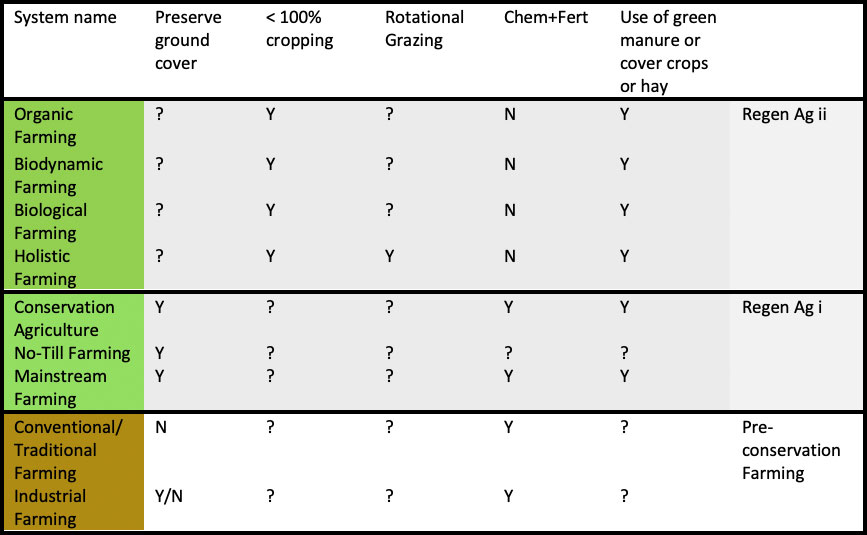
In terms of practical implementation of Regenerative Ag, two camps appear:
- those who utilise manufactured inputs to provide nutrition and protect crops from weeds, pests, and disease and at the same time retain stubbles and may use some form of cover cropping or green manuring and may have a pasture component and livestock enterprise.
- those who endeavour to use inputs that are not manufactured via chemical processes as well as retain stubble, include rotationally grazed livestock.
System i seems pretty mainstream common sense risk management to me, although it is a major change in the US. In Australia, a 2014 survey revealed that across the nation, only 20% of crop was sown with cultivation prior to, or at sowing. In the US, this number was 50 to 60% in surveys between 2012 and 2017.
That’s the important thing to understand. We are already practicing what is being promoted from the US as regenerative agriculture.
System ii is what we would consider organic or biological farming and is not new. There are some serious flaws in the science of biological farming.
Some views on System i and System ii
Back in the millennium drought, consumers and farmers were interested in what was then known as “Biological Farming”. After tough times, human nature looks for a better way. The same thing occurred after more recent droughts. In 2006, I authored a review into the farming systems considered more eco-friendly and compared those to mainstream systems.
I concluded that mainstream practices had some sustainability issues, mainly around chemical use, and that alternative systems were profit limiting in dryland farming systems in Australia, particularly on the alkaline well structured soils of the Wimmera. I concluded that the science behind the claims for soil biology improvements and the methods for improving soil chemistry were not backed by scientific evidence applicable to the environment in which we farm. Those that dabbled in the system back them, learnt that for themselves. Those currently dabbling in it are finding some aspects useful but are experiencing the replacement of Nitrogen and Phosphorous with Calcium and trace elements to be as yield limiting as it was 15 years ago.
A link to the full review is listed below.
More recently Holmes and Sackett Director John Francis estimated that running a livestock operation under regenerative agriculture principles over a period of ten years could reduce profit by $2.46M over that time. Their mainstream farms in the analysis returned 4.22 per cent, compared to those classified as Regenerative returning only 1.66pc. I find those numbers very concerning. The difference was in productivity and the number of DSEs that could be carried per hectare. Beware unintended consequences (the rant)
I value integrity of robust information and enjoy taking concepts from different places and joining the dots to come up with practical improvements to the farming system. The latter part of this article proposes one such system.
I fear though that the advocates of systems ill-suited to certain environments do not consider the human and financial consequences of their enthusiastic and passionate promotion.
For example, it is simply irresponsible to advise against using Phosphorus fertiliser in South Eastern Australian cropping systems, or in grazing systems along the East Coast.
It’s a case of buyer beware.
Ultimately, it is an individual’s responsibility to understand the consequences, both financial and human, of any major system change. It could be purchasing $1.5M of machinery to do a wholesale conversion to disc seeding and controlled traffic or including summer grown crops in the system and foregoing a bank of stored summer moisture. If choices are made well and implemented well, system changes have the best chance of success.
Experimentation is a great thing and that’s how we learn. However, if that experimentation comes at great cost, then there will be consequences that sadly could mean a decline in mental health, loss of net worth, and in the worse case scenario, loss of the farm.
These worst case scenarios can be avoided if one simple question is answered.
Why am I doing what I am doing?
If you can’t answer it, don’t implement full scale change until you can answer it!
About 8 years ago a Canadian colleague asked that question to a Wimmera farmer, a friend of mine who had invested heavily in changing his farming system. He couldn’t actually answer that question with any depth which really worried her.
The earlier sowing time, stubble retention, summer weed control and nitrogen management delivered great rewards. The machinery investment was a live and learn exercise. A few years later, the disc seeder caused massive sowing delays that were costly. The disc seeder was sold. This is not an anti-disc seeding rant. I own one on my imaginary farm. If you own one and it works for you, please don’t sell it on the basis of this rant.
It is a rant in taking responsibility for fully understanding why you are doing what you do and being aware of past lessons and what could go wrong and how to make it work.
It is a rant in understanding where the benefit is coming from. In this case, improved agronomy delivered the benefit, not the disc seeder. That’s the difference between causation and correlation.
So, when the next fad comes along that peaks your interest, ask how could this make our system better, what will it cost and what will be the benefit. If that decision making process stacks up, then before you commit, ask why am I doing what I am doing? If the answer is because my mates are, it might be best to go to have another think before jumping in boots and all.
Rant over
The final word
So, which is the best farming system
A well run one! Article 3 explores this topic further.
Key points
- Most well run mainstream cropping business incorporate regenerative ag components.
- The US have a completely different mainstream farming system to us.
- Abandoning phosphorous fertiliser and reducing N use can have huge economic consequences.
- Understand why you do what you do.
- Don’t abandon sound evidence based agronomy without thinking it through.
- Keep an open mind and look to integrate practices that can improve your system.
Do this?
I would dearly love feedback.
References
Lewellyn, Rick; Ouzman, Jackie. 2019 Conservation agriculture in Australia: 30 years on. In: Jim Pratley and Jon Kirkegaard, editor/s. AUSTRALIAN AGRICULTURE IN 2020: FROM CONSERVATION TO AUTOMATION. Australian Society of Agronomy; 2019. 21-31.
McCormick K 2006 Bio-responsible Farming
https://www.farmonline.com.au/story/6548051/profit-shortfall-from-regenerative-grazing-spelt-out/
Francis John 2019 Regenerative Agriculture Quantifying the Cost
AUDIO
[/fusion_toggle][fusion_toggle title=”Topic 3″ open=”no” class=”” id=”” fusion_font_family_title_font=”” fusion_font_variant_title_font=”” title_font_size=”” title_color=”” hue=”” saturation=”” lightness=”” alpha=”” fusion_font_family_content_font=”” fusion_font_variant_content_font=”” content_font_size=”” content_color=””]
Episode 6 Article 3
Sensible approach to water limited, cropping dominant farming systems in Southern Australia
Introduction
Reflecting on farming systems got me thinking about what makes sense for farming in dryland farming on medium textured (loams to clays) in Southern Australia.
I’ve cherry picked a few systems to come up with this list. This system has no catchy name-just common sense attempt to balance risk and reward in the long term
The purpose is to achieve whole farm success, to be kind to ourselves, our environment and those who live near us and work with us. It incorporates high productivity, a profit focus, and people skills
Business and Risk Management
- Strategic and well thought out purposeful approach.
- Professional farming approach to communications and operations.
- Tailor the farming system to climate risk and likelihood of production variability.
- Anticipate potential problems and adjust approach accordingly.
- Whole farm business financial analysis to understand business risk.
- Profit focus.
- Using decision support tools, including climate risk management tools to assist with informed decision making.
- Best practice selling and price risk management for commodity sales.
- Variable and fixed cost monitoring.
Rotation
- Diverse and flexible. Less intense crop rotation (70-90%) with hay, green manure, chemical
fallow making up the rest and increasing crop intensity when season or price allow.
- Opportunistic and flexible approach toward crop choice and livestock.
- Willingness to rest paddocks that need a break, in terms of soil fertility, soil health or weed burdens.
- Adjust rotation in response to soil fertility, weed or disease management needs.
Tillage System
- Minimal tillage preferable, but not necessarily no tillage, as a strategic cultivation may be required for integrated weed management and nutrient destratification.
- Stubble retention where possible (occasional burning may be required for IWM and IPM).
Soil Health and Fertility
- Maximise soil organic matter which requires nutrition as well as carbon.
- Monitoring of soil biota as a signal of soil health may be a future tool if reliable tests become available.
- Crop nutrient calculations should include an allowance for soil health.
Crop Management
- Timely management of weeds, pest, disease, and nutrients is required to maximise water use efficiency and yield potential.
Livestock Management
- Profit focussed best practice livestock production that compliments the cropping system.
Crop Protection
- Utilising integrated management principles for pests and weeds:
- Improved knowledge of weed and insect biology.
- Reduce weed seed banks.
- Use several tools for control.
- Improved knowledge of beneficial insects.
- Monitor populations and observe established thresholds if they exist, rather than a zero tolerance approach (particularly for pests).
- Use of softer chemicals where possible and reduce use of harsher chemicals.
- Where possible, use seed dressings instead of soil applied insecticides.
Do this
This list is not complete. Feel free to send me a note adding to the common sense farming system.
[/fusion_toggle][/fusion_accordion][/fusion_builder_column][/fusion_builder_row][/fusion_builder_container][fusion_global id=”361″]