
[fusion_builder_container admin_label=”Episode” hundred_percent=”no” hundred_percent_height=”no” hundred_percent_height_scroll=”no” hundred_percent_height_center_content=”yes” equal_height_columns=”no” menu_anchor=”” hide_on_mobile=”small-visibility,medium-visibility,large-visibility” status=”published” publish_date=”” class=”” id=”” link_color=”” link_hover_color=”” border_color=”” border_style=”solid” margin_top=”” margin_bottom=”” padding_top=”” padding_right=”” padding_bottom=”” padding_left=”” gradient_start_color=”” gradient_end_color=”” gradient_start_position=”0″ gradient_end_position=”100″ gradient_type=”linear” radial_direction=”center center” linear_angle=”180″ background_color=”” background_image=”” background_position=”center center” background_repeat=”no-repeat” fade=”no” background_parallax=”none” enable_mobile=”no” parallax_speed=”0.3″ background_blend_mode=”none” video_mp4=”” video_webm=”” video_ogv=”” video_url=”” video_aspect_ratio=”16:9″ video_loop=”yes” video_mute=”yes” video_preview_image=”” filter_hue=”0″ filter_saturation=”100″ filter_brightness=”100″ filter_contrast=”100″ filter_invert=”0″ filter_sepia=”0″ filter_opacity=”100″ filter_blur=”0″ filter_hue_hover=”0″ filter_saturation_hover=”100″ filter_brightness_hover=”100″ filter_contrast_hover=”100″ filter_invert_hover=”0″ filter_sepia_hover=”0″ filter_opacity_hover=”100″ filter_blur_hover=”0″ admin_toggled=”no” type=”flex”][fusion_builder_row][fusion_builder_column type=”1_1″ layout=”1_1″ spacing=”” center_content=”no” link=”” target=”_self” min_height=”” hide_on_mobile=”small-visibility,medium-visibility,large-visibility” class=”” id=”” hover_type=”none” border_color=”” border_style=”solid” border_position=”all” border_radius=”” box_shadow=”no” dimension_box_shadow=”” box_shadow_blur=”0″ box_shadow_spread=”0″ box_shadow_color=”” box_shadow_style=”” padding_top=”” padding_right=”” padding_bottom=”” padding_left=”” margin_top=”” margin_bottom=”” background_type=”single” gradient_start_color=”” gradient_end_color=”” gradient_start_position=”0″ gradient_end_position=”100″ gradient_type=”linear” radial_direction=”center center” linear_angle=”180″ background_color=”” background_image=”” background_image_id=”” background_position=”left top” background_repeat=”no-repeat” background_blend_mode=”none” animation_type=”” animation_direction=”left” animation_speed=”0.3″ animation_offset=”” filter_type=”regular” filter_hue=”0″ filter_saturation=”100″ filter_brightness=”100″ filter_contrast=”100″ filter_invert=”0″ filter_sepia=”0″ filter_opacity=”100″ filter_blur=”0″ filter_hue_hover=”0″ filter_saturation_hover=”100″ filter_brightness_hover=”100″ filter_contrast_hover=”100″ filter_invert_hover=”0″ filter_sepia_hover=”0″ filter_opacity_hover=”100″ filter_blur_hover=”0″ last=”true” border_sizes_top=”0″ border_sizes_bottom=”0″ border_sizes_left=”0″ border_sizes_right=”0″ first=”true”][fusion_text columns=”” column_min_width=”” column_spacing=”” rule_style=”default” rule_size=”” rule_color=”” hue=”” saturation=”” lightness=”” alpha=”” content_alignment_medium=”” content_alignment_small=”” content_alignment=”” hide_on_mobile=”small-visibility,medium-visibility,large-visibility” sticky_display=”normal,sticky” class=”” id=”” margin_top=”” margin_right=”” margin_bottom=”” margin_left=”” fusion_font_family_text_font=”” fusion_font_variant_text_font=”” font_size=”” line_height=”” letter_spacing=”” text_transform=”none” text_color=”” animation_type=”” animation_direction=”left” animation_speed=”0.3″ animation_offset=””]
Think Agri Real Insights
Season 4, Episode 15
August 2022
[/fusion_text][fusion_accordion type=”toggles” boxed_mode=”yes” divider_line=”” inactive_icon=”” active_icon=”” icon_boxed_mode=”” hide_on_mobile=”small-visibility,medium-visibility,large-visibility” class=”” id=”” border_size=”1″ border_color=”” hue=”” saturation=”” lightness=”” alpha=”” background_color=”” hover_color=”” divider_color=”” divider_hover_color=”” fusion_font_family_title_font=”” fusion_font_variant_title_font=”” title_font_size=”” title_color=”” icon_size=”” icon_color=”” icon_box_color=”” icon_alignment=”” fusion_font_family_content_font=”” fusion_font_variant_content_font=”” content_font_size=”” content_color=”” toggle_hover_accent_color=”” toggle_active_accent_color=””][fusion_toggle title=”Introduction” open=”no” class=”” id=”” fusion_font_family_title_font=”” fusion_font_variant_title_font=”” title_font_size=”” title_color=”” hue=”” saturation=”” lightness=”” alpha=”” fusion_font_family_content_font=”” fusion_font_variant_content_font=”” content_font_size=”” content_color=””]

Introduction
It’s been a while between episodes and it’s good to be back. This time TARI explores potential. In many parts of Australia the production potential is above the norm but until its in the bank it’s just potential.
The topics we cover in this episode are:
- Topic 1 provides a seasonal climate update and outlook summary
- Topic 2 looks at the impact of crop rotation on long term potential
- Topic 3 provides some ideas for taking the angst out of grain selling. Mind management is critical! Grain selling is when you realise your potential
Are you ready to get stuck in?
Happy reading, listening, thinking, feeling and doing!
And good luck
Kate
[/fusion_toggle][fusion_toggle title=” Topic 1 – The so far, now what and so what of the 2022 seasonal outlook” open=”no” class=”” id=”” fusion_font_family_title_font=”” fusion_font_variant_title_font=”” title_font_size=”” title_color=”” hue=”” saturation=”” lightness=”” alpha=”” fusion_font_family_content_font=”” fusion_font_variant_content_font=”” content_font_size=”” content_color=””]
Introduction
To say the year has been eventful in terms of climate and weather would be an understatement.
This article provides a brief explainer of what has happened so far, what could happen in the next few months and what it could mean. The objective is not to predict the weather (that’s impossible) but to arm you with tools to plan for possible scenarios. Depending on where you are located in Australia, your circumstances will vary immensely so please use these principles to understand your own situation.
SO FAR
Growing season rainfall until the end of July varies substantially throughout Australia. Central and NSW were well above average and parts of SA, WA, Tasmania and Victoria were well below average with dry July putting crops under pressure. August rains have been widespread and created relief for the dry areas and stress for those already inundated and joy for those enjoying a goldilocks (just right) season.
Why the dry July?
Despite the outlooks for favourable rain over winter, many areas had low July rainfall. This was mainly due to the Southern Annular Mode and the high-pressure system that sat over South Australia which forced the frontal systems well south of the land mass.
The SAM refers to the size and position of a belt of the westerly winds in the Southern Ocean.
ENSO and IOD are considered primary climate drivers a bit like nitrogen and phosphorus being primary nutrients with the biggest impact on plant growth. SAM is one of the secondary drivers, think sulphur or potassium and like sulphur or potassium, in some regions, its impact might limit the influence of the primary driver.
The impact of SAM is different in winter and summer because the SubTropical Ridge sits in a different position during these times. It’s complex! SAM changes every few weeks and determines weather rather than seasonal climate.
Why was August wetter?
SAM reduced its influence and the negative IOD is underway. The tap turned back on in August. A negative IOD event is associated with above average winter and spring rainfall for much of Australia which is a mixed blessing depending on your circumstance.
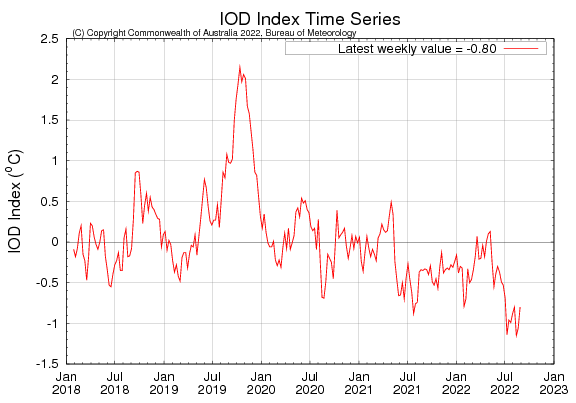
IOD Index Time Series
NOW WHAT
The current Negative IOD conditions are likely to continue through to the end of November and most models predict a return to neutral conditions in early Summer. Above average rainfall is likely for most parts of Australia except portions of SW, WA, and SW Tasmania.
The Bureau’s ENSO Outlook is now at La Niña ALERT, meaning there is around a 70% chance (almo st triple the normal likelihood) of La Niña forming again in 2022. La Niña events increase the chance of above average winter–spring rainfall across much of northern and eastern Australia. Not all models are suggesting a return to La Nina.
SO WHAT
Each season is unique to previous years but there are some strong trends from history worth keeping in mind. Climate mood is a phrase coined by Agriculture Victoria climate specialist Graeme Anderson. The Climate mood process uses a report card system to group previous years to inform how rainfall, production and whole-farm performance react to each mood.
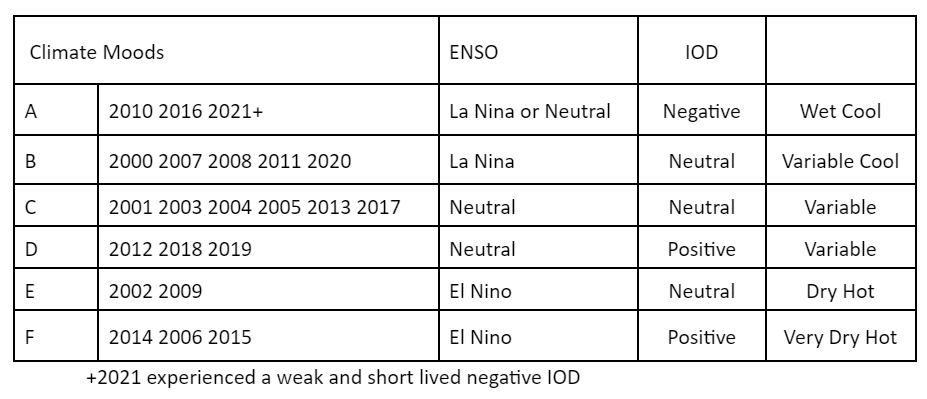
This season fits under Climate Mood A. The GRDC Ag Vic Local Climate Tool illustrates that in IOD negative (Climate Mood A) years, the August to October Rainfall is wetter than average (Blue) in 50% or more years in most regions.

Practical implications for the remainder of 2022
Our brains are wired to avoid thinking about extreme events but foresight is a powerful tool that enables preparation for several possible futures. It helps manage potential downside and capture possible upside. The scenarios below are not predictions, but they are possibilities. Thinking about things doesn’t mean they’ll happen, but it does mean you will be better prepared.
-
Optimise production potential through sound agronomy
Be judicious with nitrogen and trace element applications to set up potential and then protect that potential from disease and pests.
Understand your water limited yield potential by upgrading estimates regularly.
-
Get organised for a potentially big and potentially wet harvest
What do you need to put in place to get the crop off and protected from weather in a timely manner? Yield loss due to harvest delays can cost hundreds of thousands per enterprise. 2016 BCG research showed a 26 day delay in harvest reduced barley yield by 2 t/ha at Kalkee, in Victoria’s Wimmera. I have seen anecdotal evidence of similar magnitude.
-
Have a frost salvage plan?
Let’s hope a frost salvage plan isn’t needed but it’s worth thinking about the options to salvage income from affected crops if it does happen.
-
Do you have a fodder plan?
If you are a mixed farmer, in favourable conditions, how can you utilise excess feed or to conserve it for the future? If you look like having a feed shortage due to excess wet or too dry, when will the stock come off and what happens to them?
If you are a cropper with some hay in the program, do you reduce the hay paddocks and harvest more grain to reduce the exposure to risks associated with wet weather and hay making.
-
Flood mitigation plan?
What happened in specific parts of the farm in previous wet years like 2010 or 2016?
What was different about those years to this year so far, what was the same?
How can you put this knowledge to prepare you mentally and practically?
-
It’s not wet everywhere. If you are in a dry patch
How do the numbers for grain stack up against fodder conservation for the dry areas?
What could be terminated early to prevent weed seed set and bank moisture for next year?
-
If you are in an extremely wet area (like much of central west NSW)
What can you salvage from the season?
What could be written off and weeds controlled for the future?
Are there opportunities for spring planting or summer crops?
Do the numbers stack up or do you wait for next year?
Are there grazing opportunities?
Do you have a handle on the yield potential and production estimates of the crops at the various growth stages?
Have you done a budget for income based on a range of possible scenarios?
-
Do you have a marketing map?
Regardless of where the price is at today, what’s the number for each commodity that you know you can make a profit from and be comfortable with.
The markets are likely to remain volatile, so a clear view of how much you want to sell by when and what your triggers are can help you manage the emotion.
Episode 14 is devoted to this topic and topic three in this episode also covers it.
Summing Up
In most broadacre farming regions, above average spring rainfall is a strong possibility due to the negative Indian Ocean Dipole and potential La Nina.
Thinking through the possible challenges and opportunities based on similar years (like 2010 and 2016) can help prepare you for a range of possibilities
Each season is unique, so the past is useful but it cannot predict the future entirely.
Resources
(See Episode 4, Article 3, Episode 9, Article 1 and Episode 11 Article 1 for fuller explanations of Climate drivers).
Walter L (2016) Delayed Harvest of Barley BCG Season Research Results p49
Audio
[/fusion_toggle][fusion_toggle title=”Topic 2 – Back to basics. Revenue is driven by a fundamentally sound production system” open=”no” class=”” id=”” fusion_font_family_title_font=”” fusion_font_variant_title_font=”” title_font_size=”” title_color=”” hue=”” saturation=”” lightness=”” alpha=”” fusion_font_family_content_font=”” fusion_font_variant_content_font=”” content_font_size=”” content_color=””]
Introduction
As we head into the final quarter of the calendar year and the premiership quarter for crop and annual pasture growth, it’s timely to consider what’s happening in paddocks for next year and to recap the timeless truths about crop rotations and sequences.
You know this stuff, already but I feature it as a reminder to prevent the productivity and profitability derailment that stems from reactionary crop planning choices.
Crop rotation derailment is common
The key to maximising the productive and income potential of the whole farm is a well-considered, flexible and diverse crop rotation that delivers sustained returns.
Despite this statement being a timeless truth and somewhat stating the obvious, there are several factors that derail a robust crop rotation. A few examples are listed below:
- One in five farmers believe every paddock must be cropped every year for the maximum return.
- Others get distracted by talk of innovation and technology saving the day.
- Recency bias is the temptation to change things based on your most recent experience.
- The belief that commodity price matters more than productivity.
These and other derailments usually stem from a failure to understand the complexity of the interactions between plant biology, soils, climate and economics or they stem back to subconscious decision making bias.
The economic case for sound production systems
Experience and data across broadacre mixed farming systems consistently points to a timeless and fundamental truth. Profit is driven largely by revenue and revenue is related to productivity and enduring productivity is underpinned by a fundamentally sound production system.
John Francis of Agrista made this point with evidence at a recent livestock event focussing on the profitability of livestock farming systems. His point was that the system revolves around the feed growth curve over a calendar year for an individual enterprise.
On cropping dominant broadacre farms, revenue success is underpinned by the rotation or sequence of what’s grown and how it’s managed.
The law of diminishing returns is at play
Why is it that cropping every paddock every year doesn’t result in the highest profits, despite one in five farmers surveyed thinking it does?
Whole-farm economic analyses consistently demonstrate this. Depending on the location, it caps out between 50 and 90 percent of crop intensity.
Assuming that profit is maximised by cropping every paddock every year is a common mistake that counters productivity.
The reason is the principle of marginal returns. The return you get from every dollar spent is not the same. So the dollars spent on the last 10 percent of cropped land are usually more than the income generated. (Malcolm, 2005), (Ewing, 2006), (Hunt, 2010).
A team of crops with complementary roles
Long-term profitability from grain production is successful through maintaining a balanced crop portfolio.
Crop rotations planned on spreadsheet economics, without an appreciation for the complex biological system that is the whole farm, rarely top the profit charts and often place the business at extreme risk.
It is false economics to base decisions of whether or not to include a crop purely on its individual gross margin. Each crop has a role to play in the team. It’s like judging each player in an AFL team purely on their disposal count without appreciating the role they’ve played. A tagger can have few possessions and be a game winner if they’ve negated the opposition’s most effective player.
Consider a Wimmera case study. Comparing the gross margin of faba beans, canola, lentils and wheat and basing inclusion purely on financial performance only considers part of the picture. Each crop has a role on the team, provided it is suited to the soils and seasons in the region. In the southern Wimmera, faba beans are a great source of nitrogen and allow late-season crop topping of grass weeds. They don’t perform well in late dry starts, and they aren’t fond of heat during flowering, but some farms are prepared to take that risk or scale down the area if the outlook is not good, and it has been a dry summer. It’s the same as some footballers being more suited to wet tracks or dry tracks. It’s an individual risk decision for each farm to decide what role they play.
Cereal crops in the southern regions and sorghum in the northern regions historically have a more stable grain yield with less production risk than broadleaf (dicotyledonous) crops e.g. canola in the south or cotton in the north. These pillar crops make up the greater proportion of a crop rotation. These are the blue chip shares in the crop portfolio.
What about the cost of production and commodity price?
The cost of production, production risk and relative profitability of each crop need considering during crop selection and finalising the overall rotation program. Still, ultimately it is plant biology and interaction with the soil that determines these economic factors.
Commodity price considerations play a part, but choosing crop type based on price rarely results in optimum long-term profit. This is because production risk outweighs price risk in dryland cropping.
Flexible approach to changing circumstances
We are living in volatile and uncertain times in terms of climate and weather and the supply chain. While I favour a general crop sequence that makes agronomic and economic sense, it is also imperative to respond to challenges when they present. The caveat is to avoid creating more problems in future years that outweigh the perceived short term benefits of changing the crop mix.
Summing Up
Crop rotation basics underpin the yield potential and income potential for several years.
When observing paddocks now for next year, think five years ahead as well.
Audio
[/fusion_toggle][fusion_toggle title=”Suggested Actions” open=”no” class=”” id=”” fusion_font_family_title_font=”” fusion_font_variant_title_font=”” title_font_size=”” title_color=”” hue=”” saturation=”” lightness=”” alpha=”” fusion_font_family_content_font=”” fusion_font_variant_content_font=”” content_font_size=”” content_color=””]
Do this
How does your Rotation stack up for whole-of-farm production management?
| Production Management Challenge | Rotation Solutions |
| Previous crop type | Solutions |
| Each crop leaves its own mark: weed burdens, root disease, foliar disease, soil fertility ups and downs. | A logical crop sequence that manages the risks.
|
| Weed spectrum including herbicide resistance | |
| 70 (82%) of 85 growers surveyed by Birchip Cropping Group indicated that weeds highly influenced crop choice. Broadleaf weeds build up if too many broadleaf crops are grown in a few seasons. Over-exposure to cereals means more grass weeds. Continual use of the same herbicide chemistry over several years inevitably results in herbicide-resistant weed population (Birchip Cropping Group, 2018). | Rotate to crops that allow different herbicide chemistry.
Minimise seed bank increases through hay crops, chemical fallow or green/brown manure cover crops or a pasture phase. |
| Root and foliar disease risks | |
| Some soil-based organisms infect crop roots of susceptible species and cause yield loss. Examples include take-all, cereal cyst nematode and root lesion nematode. Foliar disease pathogens carry over from season to season in either the soil, on old crops, or in the air. Growing the same crop back-to-back increases the risk of infection. | Rotating away from the crops that may be affected, variety resistance and removing host weeds all contribute to minimising the impact. |
| Paddock fertility | |
| Soil nitrogen levels can influence crop choice when nitrogen levels become too low. | Legume, grain, hay or green manure crops top up the organic nitrogen pool. Legumes provide between 10 and 20 kilograms of nitrogen per ha per tonne produced. This can equate to $60 to $300 per hectare of nitrogen contributing to the following crop. |
| Available soil moisture | |
| Available water is an obvious and major factor driving grain production in dryland farming systems. Available soil moisture is determined by previous crop type, out of season weed control and out of season rainfall. | Crops such as canola, with a higher water demand, make up more of the rotation in medium and high rainfall regions than in a lower rainfall area.
Long fallow (not growing a crop for a season to conserve moisture) is an underrated risk management strategy.
|
[/fusion_toggle][fusion_toggle title=”Topic 3 – Implementing effective grain selling” open=”no” class=”” id=”” fusion_font_family_title_font=”” fusion_font_variant_title_font=”” title_font_size=”” title_color=”” hue=”” saturation=”” lightness=”” alpha=”” fusion_font_family_content_font=”” fusion_font_variant_content_font=”” content_font_size=”” content_color=””]
Introduction
Grain marketing is repeatedly cited as one of the most stressful aspects of a grain growing business. This article is a shortened version of Episode 14.
Yield potential is just potential until it’s harvested, and income potential isn’t income until it’s sold. This selling step causes much angst.
Here I offer five ideas to reduce the angst and improve the odds of converting income potential into real dollars.
1. Seller’s regret occurs because you are human, but it is a choice.
It is human nature to feel anxious and to overthink decisions, especially when money or performance is involved, and when the future is uncertain. Perfectionist tendencies or poor self-esteem can exacerbate self-loathing. Sporting professionals spend a lot of time training their mind to avoid performance regret and to focus on the present and the next big game without ruminating on past results. They know regret is not productive and will inhibit their ability to perform well in the next game. Take a leaf out of their book and choose to focus on the present and on the future.
2. Volatile markets by definition go up and down quickly, and this is a very volatile time.
Analysis by Andrew Whitelaiw for Thomas Elder Markets demonstrates the current market volatility of wheat futures on the Chicago board of trade compared to the past 50 years. It’s extremely volatile this year and unrealistic to pick the top of the market.

3. Seller’s regret is the resulting bias in action.
Resulting bias makes us think we are smarter than we are, and that we have more control over outcomes than we actually do. We mix up the luck component with skill. Annie Duke, author of Thinking in Bets, says “the quality of our lives is the sum of our decision making quality and luck”.
Do be kind to yourself and don’t bemoan the rapid market rise the day after you made a sale or the rapid dip on the day you decided to keep grain a little longer.
4. Understanding visibility and availability bias helps refocus on the controllables.
Pricing gets more attention than productivity because it’s visible and available, so our brain thinks it’s actually more important than it really is. Available or visibility bias is our brain’s tendency to assume the most readily available information is the most important. It’s a squeaky wheel that our thought processes are drawn to subconsciously. And that is why it causes so much angst.
Imagine if every morning you woke up to a text that gave you the updated potential revenue and profit of your crop. Add to that the daily water limited yield potential, plus your variable and fixed expenses, as well as the daily price. I wonder if increased visibility of those factors would put perspective around each component of profit.
Be mindful of visibility bias and remember yield exploitation is the biggest lever that we can control.
5. Implementing effective grain marketing starts with strategy.
With greater awareness of the thinking traps involved in grain marketing and the emotions involved, what can you do about those things and how do you bring them together for effective implementation? Here’s what I’ve learnt along the way:
- Be aware of price movements, but not obsessed. Play a straight bat and be careful with marketing instruments you don’t understand.
- Build yourself a grain selling framework based on your personal risk profile. Think about your preference for selling and storing and your previous experience and knowledge.
- Seek advice from experienced grain selling professionals, but remember it’s advice not a directive.
- Do focus on your likely production by updating both water limited and nitrogen production scenarios. These are the sums that will inform your marketing strategy and direct your input expenditure. For more information please see Episode 2 and Episode 6 of Think Agri Real Insights.
Summing up
- Grain price movements are not in our control.
- Realising the water limited yield potential on offer is largely within our control by implementing sound crop husbandry.
- Choose to stress less by ditching seller’s regret and grain selling anxiety.
- Choose to spend time creating a grain selling strategy for each commodity based on grain marketing and seasonal climate deciles.
- Choose to check in with that framework in the heat of the moment.
Disclaimer. This article is not grain selling or financial advice. Seek advice from appropriately licensed professionals. Past occurrences do not represent the future.
References
Do You View Selling Grain with Anxiety and Regret, Analyst Asks
No Regret Crop Marketing: 3 Mindsets to Reduce the Emotion of Regret
Grain Marketing Mind Game – 4 Tips for Reducing Anxiety
Existential Regret is Exhausting
It was the best of times; it was the most volatile of times
Sold too low, too fast or too slow?
The Conscious Athlete: Mental Health in Sport
Australian grain prices set to rise as Russian invasion of Ukraine disrupts global supplies
How the Covid pandemic exposed deep cracks in the Australian farm labour model
Audio
[/fusion_toggle][fusion_toggle title=”Suggested Actions” open=”no” class=”” id=”” fusion_font_family_title_font=”” fusion_font_variant_title_font=”” title_font_size=”” title_color=”” hue=”” saturation=”” lightness=”” alpha=”” fusion_font_family_content_font=”” fusion_font_variant_content_font=”” content_font_size=”” content_color=””]
Do this
Make your own marketing framework using the template below in conjunction with your grain advisory and production team
See Topic 1, Episode 5 for extra guidance.
Download and format your own form here
[/fusion_toggle][/fusion_accordion][fusion_title title_type=”text” rotation_effect=”bounceIn” display_time=”1200″ highlight_effect=”circle” loop_animation=”off” highlight_width=”9″ highlight_top_margin=”0″ before_text=”” rotation_text=”” highlight_text=”” after_text=”” title_link=”off” link_url=”” link_target=”_self” hide_on_mobile=”small-visibility,medium-visibility,large-visibility” sticky_display=”normal,sticky” class=”” id=”” content_align_medium=”” content_align_small=”” content_align=”left” size=”1″ animated_font_size=”” fusion_font_family_title_font=”” fusion_font_variant_title_font=”” font_size=”” line_height=”” letter_spacing=”” text_transform=”” text_color=”” hue=”” saturation=”” lightness=”” alpha=”” animated_text_color=”” text_shadow=”no” text_shadow_vertical=”” text_shadow_horizontal=”” text_shadow_blur=”0″ text_shadow_color=”” margin_top_medium=”” margin_right_medium=”” margin_bottom_medium=”” margin_left_medium=”” margin_top_small=”” margin_right_small=”” margin_bottom_small=”” margin_left_small=”” margin_top=”” margin_right=”” margin_bottom=”” margin_left=”” margin_top_mobile=”” margin_bottom_mobile=”” gradient_font=”no” gradient_start_color=”” gradient_end_color=”” gradient_start_position=”0″ gradient_end_position=”100″ gradient_type=”linear” radial_direction=”center center” linear_angle=”180″ highlight_color=”” style_type=”default” sep_color=”” link_color=”” link_hover_color=”” animation_type=”” animation_direction=”left” animation_speed=”0.3″ animation_offset=””]
You can access all audio for all topics below or via your Podcast feed.
[/fusion_title][fusion_audio src=”https://www.thinkagri.com.au/wp-content/uploads/2022/10/TARI-E15-Aug22-mixed.mp3″ loop=”off” autoplay=”off” preload=”none” hide_on_mobile=”small-visibility,medium-visibility,large-visibility” class=”” id=”” background_color=”” hue=”” saturation=”” lightness=”” alpha=”” controls_color_scheme=”” progress_color=”” max_width=”” border_size=”” border_color=”” border_radius_top_left=”” border_radius_top_right=”” border_radius_bottom_right=”” border_radius_bottom_left=”” box_shadow=”no” box_shadow_vertical=”” box_shadow_horizontal=”” box_shadow_blur=”0″ box_shadow_spread=”0″ box_shadow_color=”” animation_type=”” animation_direction=”left” animation_speed=”0.3″ animation_offset=”” /][/fusion_builder_column][/fusion_builder_row][/fusion_builder_container][fusion_global id=”361″]